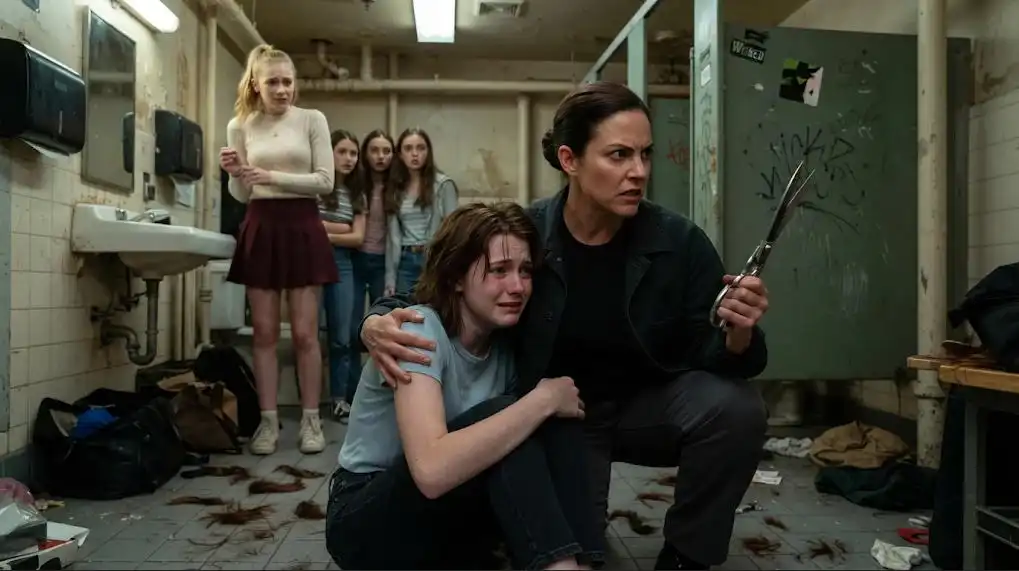
Madison’s eyes flickered toward the scissors in Vanessa’s hand.
Only for a second.
But Vanessa noticed.
“You don’t know what you’re talking about,” Madison said, straightening her cream-colored sweater. “Those are just scissors.”
Vanessa looked at the blades again.
“No,” she answered. “They’re not.”
Behind her, Emma was still sitting against the wall, her arms wrapped around her knees. Olivia and Chloe stood beside the stalls, suddenly very interested in the floor.
The stage manager, Daniel Foster, stepped forward.
“Ms. Bennett, please put those down. Security is on its way.”
Vanessa kept her fingers around the handles, then carefully placed the shears on a clean paper towel beside the sink.
“Good,” she said. “Then make sure nobody touches them.”
Madison gave an irritated laugh.
“Are you seriously trying to make a crime scene out of a haircut?”
Vanessa turned toward her.
“A haircut?”
“That’s what I said.”
“Then tell me something, Madison. Where’s your comb?”
Madison blinked.
“What?”
“Your comb. Your sectioning clips. Your spray bottle. Where did you put them?”
Madison folded her arms.
“We didn’t need all that.”
“You didn’t need a comb?”
“No.”
“Or a mirror?”
Madison glanced toward the wall mirror.
“There’s one right there.”
Vanessa looked at Emma, who had been forced facedown onto the restroom tiles.
“And you thought the best place to give her a haircut was on the floor?”
Madison’s expression hardened.
“She kept moving.”
Emma made a small sound.
Vanessa turned immediately.
“Sweetheart?”
Emma looked up. Tears had left pale tracks on her cheeks.
“I was trying to get away.”
Nobody spoke.
Then Madison stepped forward.
“She’s lying because she’s embarrassed about how it turned out!”
Daniel raised a hand.
“Everyone needs to calm down.”
Vanessa took a breath.
She had spent more than two decades working backstage. She understood how quickly a production could turn chaotic, how terrified people sometimes said foolish things, and how easily the loudest person in a room could control the story.
But she had also spent those years learning something else.
Hair told the truth about how it had been handled.
And Emma’s hair had been handled brutally.
“Daniel,” she said, “get the director. And tell security to preserve everything in this room.”
Madison scoffed.
“You think they’re going to listen to a hairdresser?”
Vanessa met her eyes.
“They’re going to listen to the facts.”
Twenty minutes earlier, Vanessa had been carrying a black styling case through the backstage corridor.
Inside was a custom wig she had spent three nights preparing.
Emma’s final audition was scheduled for eleven o’clock. The showcase was the biggest event of the six-week youth theater program, a competitive summer workshop affiliated with a nonprofit Broadway training organization.
The leading student would perform the central musical scene before invited directors, casting professionals, and education sponsors.
It wasn’t a Broadway contract.
But for Emma, it was a chance to be seen by people who could open doors she had never imagined reaching.
Vanessa remembered the evening Emma received the casting notice.
Her niece had called her from the kitchen of the tiny Queens apartment she shared with her mother.
“Aunt Vanessa?”
“What’s wrong?”
There had been a long pause.
Then Emma whispered, “I got it.”
“Got what?”
“The lead.”
Vanessa had nearly dropped her phone.
“Emma!”
“I got the lead!”
Her niece had started laughing and crying at the same time.
That night, Emma’s mother, Sarah, came home from cleaning offices after midnight and found her daughter still awake, holding the casting notice against her chest.
Sarah had kissed her forehead.
“Your grandmother always said you were born to sing.”
Emma had shaken her head.
“No. She said I was born loud.”
They had laughed until Sarah cried.
But the happiness didn’t last.
The other students began treating Emma differently almost immediately.
At first, the comments were small.
One girl asked whether Emma had borrowed her audition shoes.
Another wondered aloud if the director had chosen her because the program wanted a scholarship success story.
Then Madison Clarke began making the comments openly.
“Some people earn roles,” she said one afternoon. “Other people get handed sympathy.”
Madison’s family had donated money to the theater training program for years.
She attended a prestigious private school, had expensive vocal coaches, and arrived at rehearsals wearing clothes Emma couldn’t have afforded with three months of savings.
Madison had been cast as the alternate for the lead and was scheduled to perform the supporting role when Emma took the stage.
She had expected the leading role.
Instead, Emma got it.
And from that day forward, Madison seemed determined to make her regret it.
Emma told Vanessa some of what was happening.
Not everything.
She didn’t want to cause trouble.
She didn’t want people accusing her of being difficult.



