Officer Angela Morales, a calm woman with fifteen years on the force, listened as Emma described the incident.
She didn’t interrupt.
When Emma finished, Morales asked several specific questions.
“Who first grabbed you?”
“Olivia.”
“Where were you standing?”
“Near the sinks.”
“What happened next?”
“Chloe grabbed my arms. Madison pushed me down.”
“Did you give permission for the haircut at any point?”
“No.”
Morales made notes.
“Did you tell them to stop?”
Emma’s eyes filled again.
“Over and over.”
The officer paused.
“Thank you. I know this is difficult.”
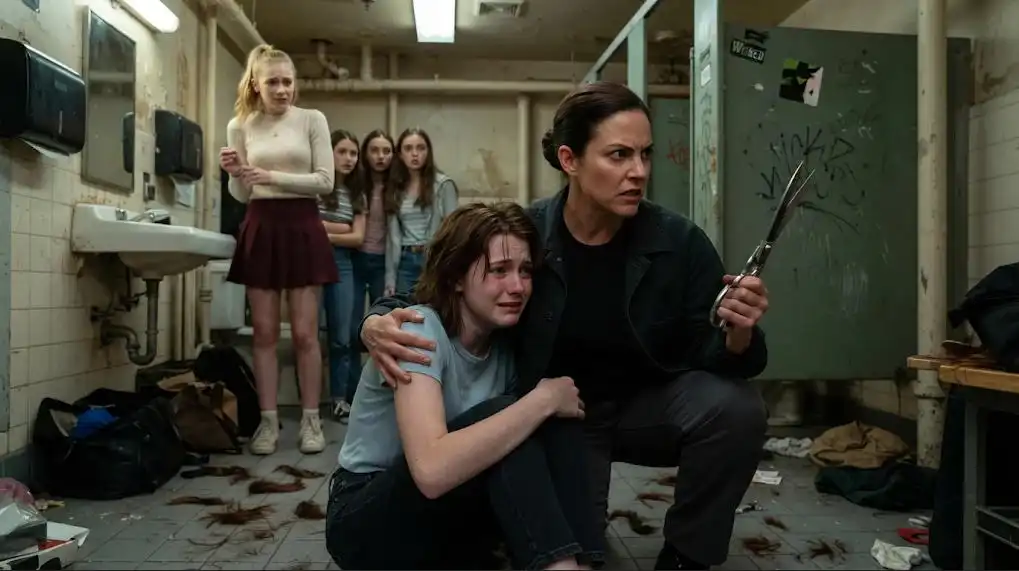
Vanessa waited until Emma had finished before explaining what she had witnessed.
She described hearing the screaming, kicking the door open, seeing the girls restraining Emma, and striking Madison to stop the cutting.
She did not attempt to hide the kick.
“I used force,” Vanessa said. “I understand that. But I believed my niece was being assaulted, and the girl holding those shears was about to cut more of her hair.”
Morales studied her.
“Did you continue striking anyone after the scissors fell?”
“No.”
“Did you threaten the students afterward?”
“I told them to get away from Emma.”
The officer nodded and wrote it down.
“Your use of force will be reviewed along with everything else.”
Vanessa accepted that.
She wasn’t asking to be excused from scrutiny.
She was asking that Emma not be forgotten.
Then Officer Morales asked whether there was any video evidence.
Rebecca explained that the theater had cameras in the corridors but not inside the restroom.
Madison, who was being interviewed separately, apparently had the same point ready.
There was no recording of the cutting.
Vanessa looked toward the sealed evidence bag containing the shears.
“Officer,” she said, “there’s something about the tool and the hair you should understand.”
Morales turned toward her.
“Go ahead.”
“Those aren’t hair-cutting shears. They’re costume-department tailor’s shears.”
“What’s the difference?”
“Quite a lot.”
Vanessa explained that professional hair-cutting scissors were generally designed for controlled hand positioning, precise angles, and small sections of hair.
The long costume shears had a different purpose.
They were built to cut fabric efficiently.
Their broad handles and extended blades were suited to worktables and costume construction, not safe, controlled hair cutting near someone’s face or scalp.
Vanessa had seen the same model in the theater’s wardrobe department.
She recognized its distinctive brass-colored pivot screw and a small notch near the inside of one handle.
But the tool was only part of the story.
“The way the hair was cut matters, too,” she said.
Morales listened carefully.
Vanessa explained that Emma’s hair contained several irregularly cut sections, with long strands drawn across shorter ones and tangles consistent with forceful handling.
The cut pattern differed from what she would expect in a planned, controlled salon haircut.
It also matched what she had personally witnessed: Madison holding Emma’s hair taut while the other girls restrained her.
“Can you prove someone was forced to have their hair cut just from the shape of the ends?” Morales asked.
“No,” Vanessa said immediately. “Not from the ends alone. Hair doesn’t tell you whether someone consented.”
The officer looked up from her notebook.
“But it can tell you something about the method?”
“It can support what happened. Especially when you compare the pattern with the witness accounts, the tool, and the surrounding circumstances.”
Morales nodded.
Vanessa leaned forward.
“And there is one more thing.”
“What?”
“Those shears belong to the theater.”
Rebecca led Vanessa and Officer Morales to the costume department on the lower backstage level.
At the entrance, Vanessa stopped beside a wall-mounted rack of tools.
Several empty outlines marked where equipment normally hung.
A label beside one vacant space identified a pair of heavy-duty silver dressmaking shears.
Rebecca frowned.
“That’s where they should be.”
Vanessa nodded.
“Exactly.”
A costume supervisor named Helen Price came out of the adjoining workroom.
When Rebecca explained the situation, Helen’s expression changed.
“We keep a sign-out record for sharp tools,” she said.
“Can we see it?” Officer Morales asked.
Helen brought out a clipboard and an electronic inventory tablet.
The record showed the shears had been borrowed that morning.
At 9:18 a.m.
Borrower: Madison Clarke.
Purpose: Costume adjustments.
Expected return: 10:00 a.m.
Vanessa felt her chest tighten.
The attack had happened shortly after ten.
Helen pointed to the entry.
“She told me she needed them for a hem adjustment. I reminded her to return them directly to the workroom.”
Rebecca looked at the time.
“Madison wasn’t assigned to wardrobe today.”
Helen shook her head.
“No.”
Morales asked whether anyone had witnessed the checkout.
“I handed them to her myself.”
“Would you be willing to provide a statement?”
“Of course.”
Vanessa kept her voice steady.
“Did she bring fabric or a costume piece?”
“No. She said the costume was upstairs.”
That was the moment the case began to change.