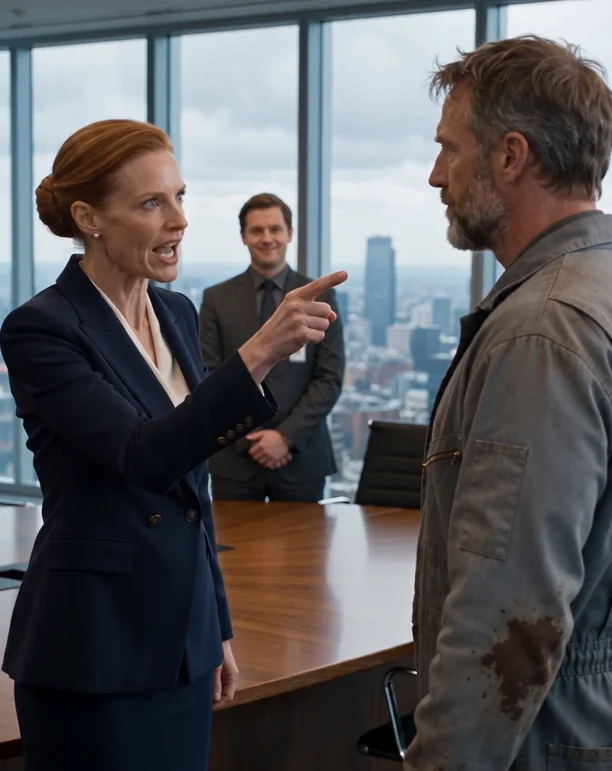
And she assumed the worst kind of story instantly. The story where an underpaid contractor decides to tinker with something above his authorization simply because no one is watching. Phân cảnh 3: Kalen is escorted out She did not ask what he was doing. She did not check the access logs on her tablet which would have shown his credentials were valid for exactly this workstation. She simply pointed and said the four words that would echo through every floor of the building by the end of the day. Escort him out right now. Two security guards appeared within seconds, moving with the practiced speed of men who had done this before for far less serious offenses. Ken looked at Viven for exactly one second, long enough for anyone paying attention to notice the flicker of something unreadable cross his face, something that was not anger and was not fear, but resembled quiet disappointment instead. He reached into his jacket pocket, removed his contractor badge without being asked, and placed it gently on the edge of the console. He said nothing. He walked between the two guards toward the elevator, his footsteps even and unhurried.
And the last thing anyone in that room saw of him that morning was the back of a gray jacket disappearing behind closing doors. Viven turned back to her assistance and resumed her inspection as though nothing significant had happened at all. Satisfied that order had been restored and the demonstration could proceed exactly as planned. She had no idea that the flaw Kalen tried to report was still sitting untouched inside the system, waiting for the exact conditions that would make it impossible to ignore.
In the elevator, Kalan stood alone, watching the floor numbers fall one by one, his expression unreadable to the small camera mounted in the corner. He had spent enough years in rooms far more dangerous than this one, to know that anger accomplished nothing once someone in authority had already decided what kind of man they were looking at. He thought briefly of the modest contract sitting in his email, the small apartment 2 mi from the office where he lived alone since his son had moved across the country to build a life of his own, and the quiet, uncomplicated routine that came with being nobody in particular. None of it depended on being recognized inside that building.
He had learned that lesson the hard way years earlier in rooms with far higher stakes than a corporate product demonstration, and he had made peace with it long before he ever walked through Helix Dynamics front doors. Outside, the autumn air was cool and sharp, and he pulled his jacket tighter and began the walk toward the small commercial strip a few blocks south, in no particular hurry to be anywhere else. behind him inside the building. The morning continued exactly as Viven intended, at least for the next 17 minutes.
The trouble began 17 minutes after Ken left the building. The primary display in the control room flickered once, then twice, then filled with a Phân cảnh 4: The system collapses cascade of red warning text that no one in the room had ever seen before. The radar simulation, which moments earlier had been rendering a smooth composite of simulated fleet positions, suddenly froze into a single distorted frame before collapsing entirely. Somewhere deeper in the architecture, the security layer responded to the corrupted data stream the only way it knew how, by locking itself down completely, treating the malfunction as a potential intrusion. Every terminal in the room went dark at nearly the same instant, and for three long seconds, nobody said a single word.
Then the room erupted into the particular chaos that only expensive failures can produce. Engineers scrambled between terminals, running diagnostic scripts that returned nothing but error codes. Derek Hollis, the same man who had waved Ken away less than half an hour earlier, stood frozen in front of his screen with his mouth slightly open, unable to explain to anyone what had just happened or why. Vivien Sterling stormed back into the control room the moment her assistant relayed the news, her calm inspection posture, replaced entirely by something closer to controlled panic. “Fix it,” she said, her voice sharp enough to cut through the noise. I do not care how. Just fix it before those officers walk through that door. A senior systems architect named Marcus Whitfield, who had overseen the platform’s last three software revisions, insisted the failure was nothing more than a routine memory leak, the kind of thing his team fixed twice a month without any drama at all.



