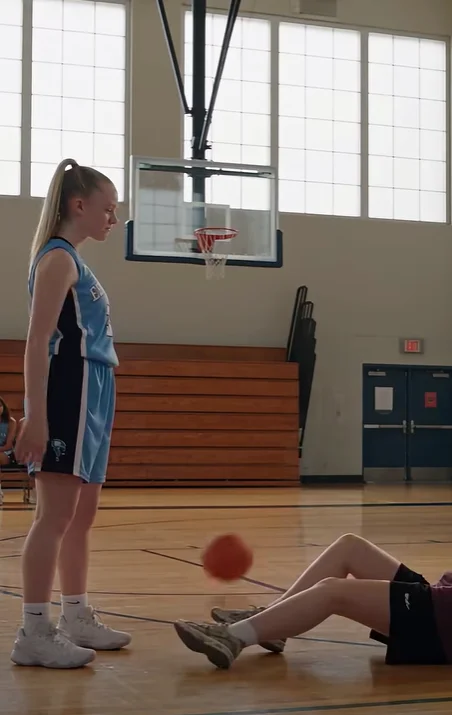
She had treated Hazel as though a lack of expensive shoes meant a lack of influence.
She had repeated her father’s claims about controlling the school’s volleyball program.
And Graham had assumed the same girl was someone he could dismiss without consequences.
But the sports brand he had used to intimidate everyone belonged to that girl’s family.
The expensive shoes Sloane worshipped came from a company Hazel’s father had built.
Hazel learned about the termination from her father that evening.
She was sitting on the couch with school assignments spread across a small table.
Her concussion symptoms hadn’t disappeared.
She still needed frequent breaks because concentrating for too long brought back her headache.
Adrian arrived carrying dinner.
He placed the food nearby and sat beside her.
“Your school has the recording,” he said. “The district is handling the conduct case.”
Hazel looked up.
“And Sloane?”
“She’s off the team while they finish the hearing.”
Hazel nodded.
For a moment, she simply looked down at the papers in front of her.
Then Adrian explained what had happened with Harlan Sports Supply.
He told her about the existing compliance review, the contract violations, and the decision to terminate the company’s distributorship.
Hazel listened without interrupting.
When he finished, she remained silent for several seconds.
“You canceled his contract?”
“The company did. His business had violations that were already being investigated. The school incident exposed another problem.”
Hazel looked down.
She had wanted someone to examine what Sloane had done.
She had wanted the school to acknowledge that the volleyball strike wasn’t an accident.
She hadn’t wanted other students to suffer because of it.
“What about the other girls on the team?”
Adrian listened.
“They don’t deserve to lose their season,” Hazel continued.
“No,” he agreed. “They don’t.”
Hazel thought for a moment.
“Then don’t make them pay for what she did.”
Adrian didn’t dismiss her concern.
He understood exactly what she meant.
The students who hadn’t participated in Sloane’s behavior shouldn’t lose their opportunities because one family had misused its influence.
At Hazel’s urging, Summitline’s charitable foundation later offered the district a separate equipment assistance grant.
The grant was administered independently of the volleyball team’s previous sponsorship arrangement.
It was also conditioned on the district approving an appropriate student safety plan.
The old sponsorship was not restored.
Graham Harlan would never again control Lakeshore’s access to Summitline support.
But the other students could continue playing volleyball.
For the first time since the incident, Hazel felt that something had been put right.
She hadn’t wanted to punish everyone connected to Sloane.
She had wanted accountability.
And the distinction mattered.
The following week, Lakeshore completed its disciplinary process.
Sloane and her parents received formal notice of the allegations.
They were given an opportunity to review the evidence and respond.
Sloane continued insisting that she had never intended to injure Hazel.
But the preserved footage contradicted her explanation.
So did the witness statements.
The district determined that Sloane had intentionally struck another student with a volleyball outside normal play.
She received a school suspension.
Her captaincy was revoked.
She was also permanently removed from the varsity volleyball team for the remainder of her time at Lakeshore.
For a girl who had spent years treating the volleyball program as an extension of her father’s business, the decision represented a profound loss of status.
But Sloane wasn’t the only person whose conduct came under review.
Coach Reese had previously dismissed another student’s complaints about Sloane.
The school issued her a formal reprimand and required additional safeguarding training.
The district also established a documented process allowing students to report athlete intimidation directly to district officials.
It was a change that should have happened long before Hazel was injured.
Hazel wasn’t present when Sloane was informed she could no longer play varsity volleyball.
She was at home, sitting quietly with a book.
That afternoon, she managed to read for fifteen minutes without triggering another headache.
It felt like a bigger victory than she wanted to admit.
But recovery took longer than Hazel had expected.
She couldn’t return to gym class.
She missed three tests.
Even walking through the school’s crowded hallways sometimes left her exhausted.
Her mother arranged academic accommodations so Hazel could continue her education without worsening her symptoms.
Adrian remained attentive to her recovery.
He didn’t pressure her to return to volleyball or remind her how much athletic equipment she could access.
Instead, he offered to pay for a private athletic trainer once her doctor cleared her to exercise again.
Hazel initially refused.
“I don’t need somebody to turn me into a superstar.”
“I know,” Adrian replied. “But you told me you wanted to learn how to serve.”
Hazel looked at him.
“You remembered?”
“Of course.”
She finally agreed.
Her trainer was Elena Brooks, a former college volleyball coach who specialized in helping athletes rebuild their fundamentals and return to activity after injuries.
Elena didn’t begin by placing a volleyball in Hazel’s hands.
She started with posture.
Balance.
Light conditioning.
And careful attention to the doctor’s return-to-play plan.
There was no rushing.
No pressure to prove anything.
Only the gradual work of rebuilding confidence and physical strength.



