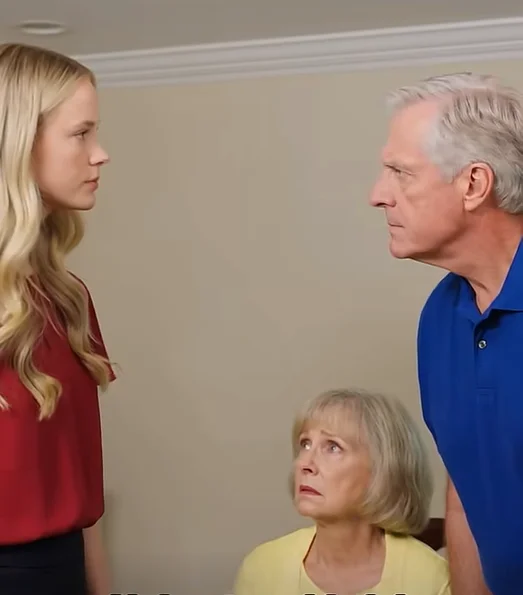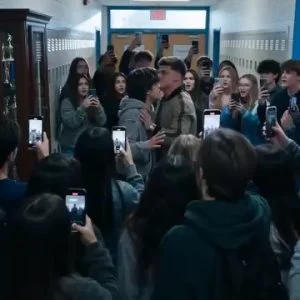
A student named Brianna had recorded the whole confrontation from the opposite side of the hall.
“I used to think it was just teasing,” she admitted. “But he kept doing it after Alex asked him to stop.”
Dr. Alvarez listened without interrupting.
Then she asked me a question no one else had asked.
“Have you felt safe at this school?”
I looked down at my hands.
“Not for a while.”
She nodded slowly.
“Then we need to address more than today’s incident.”
Julian’s father arrived
By the end of the day, Julian’s father was in the principal’s office.
He wore a tailored suit and carried himself like a man accustomed to negotiating outcomes.
“My son says this was a misunderstanding,” he said. “He has a football future. I don’t want a hallway scuffle destroying his opportunities.”
Dr. Alvarez kept her voice even.
“We’re reviewing the incident and the prior complaints. His athletic status doesn’t change the school’s responsibility to protect students.”
Julian’s father looked at me.
“Alex, boys sometimes say things they don’t mean.”
I thought about my father’s hands, permanently marked by years of work. I thought about Julian using those hands as a punchline.
“He meant it,” I said. “He said it because he knew it would hurt.”
The room fell quiet.
Dr. Alvarez asked Julian’s father to let the investigation proceed.
No one could make the recordings disappear.
The investigation
Over the next several days, the school interviewed students, reviewed the videos, and checked the earlier reports.
The findings confirmed that Julian had repeatedly harassed and physically intimidated me. The hallway incident wasn’t an isolated misunderstanding.
Julian was suspended under the school’s disciplinary policy and removed from team activities while the school determined the appropriate next steps. The students who had participated in the harassment were dealt with according to their individual roles.
The assistant principal was also required to answer for dismissing my earlier reports. The school reviewed its reporting procedures and established a clearer way for students to raise safety concerns.
I wasn’t asked to sit across from Julian and accept an apology.
I wasn’t required to forgive him.
Instead, Dr. Alvarez arranged a safety plan: a staff contact I could reach directly, changes to hallway supervision, and clear instructions that Julian was not to approach or intimidate me.
For the first time, the adults were taking responsibility for making the school safer.
The conversation with my father
That evening, I found Dad in the garage, replacing a worn belt on an old sedan.
He looked up when I walked in.
“School okay?”
I almost said yes.
Instead, I told him everything.
The insults. The shove. The kick. The videos. The principal’s office.
Dad set down his wrench.
“Are you hurt?”
“Just sore.”
He checked the back of my head anyway, then pulled me into a careful hug.
“I wish you’d told me how bad it had gotten.”
“I thought I could handle it.”
“You shouldn’t have had to handle it alone.”
I told him what Julian had said about him.
Dad gave a tired smile.
“Son, a person’s worth isn’t measured by the price of his watch or the name on his building.”
“I know.”
“And what did you do when he tried to kick you?”
“I got out of the way. I didn’t hit him.”
Dad nodded.
“Then you remembered what we practiced.”
I waited for him to say I should have fought harder.
He didn’t.
He simply said, “I’m proud you got home.”
The hallway after the cameras
A week later, I walked past the trophy case again.
The glass had been inspected. The hallway looked exactly as it always had: bright lights, rows of lockers, framed photographs of championship teams.
But the students were different.
Some looked embarrassed. A few offered quiet apologies for filming instead of helping. Brianna stopped me near the stairwell.
“I should’ve said something sooner,” she said.
“Yeah,” I replied. “You should have.”
She accepted that without making excuses.
I didn’t suddenly become popular. I didn’t become the school’s new fighter. I didn’t need to.
I went to class. I kept training with Dad. I learned that I could report what happened without having to prove I was tough enough to endure it.
And Julian’s name no longer made me feel like I had to shrink.
What my father really taught me
At the end of the semester, the school held its athletic awards.
Julian wasn’t there.
I sat near the back with Dad, whose work shirt still smelled faintly of motor oil. When the principal spoke about student safety and the responsibility to intervene when someone is being targeted, I glanced at him.
He was listening carefully.
Afterward, we walked to the old pickup.
“Do you think Julian will change?” I asked.
Dad shrugged.