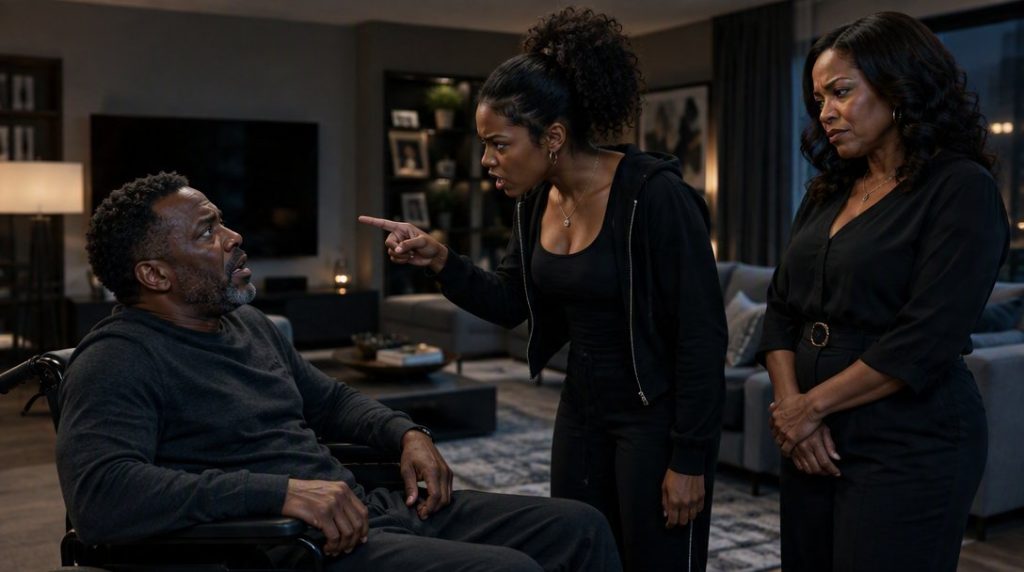
That sentence would travel farther than any of the facts that could have corrected it.
Officer Thomas Vale had served on the city police force for twenty-four years. He was experienced, respected by some colleagues, and tired in ways he rarely admitted. His career included commendations for emergency response and a reputation for arriving quickly when businesses called. It also included a handful of complaints that had never led to sustained discipline. Vale believed he was practical, not prejudiced. He thought instincts kept people safe and that hesitation could turn a manageable situation into a dangerous one.
His younger partner, Officer Nia Patel, had been on patrol for eleven months. She believed procedures existed to protect everyone, including officers who might be wrong. She had already learned that saying so aloud could make a shift feel much longer.
When the call came over the radio, Vale accelerated toward Harborstone.
“Possible unauthorized person in a bank’s restricted area,” he said. “We’ll get there, find out what’s going on, and clear it.”
Patel read the dispatcher’s notes. “No reported weapon. No forced entry. Caller can’t confirm whether anyone asked him to leave.”
Vale glanced at her. “That’s why we investigate.”
“I agree. I’m just saying we don’t have much yet.”
“We’ll have more when we get there.”
The patrol car stopped in front of the bank at 8:29. Rain ticked against the windshield. Vale was out before Patel had finished fastening her radio. Inside the lobby, customers looked up as the officers entered. The guard stepped forward, relieved that someone else would take responsibility.
“He’s in the back hallway,” the guard said. “I was told there might be an issue.”
“Who told you?”
“A customer.”
Vale nodded as if the answer settled something. He walked toward the restricted door, with Patel half a step behind him. Neither officer knew that the man they were about to confront had helped design the bank’s customer-protection policy. Neither knew that the branch manager was already on her way. Neither knew how many cameras were recording them.
Daniel had just finished speaking with a loan officer about a small business application when he heard footsteps in the corridor. He turned as Vale entered.
“Sir, I need you to step out here.”
Daniel closed his portfolio. “Of course. May I ask what this is about?”
“We received a report that you may be somewhere you’re not authorized to be.”
“I’m authorized to be here.”
“Then you can show me identification.”
Daniel reached slowly toward his inside pocket. Patel noticed that his movements were measured and visible. Vale noticed only that he had not immediately produced a card.
“Hands where I can see them,” Vale ordered.
Daniel stopped. “My identification is in my jacket. I’m going to take it out.”
“Do it slowly.”
“I am.”
A loan officer emerged from the adjoining room. “Officer, he has access. I let him through the door.”
Vale did not turn. “I’ll handle this.”
Patel looked at the employee. “Can you tell us his name?”
The employee opened his mouth, but Vale raised a hand. “One at a time.”
Daniel took out a plain identification wallet. He held it between two fingers and extended it. Vale glanced at the card, then at Daniel’s face, as if one of them must be false.
“This doesn’t tell me why you’re in a restricted area,” Vale said.
“It tells you who I am. The access card tells you why I can enter.”
“Where’s that card?”
“In my wallet. May I reach for it?”
Vale stepped closer. “Don’t reach for anything until I tell you.”
The hallway seemed to narrow around them. Daniel could hear the rain against the windows and the soft hum of the ventilation system. He had been questioned before, in airports, hotels, and offices where people assumed that a Black man who looked calm must be concealing anger. He had learned to keep his voice even because any sign of frustration could become the story others told about him.
“I’m not refusing to cooperate,” he said. “I’m asking you to verify what I’ve told you.”
Vale’s jaw tightened. He heard defiance where Daniel intended precision. “Turn around and put your hands behind your back.”
Patel’s head snapped toward him. “Officer Vale, we haven’t established—”
“I said turn around.”
Daniel did not move for a moment. “Am I under arrest?”
“You’re being detained while we sort this out.”
“On what basis?”
“Turn around.”
The words were loud enough to carry into the lobby. A customer near the teller line lowered her phone from her ear. Maya came around the desk. The branch manager, Laura Chen, appeared at the far end of the hall, still holding a folder.
“Officer, stop,” Chen said. “This man is expected.”
Vale turned at last. “Are you the manager?”