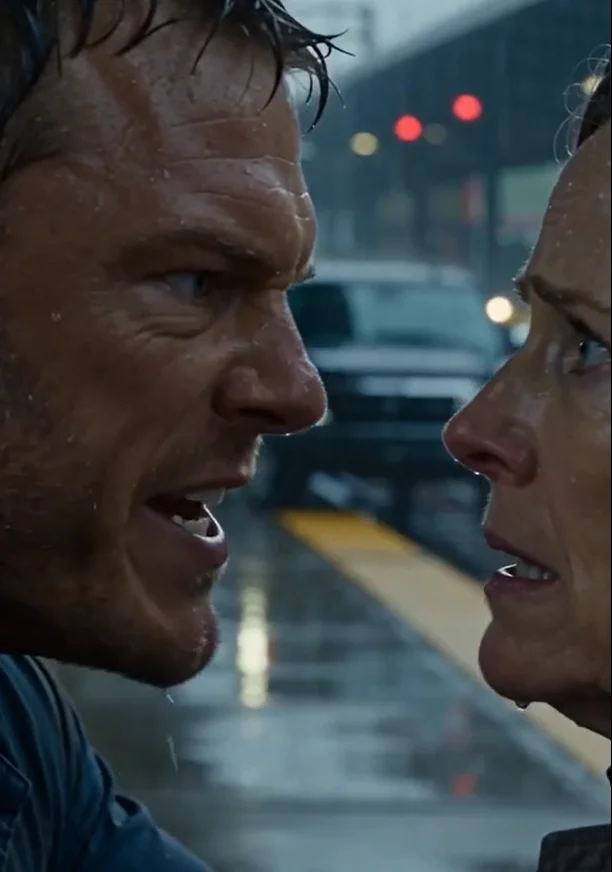
long moment, none of them spoke, while rain drumed against the metal roof. The single bulb overhead buzzed and swayed slightly whenever wind pushed through a gap in the siding, throwing long shadows across shelves crowded with carburetors and coiled hose, and the smell of old motor oil settled over the three of them like something almost comforting in its ordinariness.
Nolan sat on an overturned crate because his legs did not entirely trust him to stand, and he found himself studying the two women across from him the way he might study an engine that refused to start, searching for the one detail that would explain everything. He could not stop looking at the young woman, could not reconcile the shape of her face with anything he understood about his own history. Yet some old animal instinct in him refused to dismiss what his eyes kept insisting was true. Marin finally broke the silence, her hands wrapped tightly around a paper cup of coffee she had not touched, and told him that when she vanished 20 years earlier, she had been carrying a child neither of them yet knew existed. Nolan felt some cold move through his chest because even in the depths of his grief, he had never imagined a version of the truth that included a daughter he had never been told about. The young woman introduced herself as Sloan Hart, though she said the surname carefully as though it belonged to a costume rather than a name. She explained that she had grown up believing her father died before she was born. A story repeated so many times that it had calcified into something she never thought to question. Only 2 weeks earlier, her mother had finally told her that her father was not dead at all, that he was alive and living less than a day’s drive from where they had been hiding.
Sloan did not call Nolan anything resembling a father in that first conversation, choosing instead to study him the way a person studies a stranger who happens to share their face, cataloging the similarities without yet trusting what they might mean. Nolan noticed she pressed her fingers against the edge of the table when she grew tense, an unconscious habit identical to one he shared with Elliot, and the resemblance rattled him more than any words could have. He told them plainly that two decades of lies could not be undone by a resemblance, however striking, and that he needed proof before he let himself believe any of it. Marin agreed without hesitation, but warned him they could not send a sample to any ordinary laboratory because Gideon Wickliffe had people embedded in hospitals,
courts, and private data firms across the region. The name hit Nolan like a stone dropped into still water because he remembered it from the earliest days of their marriage back when Marin’s family had made their disapproval of a small town mechanic marrying into their world unmistakably clear. He understood then that whatever had pulled his wife back from the dead was not a simple story of a woman running from grief, but something far larger and far more dangerous than he had allowed himself to imagine. Before he could ask another question, Marin reached into her bag and set a photograph on the table between them, its edges worn soft from handling. It showed Nolan walking a three-year-old Elliot into his first day of preschool. An ordinary morning frozen in time,
except the photograph had clearly been taken 12 years after the date on Marin’s death certificate. The story that unfolded that evening carried Nolan back 20 years to a version of his life he had only ever understood in fragments. Marin had been born into the Wikliffe family, daughter of the late Augustus Wikliffe, the founder of Wickcliffe Crown Holdings, an empire built across decades of shrewd investment and careful public image. She had never wanted the crown that came with the name, choosing instead to marry a mechanic from a town. Most of her relatives could not locate on a map, and she had endured her family’s cold disapproval without complaint because Nolan had never once made her feel like a consolation prize.



