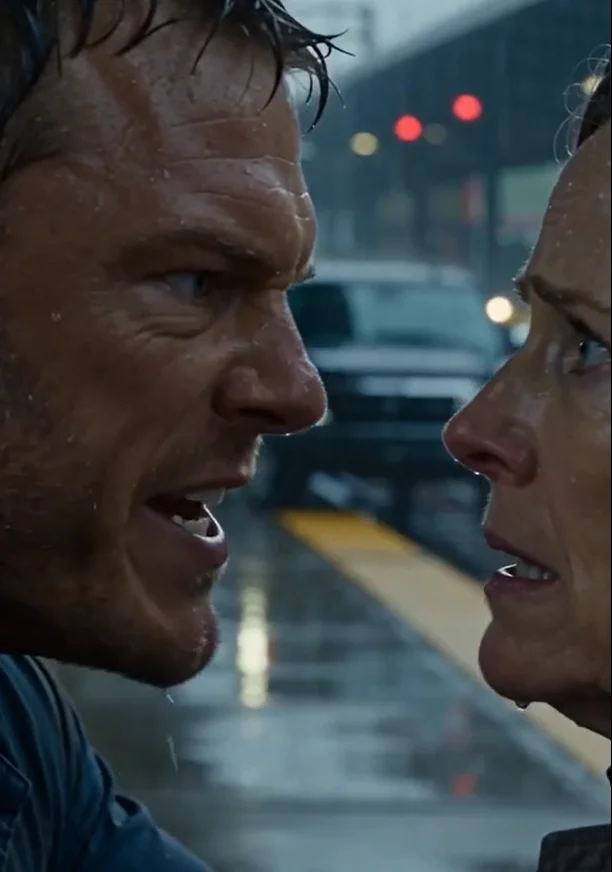
Marin spent those 20 years moving through a patchwork of borrowed names and rented rooms. First through Oregon, then further north into Montana, eventually settling for a time near the Canadian border before finally putting down something resembling roots in a small coastal town in Maine. She learned to live light, keeping a single suitcase packed beneath whatever bed she slept in. and she learned the particular loneliness of watching other families gather at diner tables on ordinary Sunday mornings while she sat alone with a newspaper she used more as a shield than a source of news. There were towns where she stayed only weeks and towns where she stayed years. And in every one of them she kept a small photograph of Nolan folded inside a coat pocket,
worn soft at the creases from being unfolded too many times in the dark. In the earliest years, Silas had still been able to send her photographs of Nolan and Elliot, proof that they remained safe. Each image a small mercy that let her sleep through another night of exile. He had also warned her again and again that Gideon’s people had never stopped watching Blackwater, waiting patiently for the moment she made a mistake that would confirm what he already suspected. Marin wrote letters during those years, dozens of them, addressed to a husband who would never receive a single one because she trusted no method of delivery except passing them through Silas. and Silas alone controlled whether they ever left his hands. When Silas disappeared, Marin was left with no way to know whether he had betrayed her,
been discovered by Gideon, or simply been erased the way so many inconvenient people in her family’s orbit seemed to disappear. Without a trusted intermediary, she convinced herself that any attempt to reach out would place Nolan and Elliot directly in danger. And so she let the silence continue long after that the fear that justified it had curdled into something closer to habit. Nolan listened to all of it without softening, unwilling to accept an explanation that reduced his son’s entire childhood to a decision made unilaterally on his behalf. He told her plainly that grief he could forgive, but the theft of his right to know the truth about his own life was a different kind of wound entirely. Sloan, who had said little through most of the conversation,
finally spoke up with a question of her own, asking her mother whether the same lie had been used to protect both sides of the family from each other. Marin did not flinch from the accusation. She admitted that fear alone no longer explained everything. That somewhere in the passing years she had simply lost the ability to imagine what a return might look like, or how she would begin explaining 20 years of absence to a husband and son who had already learned to live without her.
Nolan asked her more sharply now why she had chosen this particular moment to resurface after so long spent hiding. In answer, Marin slid a thick folder across the table, its cover embossed with the small silver crown that marked every official document belonging to Wikliffe Crown Holdings.
Sloan would turn 21 years old in exactly 3 days. And that single fact, Marin explained, carried the power to unravel everything Gideon Wikliffe had spent two decades building. Augustus Wikliffe before his death had structured a trust that held 51% of the voting shares in Wikliffe Crown Holdings, a controlling stake designed to protect the company from exactly the kind of consolidation Gideon had since achieved. Gideon had only ever been granted temporary stewardship of those shares under the condition that Marin had died without leaving behind a legitimate heir of her own. A hidden clause within the trust, one Gideon believed had died with Augustus, specified that control would automatically revert to Marin or to her biological child the moment that child turned 21, and that the transfer would trigger a mandatory audit of every pension fund and corporate account the company controlled. For 20 years, Gideon had built his empire on the confident assumption that Marin was dead and that no heir existed to threaten his position. He was at that very moment finalizing the sale of a substantial portion of the company to a foreign investment fund. A deal structured to close before Sloan’s birthday made her legal claim impossible to ignore. Once that sale closed, Marin explained, the financial evidence of Gideon’s fraud would be scattered across so many shell companies that even a federal investigation might never fully reconstruct it. She possessed only a copy of the trust’s hidden clause because the sole original document had been hidden by Silus Crowe somewhere in Blackwater before his disappearance two decades earlier. Days before showing up at the train station, Marin had received a recording from a lawyer representing Silas’s estate. A message set to release automatically after his death. And in it, Silus revealed that the original document had been concealed inside something belonging to Nolan. Nolan felt the memory surface before he consciously reached for it. The image of a wooden toolbox Marin had given him the day he opened his garage. a gift he had treasured enough to keep for 20 years without ever suspecting it held anything but wrenches and sockets. The three of them drove back to the shop through streets slick with rain, headlights smearing gold across the wet asphalt, and none of them spoke because there seemed to be nothing left that words could accomplish. When they arrived, Nolan found the toolbox exactly where it had always sat, undisturbed in the corner of the storage room for two full decades. Its brass latches dulled with age, but still intact beneath a thin film of dust. When he pried it open, his hands were not entirely steady, and what he found waiting inside was not the sealed document Marin had described, but a room that had clearly been searched already. drawers overturned and the lock on the storage door forced open sometime before their arrival. Scrolled across the wall behind the emptied toolbox in handwriting none of them recognized was a single sentence meant to be read as both a warning and a threat. The words read simply that the dead ought to know better than to stop staying buried.



