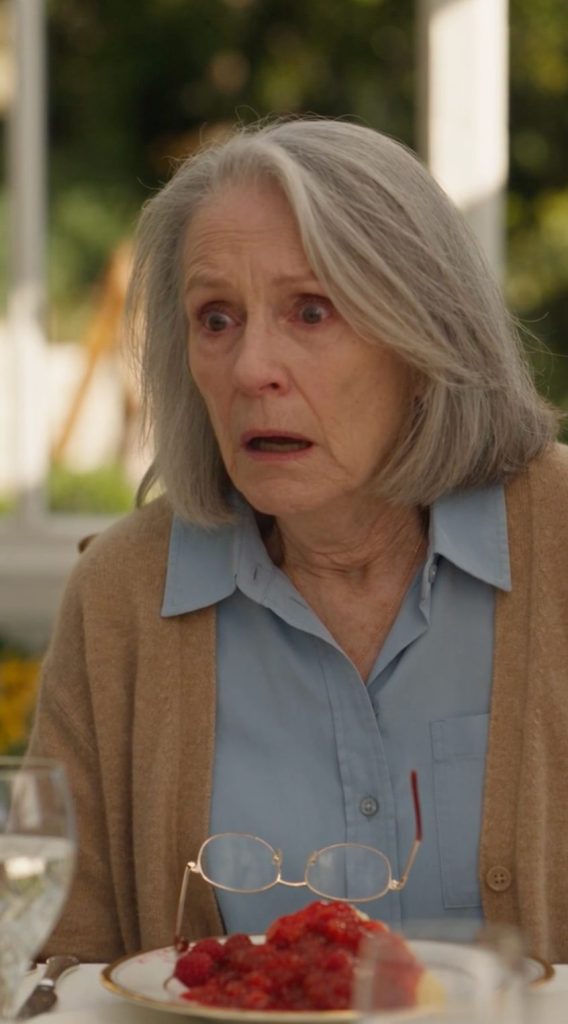
At sixty-four, she was a composed woman with silver hair, sharp gray eyes, and a remarkable ability to become calmer whenever the situation around her grew more chaotic.
She carried a legal pad and a leather document case.
Before we went upstairs, she examined my cheek.
“Evelyn, you should have someone document that injury.”
I looked away.
“I don’t want to make a spectacle of this.”
“You didn’t create the spectacle.”
She gently touched my hand.
“Protecting yourself isn’t the same as punishing your family.”
Those words stayed with me.
We entered Thomas’s office.
Afternoon sunlight streamed through the windows, illuminating tiny particles of dust above the old oak desk.
His reading glasses still rested beside a brass paperweight.
His favorite fountain pen lay in the drawer.
For a moment, I could almost imagine hearing him walk down the hallway.
Naomi stood beside me while I moved the framed photograph.
Behind it was the safe.
My hands trembled as I turned the dial.
The lock clicked.
Inside were several envelopes, a small black ledger, an old leather-bound notebook, and a metal box secured with a tiny brass clasp.
A cream-colored envelope lay on top.
Across its front, in Thomas’s familiar handwriting, were five words.
FOR EVELYN, IF THE HOUSE IS EVER THREATENED.
My knees felt weak.
Naomi pulled out a chair.
“Sit down before you read it.”
I broke the seal.
Inside was a letter written on the stationery Thomas used for business correspondence.
The first sentence made my throat tighten.
My dearest Evie, if you are reading this, then something has happened that I hoped would never happen.
I pressed my fingers against my mouth.
The letter continued.
There are things about Carter House that I should have explained more carefully while I was alive.
I thought we had time.
Perhaps that was my greatest mistake.
You know we built the business with our own hands.
You know what we sacrificed.
But the land beneath it has a history older than our marriage, and the agreements protecting it matter more than anyone has ever understood.
When Ruth Carter helped us acquire the inn, she asked for only one promise: that the place would never become something that served wealth while forgetting people in need.

Years later, I made sure that promise would survive us.
If anyone tries to make you surrender control of Carter House, do not argue about sentiment.
Find the original trust documents.
Find the black ledger.
And ask Naomi to examine the records concerning the north parcel.
Above all, remember this: the person who manages Carter House does not necessarily own the ground beneath it.
I love you more than I was ever able to say.
Thomas.
I lowered the letter.
Naomi had gone very still.
“What is it?”
I whispered.
She looked toward the documents inside the safe.
“Evelyn, we need to find out exactly what Thomas left here.”
I handed her the first bundle.
It contained copies of old deeds, financing agreements, meeting minutes, and a trust declaration dated nearly thirty years earlier.
Naomi examined the pages carefully.
Then she looked at me.
“Do you remember the Carter Family Land Trust?”
“Of course.
Thomas and I used it to protect the original property arrangements.”
“And do you remember how the land and the restaurant business were separated?”
“Generally.”
Naomi placed two documents side by side.
“The operating company owns the restaurant business and certain improvements.
But substantial portions of the underlying property are held by the land trust.
You have voting authority in both arrangements, but Daniel only manages the business.”
I nodded.
That was how we had protected Carter House from irresponsible borrowing.
Naomi turned another page.
Then another.
Her expression sharpened.
“These documents confirm the original restrictions.
There is a recorded limitation on unauthorized transfer, and the trust retains important approval rights over changes in use.”
“What does that mean?”
“It means the papers Madison wanted you to sign may be worthless without additional approvals.”
Relief rose in my chest.
But Naomi did not look relieved.
She reached for the black ledger.
Inside were dates, account numbers, handwritten calculations, and names I recognized from decades earlier.
Near the final pages was an entry concerning a parcel along the north boundary of Carter House.
Beside it, Thomas had written:
THE LAND IS THE KEY.
THE ROAD IS THE LOCK.
Naomi frowned.
“Why would he put that here?”
I shook my head.
“I have no idea.”
She examined an old survey folded between the pages.
The original road leading into Carter House crossed the north parcel before reaching the restaurant.
According to the survey, there was no practical vehicle entrance to the commercial property without using that strip of land.
Naomi leaned closer.
“Interesting.”
“What?”



