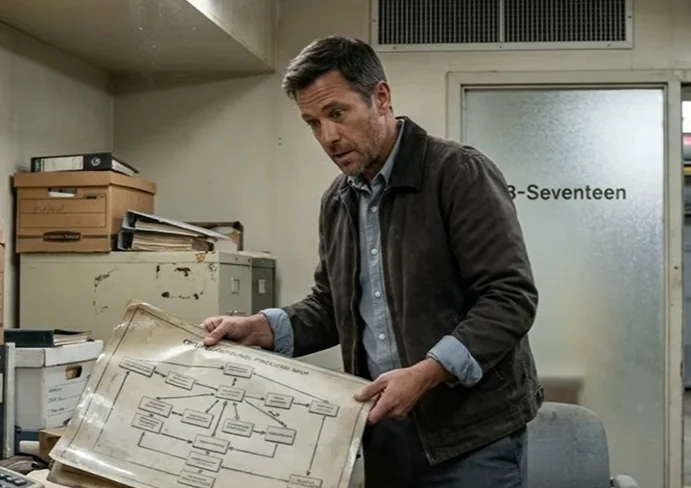
The room was in the basement, past the freight corridor with a low ceiling, a frosted glass door, a wobbling table, and an air handler that produced a warm breath instead of cold air. The hallway outside smelled like cardboard and floor sealant, and every 11 minutes, the loading dock door rolled up and shook the wall.
Blair made sure the news traveled. She did not send anything in writing. She mentioned it twice in meetings, in a tone of mild regret, as a decision that had been difficult but necessary, and once in the elevator, she called it the office for people who would not move forward.
By Friday, two different managers had stopped asking Graham questions they had been asking him for years.
He spent that first afternoon clearing out what had been left behind. Four boxes of expired vendor files, a broken label maker, a carton of binders from an acquisition that had closed before his daughter was born.
In the bottom drawer of a steel desk pushed against the back wall under a layer of dust that had gone soft, he found a laminated process map 3 ft wide folded in half. Dozens of arrows ran between department names, and at the center of them, printed in a typeface the company had stopped using a decade ago, were the words cross-functional incident coordination, room B17.
He stood there holding it for a long time. Long enough that the loading dock door rolled up twice.
“Guess they forgot what this room was for,” he said to nobody.
He did not quit, and the reason was not dramatic. The mortgage on the house in Berwyn had 11 years left on it. His daughter Hannah was 16 and swam four mornings a week at a pool that opened at 5:40. And the insurance through the company covered the orthodontist who was slowly straightening her bottom teeth.
Graham had been a single father for 6 years since the divorce. And one of the things he had learned in that time was that pride is a thing you spend after the bills are paid, not before.
So he came in on Monday and he sat in the bedroom and he opened his new job description to see exactly what it let him do.
It let him do more than Victoria had probably intended.
The description had been written quickly, mostly by copying language out of the old incident desk charter, and it authorized him to receive, track, and coordinate the resolution of unresolved operational matters across business units.
It did not authorize him to approve expenditures, alter contract terms, or direct staff outside his function.
He read it four times. Then he printed it, underlined two phrases, and put it in a folder where he could reach it.
The rest of that week, he did unglamorous things.
He archived the vendor files according to the retention schedule, which took 2 days, and generated a signed transfer receipt he kept a copy of. He submitted a facilities request for the air handler. And when it came back with a missing cost code, he found the cost code himself and resubmitted it, and the unit was serviced on Thursday.
The 11th floor was being reconfigured for the new platform team. So he walked up and asked the move coordinator what was going to the dock and he carried down a conference table in two trips, eight chairs over three more and a rolling cart that had lost one caster.
Evelyn Brooks found him on the fourth trip. She was 56, had worked in records control since the building still had a mail room. And she looked at the long table the way people look at a relative they have not seen since a funeral.
They used to hold the incident sessions here. She said every Tuesday and Thursday. Whatever was stuck, it came down here and somebody left with it.
What happened to it?
Cost program 2016. They decided each department could handle its own exceptions.
She set a stack of folders on the end of the table without being asked.
That worked out the way you’d expect.
Graham did not have a plan at that point. He has said so since to anyone who asked, and it has the ring of truth because the alternative would have required him to have imagined the next 6 months, which nobody could have.
What he had was a long table in a room where nobody wanted to be. And on his second Monday, a request from a woman named Megan Alcott in corporate accounts who had been with the company 8 months and was close to tears about a maintenance ticket.



