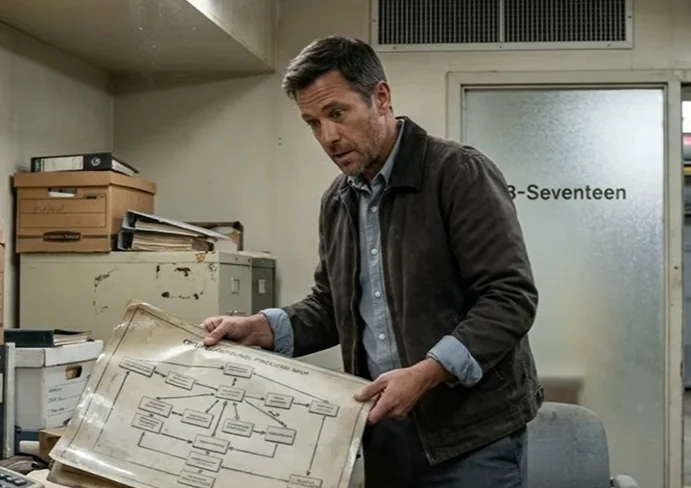
Graham was offered the role of director of operational process improvement, which was a title somebody wrote on a Tuesday and which he found faintly ridiculous.
He accepted it.
He declined the office on the 28th floor.
He asked instead that B17 be brought up to code, which it had not been in a decade, and that the room next to it, the one holding the storage cage, be cleared for a second table.
Facilities put in proper ventilation, lighting that did not hum, a door that closed, and two outlets that worked.
The wobbling table stayed because by then it had a notebook on it that had become a controlled document with a retention schedule, and because the people who used the room had decided without discussing it that replacing the table would have been a kind of forgetting.
Russell Keen signed a 2-year renewal in June instead of a 5-year one with quarterly verification and a termination right on 60 days’ notice, which was less than the company wanted and more than it deserved.
Eight of the 43 site codes were still wrong in August.
Graham did not pretend otherwise, and Keen did not expect him to.
And the relationship between those two facts is most of what the word trust actually means in a commercial contract.
A legacy of accountability
Victoria came down on a Thursday in July alone with no assistant and nothing in her hands.
There were four people in the corridor and she took her place behind the last one, a payroll analyst who recognized her and offered to let her go first and was told, “No, thank you.”
She waited 19 minutes.
From where she stood, she could hear a voice inside explaining patiently and more than once why the date on a commitment mattered more than the promise attached to it.
When Graham finally came out, she said, “I thought this room would make you feel small.”
He looked past her at the line, at the whiteboard visible through the open door, at the carafe on the cart with the broken caster.
“It did,” he said.
“What changed?”
I stopped letting the room decide what I was worth.
She apologized then properly without putting it in the language of organizational learning.
She said she had used her position to humiliate him in front of people whose respect he had earned over 14 years and that she had done it because he had not been ashamed when she wanted him to be and that she had known what she was doing at the time.
Graham accepted it.
He did not tell her it was fine because it was not, and he did not offer her the absolution she was partly there for.
The two of them stood in a basement corridor for a moment with the loading dock door rolling up at the end of it, and that was all there was.
“Do you think I can be better at this than I’ve been?” she asked.
“That isn’t up to what I think,” Graham said. “It’s up to what you do starting tomorrow.”
On a Monday in September, the basement elevator opened at 8:00 in the morning and there was a line outside B17 again, but it had changed and the change was the only victory Graham ever cared about.
Three of the groups in it were not waiting for him. They were waiting for the room.
A procurement specialist and two engineers were already at the whiteboard running their own session under the approved procedure with a name and a date going up next to each item.
And Evelyn was at the end of the table showing somebody from the new platform team where the superseded procedures were kept.
Victoria walked past the door on her way to a meeting she was not going to be late for.
The sign was still taped to the frosted glass. The marker faded now. The cardboard gone soft at the corners.
Underneath the eight words Graham had written in April, somebody had added a line in different handwriting in blue.
And we’ll find the people who can solve it.
She stood there longer than she meant to.
Then she went in and took a chair at the back and did not say anything for 40 minutes.
Here is the part that stays with you.
People will measure you by the floor you work on, the title on your card, the size of the window behind your desk, and most of the time they will be certain they are measuring something real.
Graham Hensley never got rich, never ran the company, and never once got to watch the woman who demeaned him lose everything.
What he got was smaller and harder and better.



