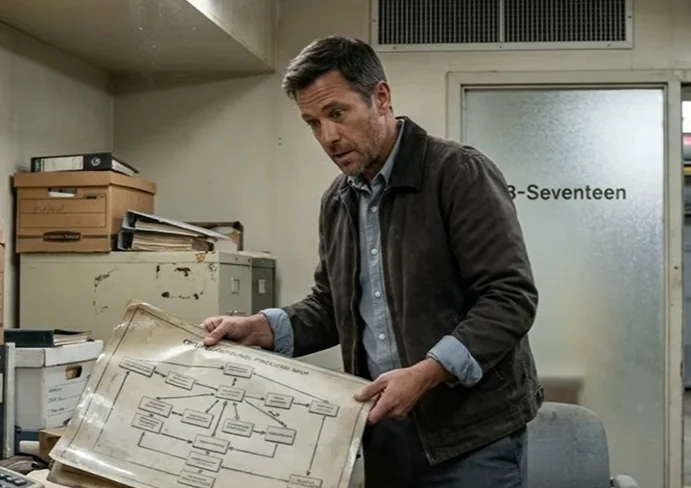
He did not negotiate. He had no authority to negotiate and he said so at the start, which Keen would mention later as the first thing that made him believe anything else he heard.
He asked the engineering lead to walk through what had actually happened on each of the 17 requests and then he asked Phil Sutter the question nobody had asked in 5 months, which was why 11 of those requests had never appeared in the routing queue at all.
It took Phil most of an hour to find it with his laptop open on the long table and the whiteboard filling up behind him.
Northbridge had been onboarded under a master services agreement in 2019 and then added 43 properties in 2022 under a site-level amendment.
The work order system identified properties by the master contract number. The vendor dispatch system, which had been bought from a different company and bolted on during the integration, identified them by site code.
Requests entered at the property level under the amendment carried a site code with no master number and the routing rules dropped them into an exceptions bucket that one person had been clearing manually until that person left in August and was not replaced.
Keen listened to all of it without changing expression.
Then he said, “Five months and nobody in this building knew.”
“Somebody knew,” Graham said. “They just didn’t know anyone to tell.”
They built a plan on the whiteboard with 11 line items, each one carrying a name and a date, and Keen took a photograph of it with his phone.
He did not sign a renewal. He said he would hold the termination process for 30 days and judge the company by whether the dates on that board turned out to be real.
And on his way to the elevator, he asked Graham what the sign on the door was about.
It’s a long story, Graham said.
It usually is.
Blair was in Victoria’s office before lunch.
She did not accuse Graham of anything. She described a situation which was her particular talent.
A strategic account with a termination letter on file had been handled in an unapproved space by an employee two levels below the executive team without the chief executive present. And if that account was lost, the narrative would be very difficult to control.
She used the word narrative twice.
Victoria called Graham up at 4:00 to the executive conference room with the door open and three people within earshot in the corridor.
I gave you the worst office in this building so you would understand your position. She said you turned it into a stage.
I never invited anyone to watch me perform.
$8.4 million walked into my lobby and went to the basement. He asked where the work was.
Graham said, “I showed him.”
She told him that no further group sessions would be held in B17 until compliance had reviewed whatever it was he had constructed down there.
Graham said he would comply, and then he asked for two things, which she had not expected.
He asked for the instruction in writing, and he asked that the 14 open matters currently being coordinated out of that room be reassigned to named individuals before the room went dark, because otherwise they would return to the condition they had been in, and the 30 days Keen had given them had 26 left.
Suspension and fallout
Victoria heard the second request as a threat dressed as diligence.
She said she would take it under advisement, which meant no.
That evening, she stayed late and pulled the operational dashboard herself for the first time since her second week instead of reading the summary.
Aged open items were down 31% over 5 weeks. It was the single number she had promised the board in September.
She sat with it for a while, pleased, and then she opened the underlying records, which took her 20 minutes to find, and started reading the coordination notes on the closures.
Most of them had the same three letters and two digits in them.
She was still looking at it when Blair knocked at 7:40 with a tablet under her arm and a different report on it.
Blair had been doing her own reading across the previous 11 months.
More than 400 service requests had been marked complete in the system before the client confirmed resolution, some of them by 30 days or more.
It was, Blair said, exactly the kind of exposure an outside auditor would find first and exactly the kind of thing that happened when people improvised outside of approved process.



