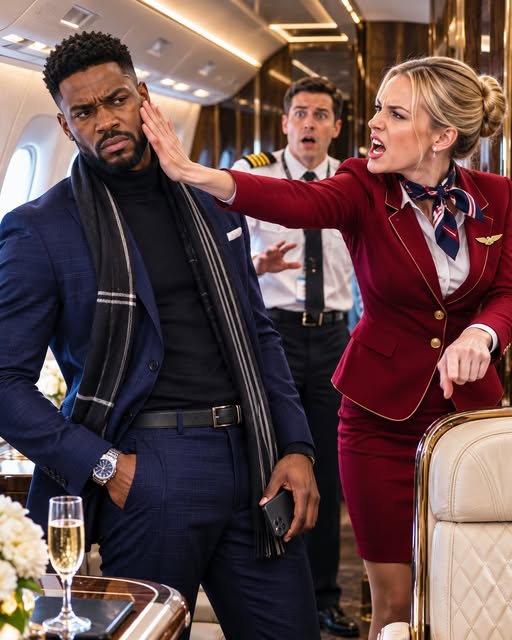
Emily let out a ragged breath, collapsing back into her seat. “We shook them.”
“For now,” I said, looking out at the flashing navigation lights of civilian aircraft filling the night sky.
My phone vibrated against my hip. The satellite link had caught the edge of a Massachusetts coastal tower.
A new message blinked on the screen:
Chapter 13 – Hangar 7
Boston Logan was bathed in cold, blue halogen light when our tires touched down on Runway 4 Right. Emergency fire trucks with flashing beacons flanked the runway, but Captain Bradley brought the massive twin-engine craft to a smooth halt near the international terminal without incident.
“Port Authority police are requesting to board,” Bradley announced over the intercom.
“Tell them the cabin pressure issue resolved upon descent, Captain,” I replied through the cabin handset. “Log it as a precautionary sensor glitch. Let our ground crew handle the debarking.”
I turned to Emily, who was adjusting her new executive uniform. “Stay with the aircraft. Ensure our legal team in New York monitors every single fuel line and avionics port. If any federal agent without a signed civilian court warrant approaches this plane, invoke Donovan Capital’s maritime carrier protections.”
“Marcus,” Emily whispered, catching my arm. Her eyes were wide with genuine concern. “You can’t go to Hangar 7 alone. If Harold Sterling and Vance were willing to plant a bomb on your private jet, whoever is running Project Archangel won’t hesitate to pull a trigger.”
“They had the chance to shoot us down over the Atlantic, Emily,” I replied, pulling my dark hoodie over my head. “They didn’t. They want something from me. Harold had the flight records, but whatever was in those three titanium pods on Flight 402 is still missing. They think I know where it is.”
I stepped out of the lower service hatch into the freezing Massachusetts night, bypassing the crowded terminal via the secure service road. The rain was slick on the tarmac, reflecting the amber beacons of cargo tugs.
Hangar 7 sat on the northern perimeter of the airport—a derelict steel structure once leased by Sterling Atlantic before their bankruptcy restructuring. The massive sliding doors were cracked open just wide enough for a man to slip through.
Inside, the smell of oxidized kerosene and damp concrete hung heavy in the air.
Standing in the center of the cavernous, unlit bay beneath the rusted wing of an old Boeing 707 was a tall, lean figure in a tailored charcoal overcoat. His silver hair was cropped close, his back completely rigid.
“You’re late, Marcus,” the man said without turning around.
“Who are you?” I demanded, keeping ten paces between us, my hand resting near the panic transmitter in my pocket.
The man turned slowly. His face was weathered, scarred by decades of military service, with piercing steel-gray eyes that bore an unmistakable family resemblance to Richard Vance.
“I am General Julian Vance,” he said, his voice deep and raspy. “And unlike my fool of a nephew Richard, I didn’t spend the last ten years stealing airline pennies. I spent it cleaning up your father’s mess.”
“My father built civilian engines,” I said cold. “He didn’t make messes.”
Chapter 14 – The Archangel Core
The silence inside Hangar 7 was deafening, broken only by the steady drum of rain against the corrugated metal roof.
“Hypersonic defense?” I echoed, refusing to let my posture betray the shock vibrating through my chest. “Flight 402 was a commercial airliner carrying international freight. My father was an aeronautical consultant, not a black-ops operative.”
General Vance pulled an unlit cigar from his coat pocket, rolling it between gloved fingers. “Your father was the chief architect of the guidance platform that made atmospheric hypersonic maneuvering possible without structural burn-up. Aegis Orbital Dynamics contracted Donovan Aerospace back in 2012 to develop the actuator algorithms. Arthur thought he was building an emergency stabilization system for commercial space shuttles.”
“And when he found out it was for an uncrewed nuclear delivery vehicle?” I asked, my jaw clenching.
“He refused to deliver the final decryption keys,” Vance replied. “He packed the only prototype hardware cores into three titanium containers, loaded them onto Flight 402 disguised as ordinary maintenance equipment, and attempted to fly them to London to hand them over to international oversight.”
“So Harold Sterling and your nephew Richard sabotaged the aircraft to stop him,” I hissed.
“Harold and Richard were idiots,” Vance snapped, disdain dripping from his tone. “They were mid-level fixers. They were ordered to seize the plane on the ground in London. But Richard panicked. He hired an amateur mechanic to falsify a rudder telemetry glitch, hoping to force an emergency landing at Shannon Airport. The bypass failed at forty thousand feet. The tail broke off. The plane went into the trench.”



