Emily stepped into the cabin, placing a steaming cup of black coffee on my tray table, smiling with deep, unshakeable pride. “We’re thirty minutes out from New York, Marcus. The governor and the Secretary of Transportation are waiting at the terminal.”
I looked out the window at the endless blue horizon where the sky met the sea.
Beneath our wings, the world was wide, clear, and just.
Then, on the executive monitor mounted to the forward bulkhead, an automated alert pinged from Donovan Capital’s deep-space satellite telemetry network.
A small, encrypted file had bypassed our global corporate firewall from an ultra-low frequency naval transmitter located beneath the Arctic ice cap.
It wasn’t signed by Harold, Vance, or Adrian.
It bore a single, ancient insignia: the seal of the United States Office of Naval Intelligence, dated twenty minutes ago:
*Flight 402 is vindicated, Marcus. But the weapon cores your father refused to build? The second prototype wasn’t on that plane. It’s already in orbit. See you at the Pentagon.*
I stared at the glowing green cursor on the screen as the Manhattan skyline appeared through the mist below.
Chapter 21 – The Shadow Over Terminal 4
The tires of Donovan Flight 1 struck the tarmac of John F. Kennedy International Airport with a definitive, thunderous chirp. Outside my window, the sprawling expanse of Terminal 4 gleamed in the sharp midday sun, surrounded by a sea of flashing red-and-blue emergency beacons, white media vans with extended satellite dishes, and a ceremonial guard of Port Authority fire engines spraying towering arches of water over our wings.
It was the hero’s welcome that had been denied to my father for an entire decade.
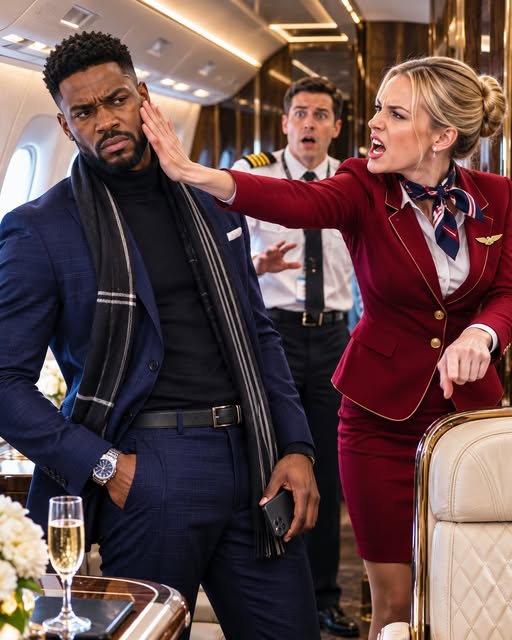
“Look at them, Marcus,” Emily whispered, leaning over my shoulder from the aisle of first class. Her hand rested gently on the headrest of seat 1A—the very seat where this war had begun when Vanessa Whitmore slapped me in London thirty-six hours ago. “Every major network on earth is broadcasting our arrival. The President issued a formal citation honoring Arthur Donovan twenty minutes ago.”
I didn’t answer right away. My eyes were fixed on the encrypted slate resting against my knee. The glowing green text from the Office of Naval Intelligence still burned into my retinas: *The weapon cores your father refused to build? The second prototype wasn’t on that plane. It’s already in orbit. See you at the Pentagon.*
“Marcus?” Emily asked softly, noticing the tightness in my jaw. “Are you alright?”
“We cleared my father’s name from Harold Sterling’s lies,” I said, sliding the tablet into my inner pocket. “We put Adrian Cole in chains in Nova Scotia. But the men who financed Harold’s board… they didn’t stop when Flight 402 went into the sea. They finished the job.”
Captain Bradley brought the massive wide-body to a stop at Gate 4. The engines wound down with a deep, settling vibration that rattled through the floorboards. Through the forward windows, I could see New York Governor Martinez and the Federal Aviation Administrator waiting at the bottom of the jet bridge, flanked by secret service details and executive dignitaries.
“Keep the cabin doors sealed for another three minutes,” I said into the cabin intercom, unbuckling my harness and standing.
Emily followed me toward the forward galley. “Marcus, the Governor is standing right there on the red carpet. If we delay deplaning, the press will think something is wrong.”
“Something is wrong,” I replied grimly. I tapped my primary phone, initiating a dedicated scramble protocol to General Julian Vance’s private line.
Vance answered before the first ring completed. “Don’t walk out that front door, Marcus.”
His voice was clipped, layered with the static of high-altitude tactical communications.
“I received the Arctic transmission, Julian,” I said, keeping my tone level. “Who owns the orbital platform?”
“It’s not registered to the United States military, and it’s not under NATO operational control,” Vance replied, the sound of jet turbines screaming behind him. “It’s operating under a black-budget carve-out funded by Aegis Horizon—the defense consortium Harold Sterling tried to sell the original cores to in 2014. The orbital vehicle is designated Archangel-II. It carries an autonomous kinetic payload, Marcus. And the ground link controlling its telemetry isn’t at the Pentagon.”
I froze in the galley. “Where is it?”
“It’s within three miles of where you are parked right now,” Vance warned. “They’ve embedded a tactical upline inside JFK’s private cargo sector to mask their transmissions inside regular commercial radar chatter. And Marcus… they know you figured out the failsafe.”
Suddenly, every display screen in the first-class cabin flickered violently. The crisp digital maps showing our completed flight from London turned into a wash of jagged green static.



