I looked down at the amber light pulsing on the titanium cylinder.
“You think you understand my father’s engineering, Adrian,” I said quietly, the sound of the rain outside swelling into a deafening roar. “You spent ten years managing balance sheets, but you never spent an hour in the hangar with him.”
“Place your palm on the glass, Marcus!” Adrian ordered, motioning to his lead gunman, who raised his weapon and aimed directly between my eyes. “Don’t test me.”
I slowly lifted my right hand.
I didn’t press my palm against the glass.
Instead, I withdrew my father’s old titanium slide rule from my pocket. I pressed the beveled edge of the rule into a recessed maintenance notch hidden beneath the primary pressure manifold—a mechanical override designed into every Donovan prototype since 1985.
“What are you doing?” Adrian barked, taking a step back.
“The Archangel Protocol wasn’t an atmospheric guidance core, Adrian,” I said, twisting the slide rule ninety degrees until a sharp metallic click echoed through the processing floor. “My father knew Harold Sterling and Vance were watching him. He knew they’d try to steal it. So he never loaded the hypersonic guidance keys onto Flight 402.”
The amber lights on both titanium containers suddenly shifted from pulsing amber to blinding, solid crimson.
A high-frequency digital tone screamed from the pods.
*SYSTEM OVERLOAD: CLASSIFIED TELEMETRY DUMP INITIATED.*
“He turned the pods into flight data black boxes,” I smiled coldly. “The moment the atmospheric pressure seal is broken, the internal solid-state memory doesn’t release weapon keys. It broadcasts the unedited cockpit audio and black-box telemetry of Flight 402 to every open search-and-rescue satellite network in the northern hemisphere.”
Above our heads, the corrugated steel roof violently shattered as tactical flash-bang grenades rained down from the rafters.
The explosive cracks turned the dim plant into a white-hot hell of smoke and concussive sound.
“RCMP! DROP YOUR WEAPONS!”
General Vance’s tactical strike teams breached every doorway simultaneously, laser sights cutting through the smoke. Adrian’s private contractors were swept to the ground under an overwhelming barrage of non-lethal suppressive fire before they could squeeze a single round.
Adrian lunged toward the open pier, his briefcase swinging wildly.
I didn’t wait.
I closed the distance between us in three strides, tackling Adrian across the slick wooden floor, sending his briefcase skittering across the boards and into the freezing ocean below.
Adrian rolled over, coughing blood and salt water, his manicured hair plastered to his forehead as I pinned him against the salt-encrusted piling.
Chapter 20 – The Truth in the Clouds
By noon, the squall over Nova Scotia had broken, leaving behind a brilliant, sapphire sky reflected in the cold Atlantic waters.
The processing plant was swarming with international investigators. DCI Sarah Bennett, having arrived on the RAF transport, stood on the pier alongside Canadian federal prosecutors, watching as Adrian Cole, Richard Vance’s defense associates, and a dozen foreign operatives were led away in heavy steel chains.
The three titanium pods sat secured on flatbed military transports, their recovered flight data already transmitting directly to the International Civil Aviation Organization in Montreal.
Emily Carter stood beside me at the end of the pier, watching the *Oceanic Surveyor*’s blue flag being lowered and replaced with the clean white banner of the Donovan Foundation for Air Safety.
“The black box recordings are completely intact, Marcus,” Emily said softly, holding her tablet. Her eyes were shimmering with tears. “The final cockpit transmissions from 2014… Arthur fought the controls for nineteen minutes trying to steer the plane away from populated coastal shipping lanes. He saved thousands of lives before it hit the water.”
“He was never a failure,” I whispered, the slide rule warm against my chest. “He was a hero.”
Captain Bradley walked down the wooden dock, his RAF medals gleaming on his chest beneath the Canadian sun. He stopped before me, snapped to attention, and delivered a crisp, formal salute.
“Mr. Chairman,” Bradley said, emotion thick in his voice. “Donovan Flight 1 has been cleared for immediate departure to New York JFK. The airspace along the entire eastern seaboard has been designated an official ceremonial corridor in honor of Arthur Donovan. Every civilian air traffic tower from Boston to Miami is standing by to welcome us home.”
“Thank you, Thomas,” I said, returning his hand with a firm, steady grip. “Let’s bring my father’s plane home.”
An hour later, the massive commercial airliner climbed effortlessly through the broken clouds above Halifax, turning south toward New York.
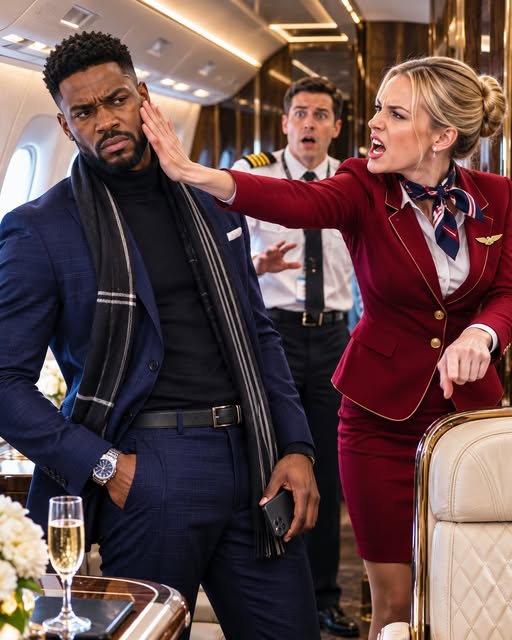
I sat back in seat 1A. There was no bruise hurting on my cheek anymore; no arrogant purser shouting insults down the aisle; no corrupt corporate board waiting to steal my family’s legacy.



