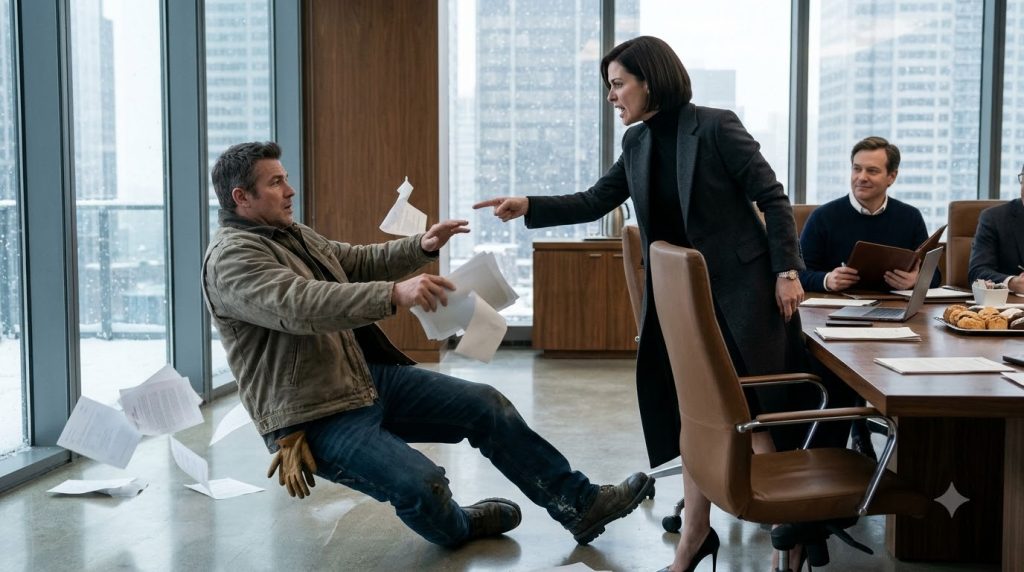
She sat with that for a long time because she had stood in a conference room and told a man that competence does not stay 11 years in one place. And the document in her lap said that the reason his work had never shown up as achievement was that he had spent 11 years preventing the events that would have made it visible. Every month in which nothing broke had been entered against him. The quiet was the work, and the quiet had been read as idleness, and she had been the one who built the system that read it that way. Graham had manipulated the categories, but the categories had existed because she had asked every year for a single page with fewer numbers on it.
The independent review ran for 6 days. Graham Pembroke was suspended on the 5th, and his attorney made it known that he intended to characterize the closed tickets as a routine prioritization dispute, which was neither entirely true nor entirely absurd. He was not a monster. He had taken over a renovation already 4 months late and over budget, made one decision in a spring to keep an item off a punch list, and then been required to keep making it.
Vivien went to the board on the 9th of January, 4 days out of the hospital with the chest pain of a healing artery and no notes. She did not use the word unfortunate. She said that she had personally signed a termination on the 29th of December without reading the employee’s file, that she had been given a performance page built from a metric she herself had requested, and that the metric could not see preventive work by design. She said that the company’s operating costs had been reduced in part by the uncompensated judgment of two technicians and that this was not efficiency but a transfer of risk onto people who had no authority to refuse it. Two of the board members had been with her father. One asked whether she had been advised to say any of that out loud. She said she had been advised not to.
She asked Nolan to come to the building on the 12th. He came in a flannel shirt because he had an interview that afternoon at a facilities group in Lawrenceville and did not want to walk into it wearing a suit he had worn to see her. She offered him back pay to the 29th, a settlement amount she had argued the board up to, and the newly created position of technical operations manager for the whole portfolio—four buildings, a title, a staff of five. Nolan listened to all of it without interrupting. Then he worked the brass key off his ring, which took some doing, and set it on the walnut between them.
“That’s the key,” he said. “It isn’t much, is it? No, it opens a box in the back of my truck. That’s all it’s ever done.” He turned it a quarter turn with one finger, so the worn part caught the light. “I think you brought me here to make it mean something. A man kept a secret key and saved the CEO. It makes a better story than the real one, and it lets everybody in this building off.”
“Then tell me the real one.”
“The real one is that a release lever in a door frame should have been on a drawing in a procedure and in the hands of five people. I asked for that twice in writing. It stayed in a box in my truck because that was the only place anybody would let it stay.” He sat back. “You offered me a title just now. You think I need one to prove I was worth something? I was worth something before you knew my name. That’s not a speech, Vivien. It’s just the arithmetic of 41 items in a year.”
She did not have an answer. And to her credit, she did not reach for one.
Nolan took a thin bound document out of his coat, 22 pages, the cover sheet dated the previous March: A proposal for a building safety and escalation program written on his own time, submitted, acknowledged, never discussed. He put it on the desk facing her. “I’d rather you read this than pay me.”
She looked at the date on the cover for a moment. Then she pulled the document toward her and sat down and began to read it page by page while he waited.



