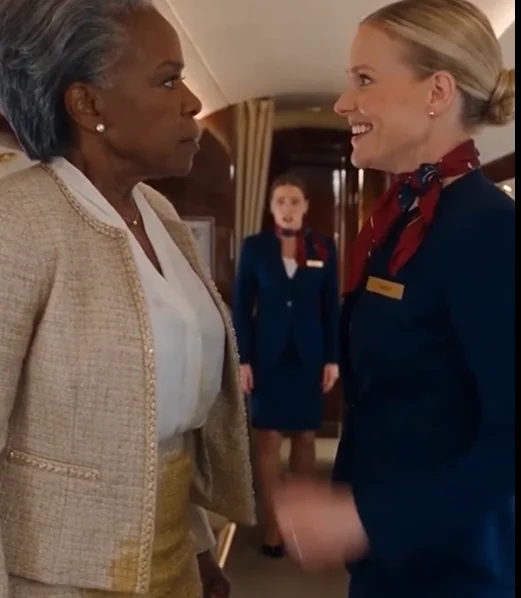
“Please identify yourself and show your credentials.”
She reached into her coat, then stopped when he raised one hand.
“Slowly,” he said.
“Keep your hands where we can see them.”
The woman drew out a badge holder and presented it.
Reynolds examined it without taking his eyes off her for long.
“Elaine Porter,” he said.
“Compliance.”
“You said you were coming,” I replied.
“You didn’t say you had authority to take my report.”
“I’m authorized to verify it,” she said.
“Those are not the same thing.”
Her gaze shifted to the captain.
“The airline has an obligation to secure this material.”
“Then provide the written authority and identify who approved it,” I said.
Porter’s expression tightened.
“We can resolve this much faster if you cooperate.”
“I’ve cooperated by keeping the binder closed and preserving it.
I have not agreed to surrender it.”
Shaw remained behind the captain, silent.
I could see the strain in his face, but he made no attempt to explain Porter’s arrival or speak for her.
Reynolds asked her to step farther into the cabin, away from the open door and the waiting passengers at the gate.
She did so, but only after looking once more at my case.
“Do you have a written instruction?” the captain asked.
“I have the email.”
“That email asks us to keep the report available.
It does not authorize you to take possession of it.”
“It says the report should be secured pending verification.”
“It is secured,” I said.
Porter exhaled through her nose.
“Ms.
Hart, the concern is that the document may not be the final version.
If it is circulated before the meeting, people could act on recommendations that are still under review.”
“Then your concern is about distribution.
I have not distributed it.”
“You brought it onto an aircraft.”
“I brought my own work to the meeting scheduled to review it.”
Her eyes flicked toward the binder.
“The final page includes recommendations that have not been approved.”
“That is why the report is marked as a working copy.”
“Then you understand the risk.”
“I understand the status.
I also understand that ‘working copy’ does not mean someone can make a false statement about withdrawal or demand my badge.”
Porter glanced toward Shaw.
“Mr.
Shaw, you can confirm the document should remain with the review team.”
“I can confirm that I asked operations not to scan or distribute it before the meeting,” he said.
“I did not ask them to seize it, hold Ms.
Hart, or take her credential.”
Porter looked at him as if she had not expected that answer.
“You should have made the custody concern clearer.”
“I sent the message I sent,” Shaw replied.
“It doesn’t say what you’re describing.”
Reynolds asked Porter to provide the original instruction that had triggered the hold, including the complete header and access record.

“The captain deserves the record,” she said.
“He does,” I answered.
“So do I.”
The woman’s lips parted, then closed again.
For several seconds, the only sounds were the muted announcements from the terminal and the crew preparing to resume their checks.
Porter finally took out her phone.
“I’ll request the original message and the account record.”
“Please also preserve them,” I said.
“Do not rewrite or summarize anything before the original is saved.”
“I know how to preserve a message.”
“Then we agree on that.”
She turned away to type.
The captain remained beside my seat, his notebook open.
Shaw watched the doorway, perhaps expecting someone else to appear.
I felt the minutes passing, but I kept my hands resting on the case.
The report had been through delays, a spill, and a chain of messages that seemed to grow less accurate each time it passed from one person to another.
I was not going to let urgency substitute for authority.
Porter’s phone chimed.
She read the screen, and the set of her shoulders changed.
“What did they send?”
Reynolds asked.
“An access log,” she said.
“It identifies the account used for the original instruction.”
“Whose account?”
I asked.
She hesitated, then turned the phone so the captain could see.
Reynolds read the name once.
Then he looked directly at Porter.
“It’s yours,” he said.
“I didn’t send that message,” Porter replied.
But she had not denied that the account belonged to her.
“I didn’t send that message,” Porter replied.
“Then explain why your account did,” I said.
She lowered the phone but kept it in her hand.
“An account name doesn’t prove who was at the terminal.”
“No,” I said.
“It proves the system recorded your account.
We need the rest of the log before anyone decides what it means.”
Captain Reynolds asked her to forward the original file to him and the compliance office, including the header and the access details.



