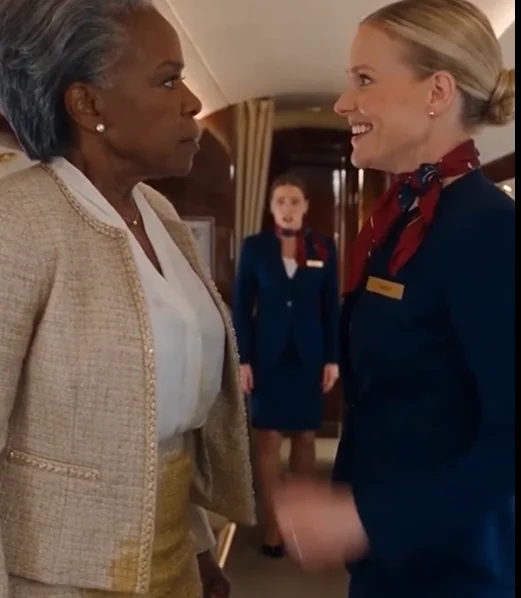
“I understand that a crew member poured a drink on a passenger and then blamed the passenger.”
The simplicity of the sentence eased something in my chest.
Not because it fixed anything, but because it left room for the truth to stand on its own.
Mara returned with the plastic sleeve.
Her hands shook enough that the opening slipped off the corners of the first page.
I guided it into place without comment.
Captain Reynolds asked me to describe the sequence.
I did: my request for water, Victoria’s answer, the cup held above my lap, the deliberate tilt, the apology that blamed me, and the napkins dropped into my lap.
I described the words she had whispered after leaning close.
“You should’ve been more careful.”
“I heard you,” Mara said.
Victoria moved toward us.
“Mara, you don’t need to get involved.”
The captain turned to her.
“I asked you to return to your position.”
“I’m trying to clear up the confusion.”
“There is no confusion about where you should be standing.”
Victoria’s face went still.
She turned away again.
I thought of Paul then, not as a dramatic voice in my head, but as the man who had once stood beside me in our kitchen while I drafted a difficult letter.
He had read the first paragraph, set it down, and asked why I had apologized three times for stating a fact.
“Because they’re powerful,” I had said.
“Powerful people can read a clear sentence,” he had replied.
“Don’t make them work through your fear first.”
He was gone now, and the memory came not as comfort but as a small, steady nudge.
Occupying a seat was not an apology.
Asking for water was not an escalation.
I did not have to make the incident sound smaller to protect someone else from its meaning.
Captain Reynolds finished his notes and asked me to confirm what he had written.
I read every line.
He had described the drink as spilled, then crossed it out and replaced the phrase with poured onto the passenger.
I watched the pen move.
“Thank you,” I said.
“I’ll make sure a copy is available when you disembark.”
“I want a copy before the aircraft leaves.”
He looked toward the galley, where the cabin log and crew paperwork were kept.
“That may take several minutes.”
“Then we’ll take several minutes.”
He nodded.
“All right.”
The captain signaled for another crew member to continue the preflight checks.
He didn’t tell passengers why we were waiting.
He didn’t ask me to excuse the delay.

A few people glanced up from their screens, but the cabin had settled into a strained quiet.
Mara stood near the galley curtain, still holding the cards.
“Tell him what you saw,” I said.
She looked at the captain, not at Victoria.
“I saw Ms.
Vale hold the cup over the passenger’s lap.
I saw her tip it.
The passenger didn’t bump it.”
Victoria’s head turned.
The confession was small, but it changed the air around us.
The captain wrote down Mara’s words, then asked whether she would give a formal statement.
She said yes.
Victoria pressed her lips together.
“You can’t be serious.”
“Please wait in the forward galley,” the captain told her.
She didn’t move.
“I was trying to keep service orderly.”
“You can explain that in your statement.”
“You know how people twist things when they don’t get what they want.”
“I know what I observed,” Mara said.
For one second, the younger attendant’s voice steadied.
Then her eyes dropped again.
Victoria leaned closer to her.
“You’ve worked with me for six years.”
“I know,” Mara said.
The sentence carried the weight of all the years she had not spoken.
Victoria stared at her, and Mara stood very still.
Captain Reynolds sent another crew member to the cabin entrance and asked Victoria to step away from the passenger.
He kept his voice even.
She obeyed, but the look she gave Mara seemed to say their conversation was not over.
I watched her disappear behind the galley curtain, then turned to the captain.
“What happens next?”
I asked.
“I will secure the report, take statements, and contact the appropriate people on the ground.”
“And the flight?”
“We’ll depart when the crew is ready and your seat and belongings are safe.”
“That isn’t what I meant.”
He waited.
“Is she going to keep serving this flight?”
“I’ll make that decision after I review the situation and speak with the crew.”
It was a measured answer.
I couldn’t fault him for it, but I also wouldn’t mistake it for a resolution.
A ground supervisor came aboard to check the delay.
Captain Reynolds spoke with him quietly in the forward galley, then returned with a small printer and a copy of the incident report.



