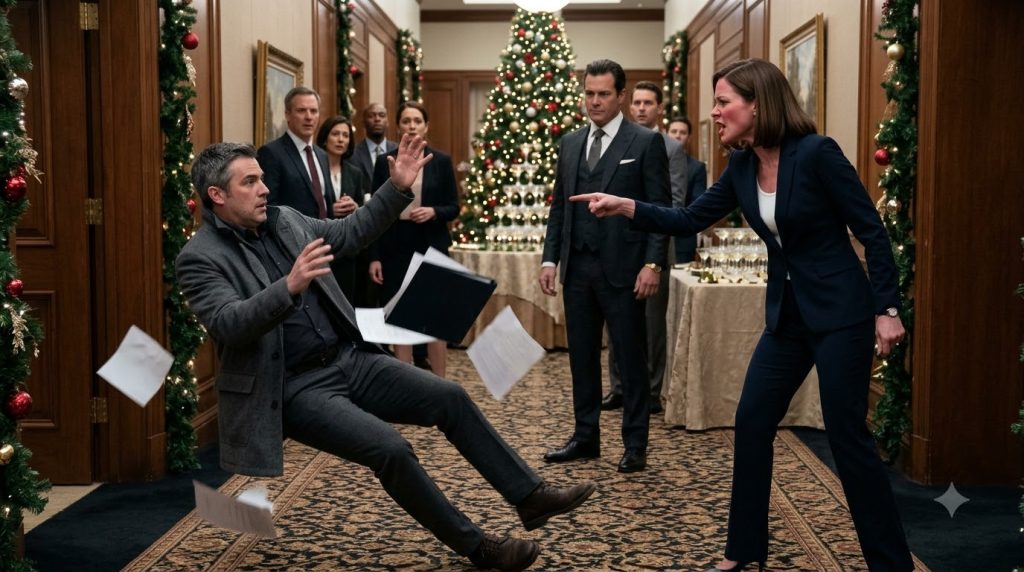
Preston Hawthorne arrived at the operations room at 9:41 and gave the order I had spent two months trying to prevent. He told them to reboot the platform globally because in his experience, a system that has stopped responding needs to be restarted and because a clean restart before midnight would mean the incident had lasted 90 minutes instead of all night. The reboot flushed every cached credential in every building at once. Controllers that had been holding their last known good state came up empty, found nothing to authenticate against, and began falling over in sequence, and the failure stopped being 12 properties and became 31. Celeste watched the map on the wall go from green to amber to a color nobody had designed for and she called me for the seventh time and then the 11th and Preston said loud enough for the room that I was not answering because I was enjoying it.
It was Tobin Akerly who noticed the thing that did not fit. Everything decorative was dying but nothing dangerous was. Stairwell doors across all 31 properties had released to free egress instead of locking down. Heating had dropped to local thermostatic control rather than failing cold, which in Chicago that night was the difference between an inconvenience and a genuine emergency. Emergency lighting held. Fire panels held. Elevator cars instead of freezing between floors were descending to the nearest landing, opening and shutting down politely. Somewhere underneath a collapsing platform, something was catching the pieces that mattered and setting them down gently.
He said the words out loud at 11 minutes 10 in front of the chief executive of the company because he was 26 and had not yet learned to be careful. He said that the man they had walked out of the building 6 hours earlier had told him to let Safe Harbor run. Celeste asked what Safe Harbor was. Nobody in that room could tell her because it appeared in no design document, no procurement record, and no line item in any budget she had ever approved.
It took them 40 minutes and a search of an internal repository to find it. And what they found was 9,000 lines of code annotated in full sentences with a version history going back 17 months. It was a supervisory layer. It sat between the Orion controllers and the physical building systems and did exactly one job. It watched for the authentication cluster to lose quorum. And when that happened, it severed the life safety and climate subsystems from Orion entirely and handed them to local logic before the cascade could reach them.
I had requested funding to build it properly with vendor support and a proper testing program in a memorandum dated the 3rd of August of the previous year. The request had been denied by the office of the chief financial officer with the notation that redundancy for a redundant system was not a defensible use of capital. So I had built a limited version with the hours I already had in the evenings on hardware we already owned, protecting only the things that could hurt somebody. I want to be honest about why it was not heroism. It was that I had a daughter who slept in a house with a furnace and I had walked through enough buildings at 3:00 in the morning to know that when automation fails, it does not fail on the people in the corner suites. It fails on the housekeeper on the ninth floor and the guest with a walker who cannot use the stairs. I could not make the company care about that. I could make it true anyway, quietly on my own time and tell nobody.
Celeste stood in front of that screen for a long moment. The man her chief financial officer had spent the evening describing as a sabotur enjoying his revenge had 17 months earlier on his own time built the only thing standing between her company and a genuinely dangerous night. She made the 18th call. I did not answer.



