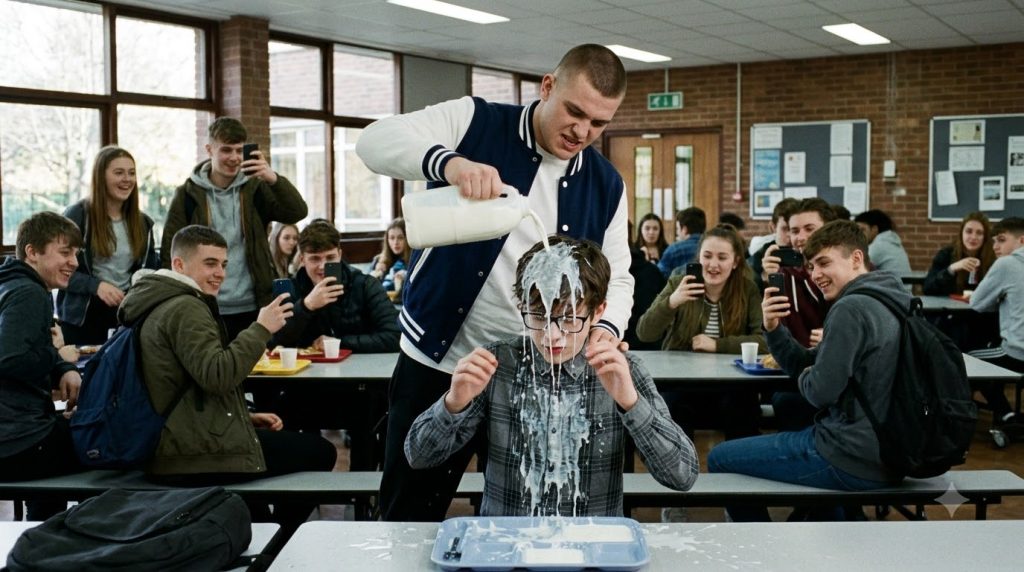
Something about Ethan’s gaze made the nearest football player uncomfortable.
He had seen frightened students before.
He knew the usual signs: eyes darting toward the exits, shoulders curling inward, hands shaking, voices rising into nervous protests.
Ethan showed none of them.
His shirt was soaked.
His hair was wet.
His glasses lay on the table.
But his expression had become almost unreadable.
The football player shifted his weight.
He told himself that the new boy was probably too shocked to speak.
That explanation made sense.
It was easier than considering the alternative.
Advertisement
Hotel advertisement 8
Marcus remained bent over the table.
His broad shoulders blocked some of the afternoon light.
He expected Ethan to lower his gaze.
But Ethan continued looking directly at him.
The silence between them began to feel different.
Earlier, Marcus had controlled it.
He had decided when to speak, when to laugh, and when to make the others laugh.
Now Ethan’s refusal to respond had turned the silence into something Marcus could not easily command.
The bully’s face reddened.
“What’s your problem?”
Ethan’s expression did not change.
Marcus looked toward his teammates, searching for the familiar reassurance of their laughter.
They were still smiling.
But not quite as confidently as before.
The students recording the confrontation had stopped whispering.
Even those who wanted to see Marcus win were waiting for something they could not predict.
And for the first time that afternoon, Marcus realized that he did not know what Ethan would do next.
That uncertainty made him angry.
He hated uncertainty.
He hated being watched while he was uncertain.
Most of all, he hated the possibility that the smaller boy understood something he did not.
Ethan kept his eyes on him.
He did not smile.
He did not threaten.
He simply waited.
Marcus straightened slowly.
“You’re making a mistake.”
The sentence came out lower than his previous shouting.
It sounded less like a warning and more like an attempt to recover control.
Ethan said nothing.
He knew that Marcus wanted him to argue.
He wanted the argument to become an excuse.
And Ethan was not going to provide one.
Not if he could avoid it.
But the choice was growing narrower.
There are moments when a room full of people becomes strangely aware of one person’s breathing.
That was how the cafeteria felt as Marcus stood over Ethan.
The students near the table could hear the soft movement of Ethan’s wet shirt whenever he inhaled.
They could hear the faint sound of milk dripping from the table onto the floor.
They could hear Marcus shifting his shoes against the linoleum.
The ordinary cafeteria sounds seemed distant now.
Ethan understood that remaining seated might not end the situation.
He had hoped Marcus would become bored.
He had hoped the football players would laugh and return to their own table.
He had hoped the humiliation would stop before it became something worse.
But Marcus had already crossed one boundary.
And he was looking for another.
Ethan glanced briefly at his glasses.
The thick black frames rested beside the sandwich.
A small drop of milk clung to one lens.
It was the kind of detail his classmates would remember afterward.
Some would remember that he had placed his glasses down carefully.
Others would remember that he had not raised his voice.
But Ethan was not thinking about how the scene would look in a recording.
He was thinking about what would happen if Marcus continued.
He had come to this school hoping to remain unnoticed.
Whatever his reasons for transferring, he had no desire to become the center of a cafeteria confrontation.
Yet here he was.
Surrounded.
Humiliated.
Watched by people who had already decided how the scene should end.
And the boy responsible was refusing to walk away.
Ethan had spent his time at the school avoiding unnecessary attention.
That decision had required patience.
It had required ignoring small things.
It had required allowing strangers to misunderstand him.
He had accepted those costs because they were manageable.
But there was a difference between allowing someone to underestimate him and allowing that person to decide what he could endure.
Ethan looked up at Marcus again.
The bully’s fists were still resting against the table.
His shoulders were tense.
His teammates were close enough to encourage him, but none seemed interested in stepping between him and the boy he had targeted.
The situation had become dangerously simple.
Marcus wanted control.
Ethan wanted the confrontation to end.
And neither was willing to give the other exactly what he wanted.
A student near the next table whispered, “Just leave him alone.”
The words were quiet.
Marcus did not appear to hear them.
Ethan did.
He could not tell whether they were meant for Marcus or for him.
Perhaps it did not matter.



