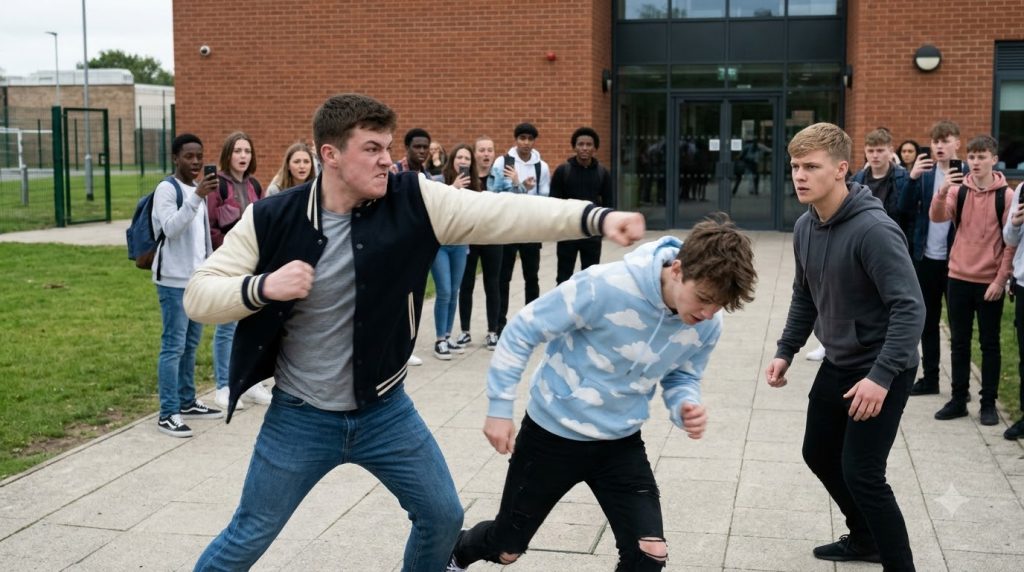
Chapter 1: THE PRICE OF STANDING UP
The five-dollar bill disappeared from my hand before I even reached the school gates.
One moment, I was holding the money I needed to get home.
The next, an enormous hand closed around it and pulled it away.
I turned so quickly that my backpack slipped down my shoulder.
Brandon stood three feet behind me, holding my money above his head with a grin that made my stomach tighten.
Two of his friends stood behind him, already laughing as though they had been waiting for this exact moment.
“What’s this, little guy?
All your life savings?”
I looked at the bill between his fingers.
“Please give it back.”
Brandon lifted it higher.
“Say please a little louder.”
I could hear students talking behind us as they streamed through the front entrance of Northfield High.
Cars were moving through the pickup lane.
Somewhere beyond the school gates, a bus engine was running.
That bus was supposed to take me home.
And the money in Brandon’s hand was supposed to pay for it.
I tried reaching for the bill, but he pulled his arm away before my fingers got close.
“Come on,” I said.
“I need that.”
He looked at his friends.
“You hear that?
He needs it.”
Both boys laughed.
Brandon turned back toward me, still smiling.
“Then I guess you better learn how to ask.”
I had been at Northfield High long enough to know that Brandon enjoyed making people uncomfortable.
He was the biggest senior in our school, broad across the shoulders, with short dark hair and a face that seemed permanently arranged into a look of amusement whenever somebody smaller than him was upset.
He walked through hallways as though everybody else should move aside.
Usually, they did.
I had moved aside for him plenty of times.
But that afternoon, I couldn’t.
That five-dollar bill was the only money I had for the ride home.
And Brandon knew it mattered.
That was what made the smile on his face so difficult to look at.
“Please, Brandon,” I said again.
He tilted his head.
“Better.”
For one hopeful second, I thought he might hand it back.
Instead, he tucked his free hand into his jacket pocket and studied me like someone examining an object he had found on the ground.
“Now get down on your knees and beg.”
The laughter behind him grew louder.
I stared at him.
“What?”
“You heard me.”
He pointed toward the concrete.
“Right there.”
I glanced around.
A few students had already stopped walking.
One boy near the entrance was watching with his phone in his hand.
Two girls beside the sidewalk had gone quiet.
Nobody stepped forward.
I looked back at Brandon.
“I’m not doing that.”
His smile faded.
And I realized, a moment too late, that I had given him an answer he wasn’t used to hearing.
I had spent most of that Friday trying not to think about money.
That was not unusual.
There were mornings when I could get through the first few classes without remembering how carefully every dollar had to be used at home.
Advertisement
Hotel advertisement 1
Then something small would remind me.
A classmate would talk about buying new shoes.
Someone would complain about having to take the bus because their parents couldn’t pick them up.
A student at lunch would throw away food they had barely touched.
Nobody was necessarily trying to be cruel.
They simply lived in a world where five dollars didn’t decide whether they could get home.
For me, it did.
The distance between Northfield High and our neighborhood was almost six miles.
It wasn’t impossible to walk, and I had done long walks before, but six miles after a full school day was a different matter.
Friday was especially difficult because I stayed late to help the school custodian clean the auditorium.
I didn’t mind the work.
Actually, I liked it.
The auditorium was one of the few places in school where I could do something useful without worrying about somebody making a joke about me.
There were rows of seats to straighten, scraps of paper to collect, and floors that needed sweeping after students had used the room.
The work had a beginning and an end.
If the floor was dirty, I swept it.
If a chair was out of place, I straightened it.
Nobody could turn a clean floor into a reason I should feel ashamed.
The custodian never treated me like I was doing something embarrassing by helping him.
He was an older man with tired eyes, rough hands, and a patient way of speaking.
He had worked at the school for years, and he knew which auditorium seats stuck, which doors needed an extra push, and which corners gathered dust no matter how often they were cleaned.