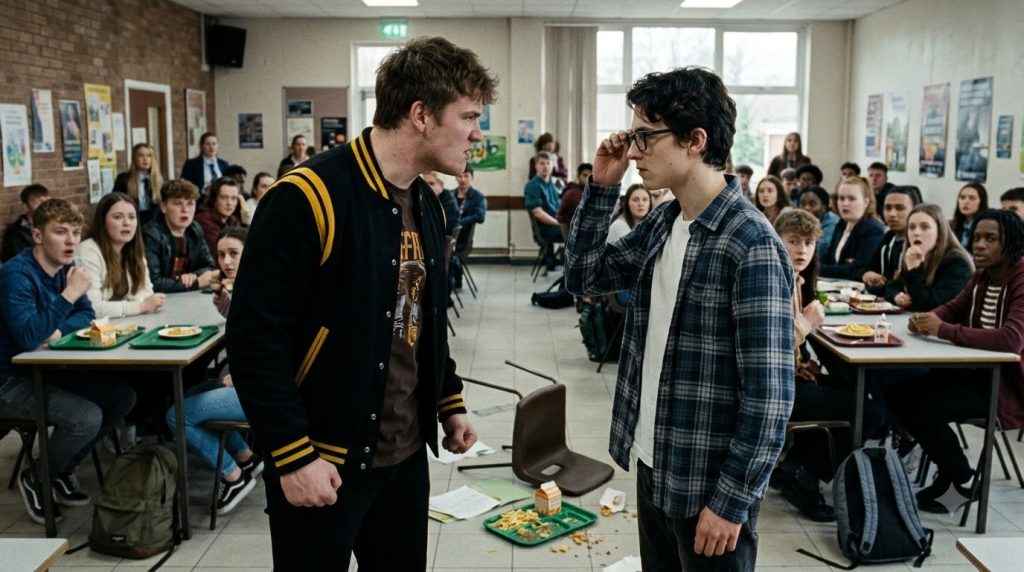
Chapter 1: THE TABLE NOBODY DARED TO CHALLENGE
Marcus slammed his fist onto the cafeteria table so hard that a carton of milk jumped beside a student’s lunch tray.
“Leave this table right now.”
The words cut through the noise of the crowded Austin high school cafeteria.
A few students immediately turned their heads.
Others stopped talking without looking up, already recognizing the voice.
Standing over the table was a tall, broad-shouldered eighteen-year-old boy whose face had turned red with anger.
Marcus was accustomed to getting what he wanted.
He was even more accustomed to people moving out of his way before he had to ask twice.
Across from him stood Toby, the new transfer student.
Toby was sixteen, slim, and quiet, with dark brown hair that never seemed to stay perfectly in place and black-rimmed glasses resting on his narrow nose.
His blue-gray plaid shirt looked ordinary beside the expensive jackets and fashionable clothes worn by many of the other students.
He held a cafeteria tray in both hands.
He had wanted nothing more complicated than a place to eat lunch.
But Marcus had decided that the empty chair in front of him was worth turning into a public confrontation.
At the edge of the bench, Noah looked between the two boys with growing fear.
He knew Marcus well enough to understand what happened when someone challenged him.
He also knew Toby had no idea how quickly a disagreement with the school’s most intimidating student could become something much worse.
“Just move away, Toby, please,” Noah whispered.
Toby glanced toward him.
Then he calmly placed his tray on the table.
The quiet sound of plastic touching the tabletop seemed to offend Marcus more than an argument would have.
For a moment, nobody moved.
The cafeteria remained filled with hundreds of students, but around that particular table, an invisible circle of silence had begun to form.
And Toby, who had been at the school only a short time, was about to learn why almost everyone avoided sitting where Marcus believed he belonged.
The strange thing was that Toby had not come looking for trouble.
He had spent his first days at the school doing almost everything a new student was supposed to do.
He found his classrooms, followed the printed schedule he kept folded in his pocket, answered teachers politely, and tried not to draw unnecessary attention.
He was not naturally talkative, especially among strangers.
When someone asked him a question, he answered.
When a teacher requested volunteers, he paid attention.
When other students laughed at something across the room, he usually returned to whatever he was doing.
There was nothing particularly remarkable about his behavior.
Yet in a school where reputation mattered almost as much as grades, being unfamiliar was enough to make a person interesting.
Some students wondered where he had come from.
Others noticed his glasses or the fact that he often sat quietly instead of joining a group.
A few tried to guess whether he was shy, unfriendly, or simply uncomfortable.
Toby rarely corrected anyone’s assumptions.
Advertisement
Hotel advertisement 1
He had learned that people often decided what kind of person someone was long before they knew anything about him.
Sometimes correcting those assumptions accomplished very little.
He preferred to let his behavior speak for itself.
That approach had worked reasonably well in classrooms and hallways.
The cafeteria, however, operated by different rules.
There were no assigned seats, but everyone seemed to know where certain people belonged.
Groups occupied the same tables day after day.
Students chose places according to friendship, habit, popularity, and sometimes fear.
An empty chair did not always mean an available chair.
Toby had begun to understand that during his first few lunch periods.
He had also noticed how quickly conversations changed whenever Marcus entered the room.
Marcus did not need to announce himself.
His size, loud voice, and confident movements made him easy to recognize.
Students knew his friends, his temper, and the way he could turn an innocent remark into a public embarrassment.
He enjoyed an audience.
That was what Toby had noticed most clearly.
When Marcus made a joke at someone else’s expense, he looked around to see who laughed.
When he challenged someone, he watched the surrounding students as carefully as the person standing in front of him.
The laughter mattered.
The attention mattered.
Even when Marcus appeared angry, there was something deliberate about how he positioned himself where other people could see.
Toby had observed this without making any comment.
He did not know the boy personally.
He had no reason to assume he understood everything about him.
But he recognized a pattern.
Marcus seemed to feel most powerful when somebody else looked uncomfortable.
Noah understood that pattern even better.



