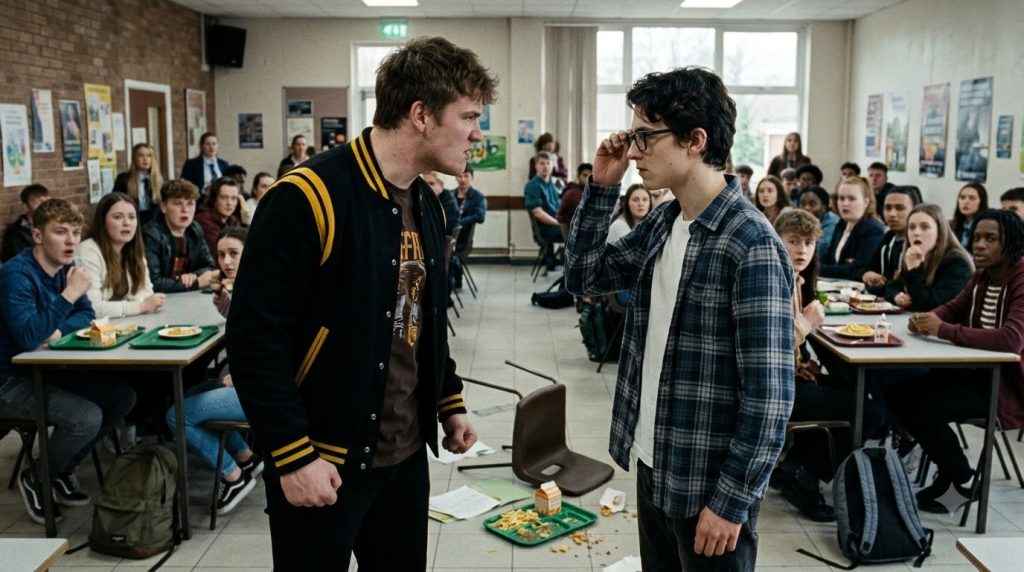
Noah watched his hands.
Marcus’s right hand opened and closed.
Toby lowered his eyes toward his apple.
The next few seconds would become impossible for any of them to forget.
But before the moment broke, Noah found himself remembering something about Toby that he had barely noticed earlier.
During their first conversations at school, Toby had never spoken as though he wanted to impress anyone.
He had not boasted about his old school.
He had not claimed to be better or tougher than the students around him.
When Noah had warned him that some groups were difficult to approach, Toby had listened without making fun of the advice.
There had been a steadiness in him that Noah had mistaken for indifference.
Now that steadiness looked different.
Toby was frightened less by Marcus’s anger than Noah expected, but that did not mean he was careless.
He seemed determined to remain responsible for his own actions.
He was not going to throw the first insult simply because someone insulted him.
He was not going to raise his voice simply because someone shouted.
And he was not going to become cruel simply because someone else behaved cruelly.
Noah wondered whether that decision required more courage than fighting back immediately.
He had never thought about it before.
At school, strength usually meant size, popularity, or the ability to make people uncomfortable.
Marcus possessed all three.
Toby possessed none of them, at least not in any obvious way.
Yet he was still sitting in that chair.
Perhaps courage was not always loud.
Perhaps it sometimes looked like a frightened person deciding not to surrender to someone else’s unreasonable demand.
That possibility made Noah feel something he had not expected.
Shame.
Not because he had advised Toby to leave.
He still believed leaving would have been safer.
But because he had accepted Marcus’s behavior as an unavoidable part of school life for so long that he had nearly stopped questioning it.
He had adjusted his habits around it.
He had learned where to sit, when to laugh, when to stay quiet, and when to pretend he had not seen something.
Those habits had kept him comfortable.
But they had also allowed Marcus to believe everyone agreed with him.
Toby had disrupted that arrangement simply by asking for a chair.
Noah glanced at the students around them.
Several appeared to be wrestling with the same uncomfortable realization.
They did not necessarily approve of Marcus.
They were simply accustomed to letting him behave as he pleased.
And now they were watching the consequences of that habit.
Marcus, however, had reached a very different conclusion.
He believed the audience was waiting for him to prove that he still controlled the situation.
The more students watched, the less willing he became to stop.
His eyes narrowed toward Toby’s glasses.
The smaller boy appeared ordinary and unthreatening.
Marcus told himself there was no reason to be cautious.
Toby’s calmness had to be an act.
Surely, if pushed hard enough, he would panic.
Surely the confident expression would disappear.
Surely the other students would laugh once the new boy understood his place.
Marcus leaned forward until he was standing directly beside Toby’s chair.
Toby remained seated.
He took another bite of the apple.
The sound seemed unusually loud to Noah.
Marcus’s face twisted.
“Are you deaf and blind?”
The question came out as a sneer.
Toby stopped chewing.
He had heard every word.
He understood what Marcus wanted.
But he also understood that answering the question would only begin another round of the same argument.
He decided not to respond.
He looked straight ahead, holding the apple loosely in one hand.
Noah saw Marcus’s expression change.
The older boy’s lips pressed together.
His shoulders tightened.
He glanced once at the surrounding students, as though confirming that everyone was watching.
Then he moved.
It happened so quickly that Noah had no time to speak.
Marcus’s hand came forward toward the back of Toby’s head.
And in that instant, Noah realized that the argument had crossed a line that could no longer be erased by simply changing tables.
The sharp impact against Toby’s head was loud enough to be heard by students at the neighboring tables.
His glasses slipped from his face.
For a fraction of a second, they caught against his cheek.
Then they fell.
The black frames struck the linoleum floor with a hard, thin clatter and skidded away from the chair.
Toby’s head jerked forward.
His hand tightened around the apple.
Noah rose halfway from the bench.
“Marcus!”
The name escaped him before he could stop it.
Nobody laughed.
That was the first thing Noah noticed.
Marcus had apparently expected amusement.
Perhaps he imagined the sight of the quiet transfer student’s glasses falling would produce the familiar sound of people laughing at someone else’s embarrassment.