Eventually the internet found other things to argue about.
Zara remained a girl with homework, a best friend, an unreasonable chemistry teacher, and a mother she still missed most fiercely at odd moments.
Buying strawberries.
Hearing a laugh in another aisle.
Finding a red button in the bottom of a drawer.
The airline had changed too, although Adrian was careful not to describe one complaint as a transformation.
Sarah and Diane had received formal corrective action and further training. Their records would reflect the incident. They also helped review how crews handled disputes involving younger passengers and people traveling alone.
The important instructions were plain: verify the assignments, act on the verified information, and do not make the easier passenger absorb the problem created by the more demanding one.
Adrian told Zara there would be follow-up checks.
She asked whether anyone who was not his daughter would notice a difference.
“That’s the only way we’ll know it worked,” he said.
Now, as they approached the gate, Zara saw an older man holding two boarding passes and looking uncertainly between the overhead signs.
He wore a faded brown coat. His suitcase had one wheel wrapped with tape.
A gate employee stepped from behind the desk.
“Can I help you find your flight?”
The man explained that he and his wife had different seats and she could not manage the walk to the lavatory without him.
The employee checked the passes, asked the wife what assistance she preferred, and began looking for a solution.
No one asked what the man did for a living.
Zara stood watching for a moment.
Then she followed her father down the jet bridge.
At the aircraft door, Sarah Mitchell looked up.
Recognition crossed her face, followed by something calmer than the fear Zara remembered from arrivals.
“Good afternoon, Zara. Mr. Coleman.”
“Hi,” Zara said.
Sarah checked their boarding passes.
“Two Alpha and two Delta. Just ahead.”
Zara looked at her father.
He lifted his eyebrows innocently.
“You chose two A?”
“You said you liked the window.”
“I do.”
She walked to the second row.
The seat was empty.
For an instant she remembered the newspaper, the briefcase, the gold watch. Her body tightened before her mind caught up.
Then she placed her backpack beneath the footrest and sat down.
Across the aisle, her father arranged his coat.
Sarah brought water and asked if they needed anything before departure.
“I’m okay,” Zara said.
This time she meant it without having to convince herself.
A few minutes later, a woman farther back in the cabin discovered someone sitting in her assigned seat. The man holding her place looked at his phone and frowned.
“I’m sure the app said this one.”
Sarah approached.
She checked both passes.
“Yours is three Delta, sir. This passenger is assigned three Alpha. Let me help you move your bag.”
The man glanced between the seats, realized his mistake, and stood.
“Sorry about that.”
“Thank you,” the woman said.
The whole exchange took less than a minute.
No father was called.
No voice changed after hearing a surname.
Zara watched Sarah put the bag in the correct space and step aside so the woman could sit.
Her father caught her eye.
He did not say anything.
He did not need to.
As the aircraft began to push back, Zara took the yellow envelope from her backpack. The paper was thinner now, its folds reinforced carefully with archival tape at her aunt’s suggestion.
She had finally read the last paragraph without stopping halfway through.
There will be people who make room for you, her mother had written. Be grateful for them. There will be people who expect you to disappear so they can be comfortable. You can be kind without agreeing to disappear.
And when you find yourself with the power to make room for someone else, please do.
Zara folded the letter.
Outside, the wing moved past a line of baggage carts. The runway waited beyond the buildings, pale in the afternoon light.
Her father leaned across the aisle.
“Ready?”
She looked at the number above the window.
2A.
On the first flight, she had thought the hardest part would be crossing an ocean alone.
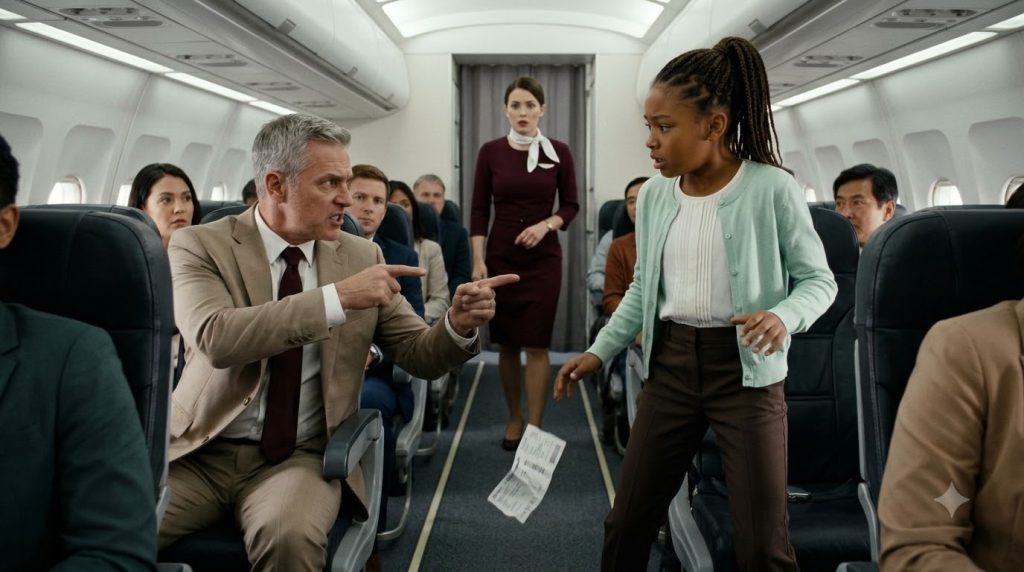
Then a stranger had tried to make her believe a seat she had paid for belonged to somebody who looked more certain of himself.
She had been scared.
Her voice had shaken.
The ticket had still said her name.
Now she reached for her belt, fastened it, and settled beside the window.
“Ready,” she said.
The aircraft turned toward the runway.
Zara kept her mother’s letter close, and let herself look forward.
THE END



