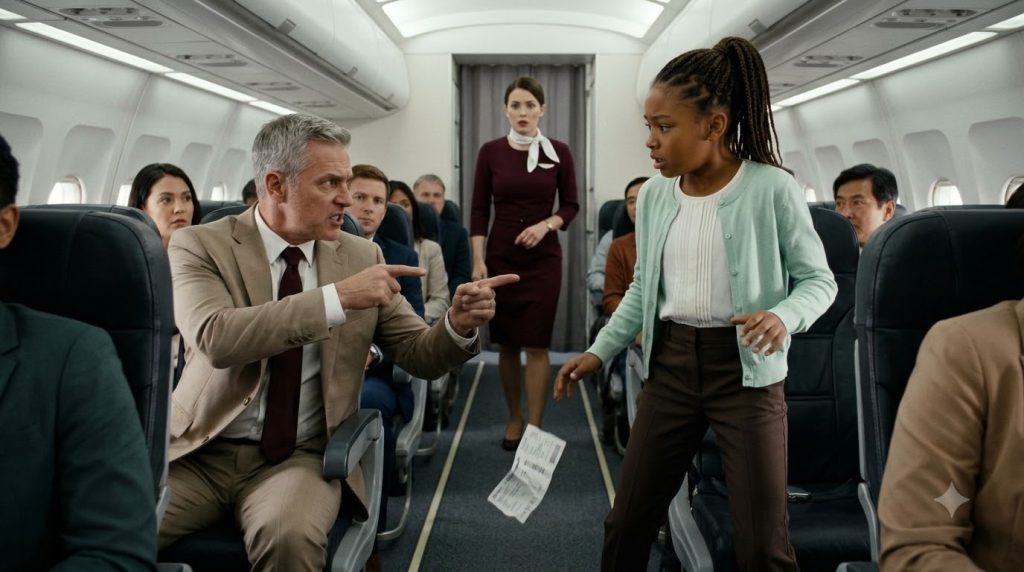
He had built an entire life around making sure she never felt that helpless again.
And this morning she had been alone on one of his company’s aircraft, waiting for adults to admit her ticket meant what it said.
“Adrian.”
Lena’s voice brought him back.
“Don’t turn one failure into every failure.”
He looked at her.
She had worked with him long enough to risk saying what other people softened.
“I’m not talking about the crew,” she said. “I’m talking about you.”
He sat down.
“I thought if I kept the review away from her until we understood it, she’d get to have tomorrow.”
“And now?”
“Now she thinks I keep her mother behind a closed door.”
Lena folded her hands on the table.
“Do you?”
The question was quiet enough to escape sounding cruel.
Adrian looked toward the rain.
At home there was still a drawer of Evelyn’s things he had never opened with Zara. A scarf. Two hospital badges. A small notebook. He told himself he was waiting until she was ready.
He had never asked whether she was.
“Sometimes,” he admitted.
Lena nodded once.
“Then that’s something you can change without waiting for a report.”
His phone lit with a new message.
Zara had sent a photograph of three handwritten headings.
What I saw.
What I was told.
What I don’t know.
Beneath it she had written:
Please put what you know in the right column when I get there.
Adrian covered his mouth with one hand.
For a moment, he could almost hear Evelyn laughing at the resemblance.
Not the face.
The demand.
Be clear. Don’t make me guess around your kindness.
He typed:
I will. And if I don’t know, I’ll say that.
Then he called the review team’s solicitor, Miriam Shaw.
He described the folder, the flight, and Zara’s concern without adding a theory.
Miriam listened.
“We’ll preserve the proper route,” she said. “He is represented. We can ask his solicitor to confirm the materials he’ll bring. Your daughter shouldn’t be involved in obtaining anything.”
“Agreed.”
“And Adrian?”
“Yes?”
“A man behaving badly on an aircraft does not establish what he did three years ago.”
He shut his eyes.
“I know.”
“Good. Stay with what we can prove.”
After the call, Lena pushed the sandwich tray toward him.
“Eat something.”
He almost smiled.
“Apparently that’s today’s answer to everything.”
“It’s an excellent beginning.”
He took a sandwich, set it down, and opened a new document.
Not a press statement.
Not an instruction to airline management.
A list for his daughter.
Three headings.
He began with the hardest one.
What I don’t know.
CHAPTER SEVEN: SOMETHING WORTH KEEPING
Halfway across the Atlantic, the cabin lights softened.
Window shades lowered one by one. Screens flickered against sleeping faces. The noise of lunch gave way to the small private sounds of people trying to rest: a blanket pulled loose, a throat cleared, a seat motor humming beneath someone’s weight.
Zara could not sleep.
She reread her mother’s letter, then put it away because reading it again had begun to feel like pressing a bruise.
Nora noticed without commenting.
Instead she held up her paperback.
“Would you like a distraction?”
“What kind?”
“I can tell you why this detective is an idiot.”
Zara blinked, then laughed.
“Isn’t he the main character?”
“That’s no protection.”
For twenty minutes Nora described a fictional murder investigation in which everyone except the detective seemed to understand what was happening. Zara argued that the gardener was too obvious. Nora said the gardener had an alibi and, more importantly, a very convincing dog.
The conversation did not fix anything.
It did something smaller and useful.
It reminded Zara that the world still contained things she could think about without hurting.
When Sarah passed with a pot of tea, she found them disagreeing about whether fictional dogs could be trusted.
“Only the ones with names,” Nora said solemnly.
Sarah’s smile arrived before she could stop it.
Zara saw the change in her face. Not the bright practiced expression from boarding, but an ordinary woman’s tired smile.
“Do you have kids?” Zara asked.
“A son. He’s nine.”
“Does he fly alone?”
“Not yet.”
Sarah poured the tea.
“I’ve been thinking about what I would want someone to do if he did.”
Zara accepted her cup.
“Probably believe his ticket.”
“Yes,” Sarah said. “That would be a good start.”
They let the answer stand.
A few rows behind the curtain, Richard requested a sheet of paper.
His first attempt at an apology began with an explanation about a difficult morning.
He crossed it out.
The second mentioned a misunderstanding over an upgrade.
He stared at the sentence for a long time before crossing that out too.
The man beside him woke, adjusted his headphones, and fell asleep again.



