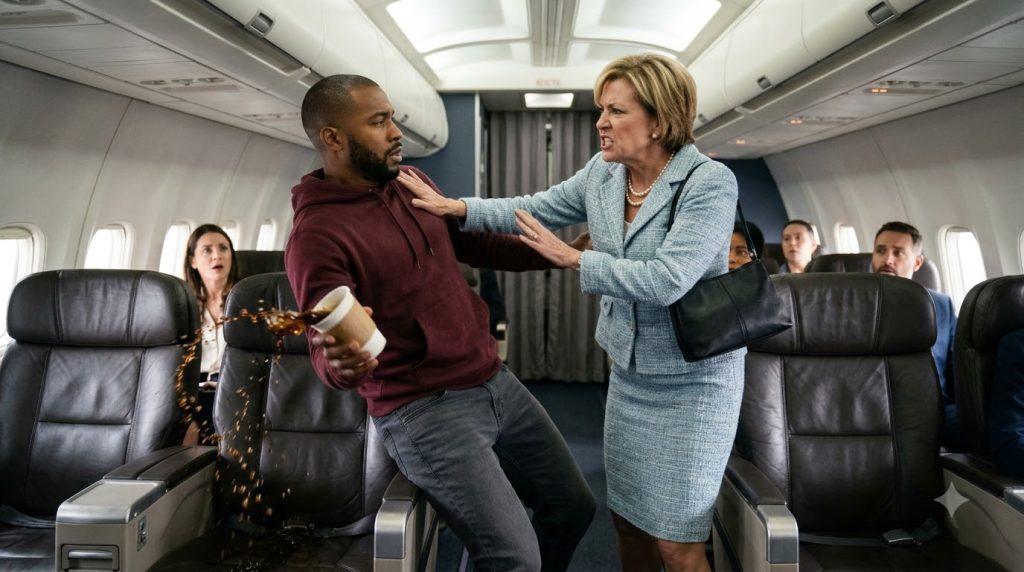
He asked to speak with Sarah. Zara passed over the phone, and Sarah listened without interrupting. Her answers were short and professional. Yes, Mr. Coleman. Of course. We’ll keep you informed through operations if needed.
When she handed the phone back, she looked Zara directly in the face.
“You will not have to speak to him again.”
Zara nodded.
Her father said, “I’ll be waiting when you land.”
“Promise?”
“At arrivals. Terrible coffee. Embarrassing sign. The whole thing.”
A small smile escaped her.
“Don’t write Baby Zara.”
“Then you’ve ruined my plan.”
“Dad.”
“Just your name,” he said softly. “I’ve got you.”
They ended the call.
Sarah brought the water and placed it on the side table. She did not leave immediately.
“I owe you an apology.”
Zara looked up.
“You didn’t take my seat.”
“No. But I knew your ticket was correct before I asked you to wait.”
Zara ran a finger along the stitched edge of her backpack.
“Why didn’t you tell him to move?”
Sarah looked toward the empty aisle.
“I was worried he’d make a complaint. He has before.”
The answer surprised Zara because it was honest.
“So you thought I wouldn’t?”
Sarah’s mouth opened, then closed.
“I think I assumed you’d be easier to ask.”
Zara considered that.
“I was.”
“That doesn’t make it right.”
For several seconds the only sound between them was the ventilation.
Then Zara asked, “Would you have moved him if you didn’t know my dad?”
Sarah did not look away.
“I should have. And I can’t ask you to believe I would have, because I didn’t do it when I had the chance.”
It was the first answer that morning that did not make Zara feel smaller.
“Okay,” she said.
Not forgiveness. Not yet.
Just a place to begin.
Across the aisle, the woman with the paperback leaned forward.
“I’m Nora,” she said. “For the record, you handled that better than most adults.”
Zara gave a shy shrug.
“I was scared.”
“Those things can both be true.”
Nora wore a green wool jacket and glasses on a cord. A thin gold band circled her left hand. Her paperback was full of bent corners and handwritten notes.
“Are you going to London on vacation?” she asked.
“To see my dad. And a center they’re opening for my mom.”
“That sounds special.”
Zara touched the backpack pocket again.
“It is.”
Nora did not ask the question adults always asked next. Where her mother was. Whether she was meeting them. Why a center carried her name.
Zara liked her for that.
The boarding door closed. A soft chime sounded overhead. Sarah began the safety demonstration while Diane walked the aisle checking belts.
When the aircraft pushed back, Zara let her shoulders settle for the first time.
She took the yellow envelope from her bag and slid one finger beneath its flap.
On the outside, in her mother’s handwriting, were six words.
For when you need your voice.
Zara had brought the letter for tomorrow.
She began to think she might need it today.
CHAPTER FOUR: ABOVE THE CLOUDS
The letter was not a farewell.
That mattered to Zara.
People sometimes spoke about her mother’s words as if every sentence Evelyn had ever written had been leading toward the day she died. But the letter had been written after a school argument about a science project. There had been burnt toast that morning. A broken washing machine. An ordinary Tuesday.
Evelyn had expected thousands more ordinary Tuesdays.
Zara unfolded the pages while the aircraft climbed through a layer of white cloud.
My brave girl,
You came home today and said you wished you were louder.
I don’t think loud is what you need.
The loudest person in a room can still be wrong. Sometimes a room gets so busy listening to volume that it forgets to listen for truth.
You don’t have to shout to tell the truth. You can say, “That happened.” You can say, “I was there.” You can say, “Please let me finish.”
And if your voice shakes, let it shake. It is still your voice.
Zara stopped reading.
The engines deepened beneath her feet. The seat tilted gently as the plane banked, and New York vanished behind cloud.
She could remember exactly where her mother had been sitting when she gave her the envelope. On the kitchen floor, of all places, sorting buttons from a sewing tin because Zara had knocked it over.
Evelyn had looked up with a red button between her fingers.
“One more thing,” she had said. “Being brave doesn’t mean standing there forever. If somebody makes you unsafe, leave. You can tell the truth from somewhere safe.”
Zara pressed the paper flat against her knees.



