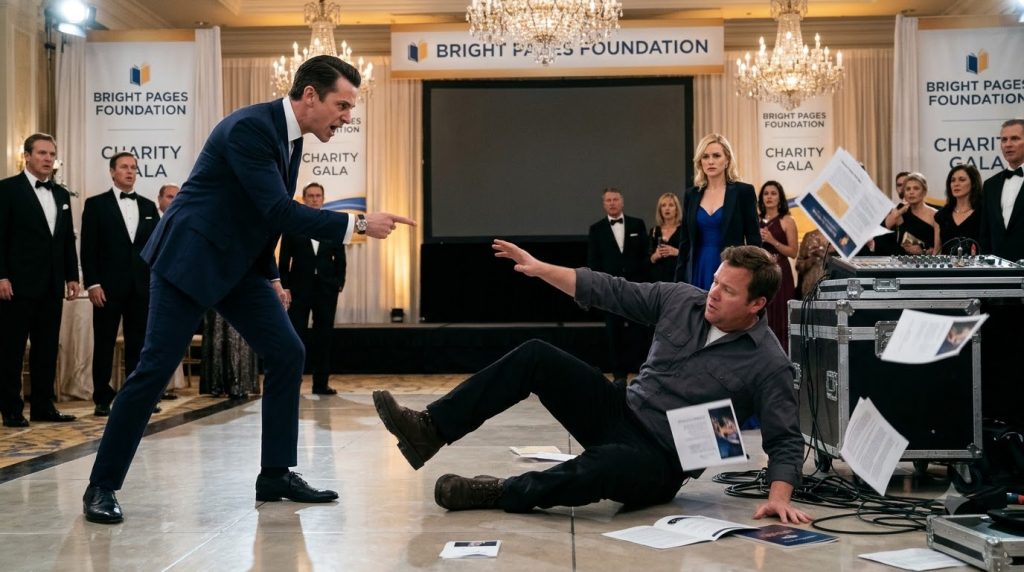
Meanwhile, Denise Parker worked through the hotel recordings preserved after Friday’s disruption. The first camera covered the corridor outside the technical control room. It showed Blake entering before Miles received the final presentation materials. Another camera overlooked the donation display area. Blake appeared carrying a slim folder. He removed a set of cards and placed others on the table. The camera was too far away to read the printed codes. Denise documented the recording times, secured the original files, and prepared the footage for review. When Rachel examined the timeline alongside Miles’s photographs and the presentation handoff log, a consistent sequence emerged. Blake had handled the replacement materials. Miles had questioned them afterward. And the blackout had occurred only after his requests for verification went unanswered.
Saturday afternoon, Claire received Rachel’s preliminary findings. She read the summary twice. For the first time, she considered that Miles might have interrupted the gala for exactly the reason he had given her. Then Rachel called with another discovery. A donor had forwarded a completed payment receipt. The receipt identified Westridge Event Services, not Bright Pages Foundation. That alone did not establish where the money ultimately settled, but it confirmed that the unauthorized payment destination had been used in a real transaction.
Claire stared at the document, remembering Blake’s assurance that everything had been approved. The question had changed. She no longer needed to know merely why Miles stopped the presentation. She needed to know who had introduced the replacement payment destination.
On Monday morning, Claire entered a conference room where Rachel, Denise, an event company representative, and legal counsel were waiting. Blake occupied his usual chair near Claire, looking irritated rather than concerned. “We have already established that the technician stopped the presentation,” Blake said. “What exactly are we investigating?”
Rachel placed two donation cards on the table. “Where the money was supposed to go.”
Denise started the preserved footage. The first recording showed Blake entering the technical control room at 5:42 on Friday afternoon, carrying a slim folder. He remained inside for several minutes. The camera did not show the computer screen or establish what he had done inside. Then Denise played footage from the donation display area. Blake removed a stack of blue cards, placed them inside his folder, and arranged replacements across the table.
Claire leaned forward. “You told me the foundation approved those materials.”
“They were updated marketing pieces,” Blake replied.
Rachel placed Miles’s photographs beside an original approved card. “The replacements directed guests to Westridge Event Services. Our foundation never authorized that payment destination.”
Blake folded his hands. “Westridge is a processing partner.”
“Then provide the agreement,” Rachel said.
Silence followed. Denise continued. The next recording showed Miles approaching Blake with his phone. They exchanged words, and Blake turned away. A later camera captured Miles returning to the control station. Equipment logs confirmed the blackout at 8:10. Denise paused the footage. “The recordings establish the sequence of events,” she said. “They do not establish anyone’s intentions.”
“But the other records explain why Miles was concerned,” Rachel answered. She presented his message to the coordinator, the two payment links, the handoff log bearing Blake’s signature, and the donor’s Westridge receipt. She also confirmed that Miles had approached her before the interruption and that she had not approved the replacement recipient.
Claire looked toward Blake. “You told me he was upset about his contract.”
“He was creating problems.”
“He was asking where the donations were going.”
Blake looked down at the table. Legal counsel explained that preliminary business records indicated a commercial connection between Blake and Westridge through a vendor company listed in earlier marketing documents. The connection required further verification. It was not yet a finding of theft, but it presented a serious conflict Blake had never disclosed.
Claire sat back. Blake had insisted on a payment link the foundation had not approved. Miles had identified the discrepancy and asked for confirmation. When he interrupted the appeal, Blake had portrayed him as a disgruntled contractor rather than acknowledging the payment concern. Blake had wanted the appeal to continue. Miles had stopped it. And Claire had helped turn that decision into a public accusation.
“Did you know the foundation had not approved Westridge?” Claire asked.
Blake remained silent.
“Did you have written authorization to change the payment destination?”
“I believed the arrangement was acceptable,” Blake replied.
“That is not what I asked.”
He did not answer.
Claire turned to legal counsel. “Preserve everything. Coordinate with the foundation and the appropriate authorities. Blake’s access must be suspended pending an investigation.”