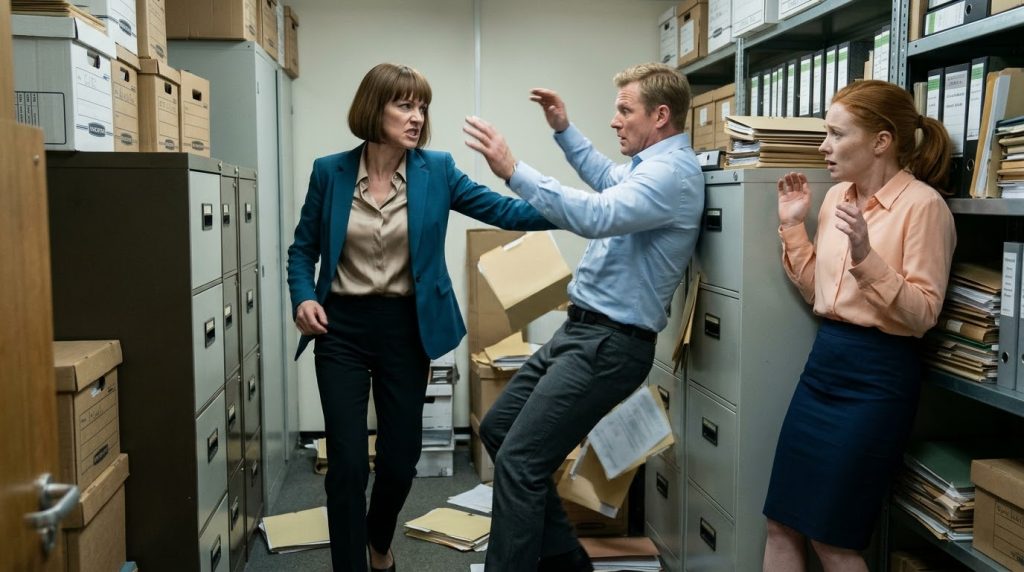
“I want a camera in my office,” I said. “And I want you next door when it runs.”
She thought about it for a long moment and then said she would be there, and she wrote the date on her calendar in front of me so I would know she meant it.
The camera went in above my bookshelf on Wednesday morning, pointed at my desk and the door, and it recorded sound. Simone checked the feed twice that day and told me it was working.
Wednesday passed with nothing. I went home at eight, ate half a sandwich standing at my kitchen counter, and slept badly.
At 11:42 that night, someone opened bay nine with a records-room terminal and logged the sealed summary out. The system noted the credentials, and the credentials were not mine. The log also noted that the summary was scanned to a device, and that the device had a serial number, and that the serial number matched a card Brielletta had signed for in March.
At 12:06 a.m. the east stairwell door opened on the ground floor and closed again, and the security desk logged a woman leaving with a tote bag, and the guard on duty did not look inside it.
What left the building that night was a copy of nothing, tucked inside an envelope I had already opened, photographed, and sealed back up with tape from my own drawer. The real document was in Simone’s desk at home under a lasagna pan, and it stayed there.
I got the call at seven the next morning, before my coffee had finished brewing.
“Ms. Kessler-Ashworth,” the investigator said. “Bring me everything you have.”
I asked her how much everything meant.
“All of it,” she said. “And bring counsel.”
I stood in my kitchen with the phone against my ear and listened to her breathe, and I understood that the part of my life where I waited for other people to fix things had ended sometime around midnight and nobody had told me.
Then I called the attorney who used to be on the other side of me, and I said, “It’s Thursday, and I need you at nine.”
Chapter 8 – The Question I Asked Twice Posted Oct 20, 2026
The conference room on the fourth floor had one window, and it looked out at the parking garage. I sat at the far end of the table with both hands flat on a folder I had built over nine days. Renata Cho sat on my left.
The firm’s general counsel sat across from me with his jacket still buttoned, as though he expected to leave early. The investigator from the disciplinary office set a small recorder in the middle of the table and pressed the button.
“For the record,” she said, “this meeting was requested by Ms. Kessler-Ashworth.”
“It was,” I said.
Douglas Halbrook came in last and took the chair closest to the door. He looked at the folder, then at me, and gave me the same patient smile he had been giving me for eleven years.
“Neravine,” he said. “Before we start, I want you to know I’ve spoken to the partners about your future here.”
“Sit down, Douglas,” I said.
I opened the folder and went through it in order. First the access logs, thirty-two openings of the Kessler file room under my credentials, twelve of them logged on nights I was asleep in my own house. Then the memory card in its plastic sleeve, and the printout of forty-one scanned exhibits sitting beside it. Then the ledger, fourteen months of payments with case names in one column and dollar amounts in another. Then a copy of a reference letter dated the eleventh of March, written for a records job that was not posted until June.
Halbrook listened with his hands folded and said he had never seen any of it.
The investigator asked whether he knew the name Corbin Slate.
Halbrook said no.
She asked whether he recognized his own trust account number on the fourth page.
Halbrook said he had people who handled his accounts.
He went on like that for eleven minutes, and I let him. I watched the clock on the wall behind his head and said nothing at all.
Then I leaned forward and asked him the same question I had asked in the evidence room.
“Who were you selling this to?”
Halbrook’s jaw moved twice before any sound came out, and then he turned to the general counsel and said, “Brielletta brought those files to me. I assumed they were copies she was permitted to make.”
Renata wrote something down and did not look up.
“Brielletta Devane is twenty-nine years old,” I said. “She does not have a trust account.”



