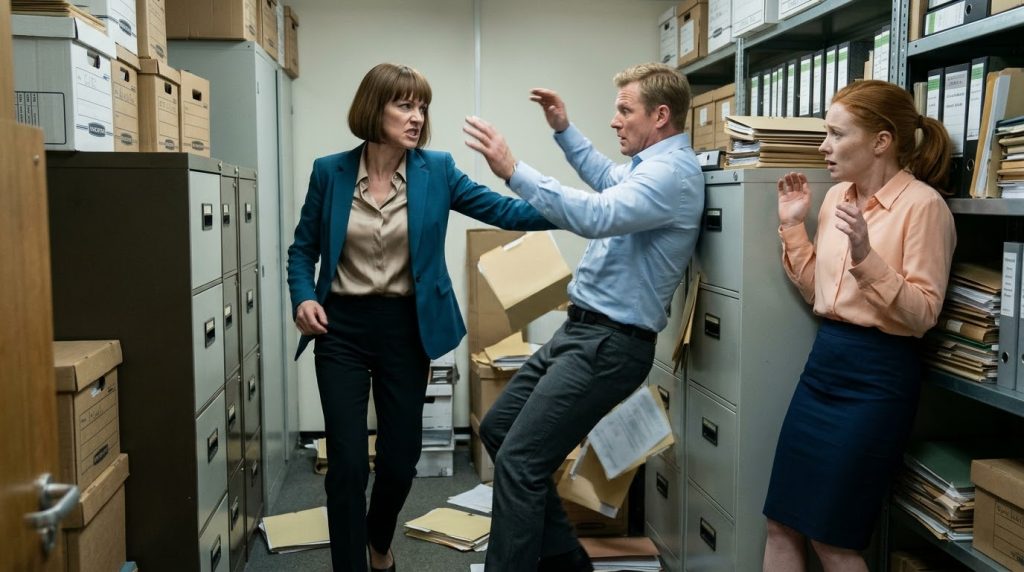
They brought Brielletta in at ten past two. She sat down and said Quade had given her the door codes, and that she had only ever copied what he asked her to copy.
When the investigator asked who paid for the copier cards, she said, “Quade did,” and then she said, “and Mr. Halbrook signed off on the invoices.”
Halbrook said he signed a great many invoices.
So they brought Quade in. He had shaved that morning, and he still had the face of a man who believed the worst thing that could happen to him had already happened behind those filing cabinets.
The investigator asked him who Corbin Slate was.
Quade looked at me first, and I gave him nothing.
“He’s an investigator,” Quade said. “He works for the defense side. He paid me. He’s been paying me for two years.”
“And who approved the arrangement?”
Quade looked at Halbrook, and Halbrook looked at the table.
“Mr. Halbrook,” Quade said. “Mr. Halbrook told me which files to pull.”
Nobody said anything for a while, and the recorder kept running.
The general counsel stood up and said he was obligated to notify the county prosecutor’s office that same afternoon. He did, and by four o’clock I was told a subpoena had been served on Corbin Slate at his office in Columbus.
On my way out, Quade followed me into the hallway and put his hand against the wall beside me.
“Neravine. Five minutes. Please.”
“Speak to my attorney,” I said, and kept walking.
The investigator caught up with me at the elevator and told me the rest of it in a flat, careful voice. The sanctions against Vantor’s defense would likely hold, she said, and the Kessler case would likely survive. But it would only survive if I testified against my own firm and against my own husband, on the record, under oath, in a room where anyone could read it later.
“You don’t have to decide today,” she said.
Chapter 9 – The Last Exhibit I Signed Posted Oct 20, 2026
I testified on a Tuesday morning in a hearing room with no windows, and I kept my hands flat on the table so no one could see them shake. My attorney, Renata Cho, sat to my left and did not touch my arm or comfort me once, which was the kindest thing she did all year.
The investigator from the disciplinary office asked the questions, and the first one was simple.
“In your own words, Ms. Kessler-Ashworth, when did you first know that exhibits from Kessler v. Vantor Medical had left this building?”
I said the date, the time, and the name of the room, and then I said the rest of it for four hours.
I described the filing cabinets and the padded envelope and the memory card I had slammed on that table. I described the spreadsheet with forty-one rows on it and my own initials typed in twice. I described a reference letter dated the eleventh of March for a job that opened in June.
Quade testified the following week. He had been charged by then, and his lawyer had worked out an arrangement, and he read from a statement in a flat voice that I had never heard him use before. He said Corbin Slate paid him, and that Douglas Halbrook approved the arrangement and took his cut through the trust account ending in 4471. He said the affair with Brielletta started in the spring, and that the thefts started fourteen months before that, and that the two things were never the same thing, and hearing him say it out loud in a room full of strangers is a thing I will not describe to you.
Halbrook was removed from the firm by the executive committee in August and disbarred by the state bar in September. I learned that from the letter they mailed to my house, because I had asked to be notified in writing.
Brielletta was charged with theft and records tampering, and she surrendered her records certification before her first court date.
Slate’s investigator license was revoked in Ohio in October, and the defense in Kessler was sanctioned for receiving privileged materials, which struck two of their central defenses and put my case back where it belonged.
The settlement came in November, and it was not a fraction of anything. Delia Reeves called me at home on a Sunday, and I stood in my kitchen with the phone against my ear and listened to a woman I had apologized to in a parking lot tell me what the money would do for her grandchildren. Then she said, “I don’t blame you, Neravine,” and I have thought about that sentence more than any other sentence in this whole business.



