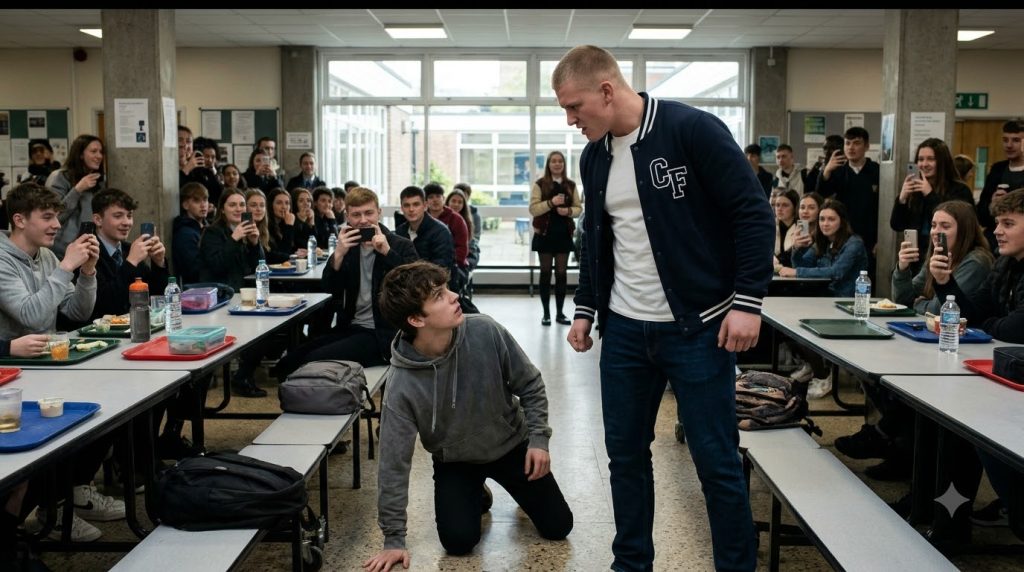
They had watched him pull it away.
The truth wasn’t hidden.
It was simply inconvenient.
A boy across the aisle looked at me, then quickly turned back toward his lunch.
Another student lowered her phone for a second before lifting it again.
Nobody seemed to know what they were supposed to do.
I understood that feeling more than I wanted to.
For months, I had watched Travis move through the school as though every room belonged to him.
He was tall, strong, and recognizable.
His name was announced at football games.
Students called out to him in the hallways.
His teammates moved around him like a group that had already decided who would speak and who would listen.
I didn’t know whether every person who laughed with him actually liked him.
I suspected some of them simply preferred being near him to being in his way.
That was something I understood.
It was the same calculation I had made whenever I changed seats.
Travis was good at making other people feel as though they were overreacting.
He never needed to announce that he was in control.
He acted as though the answer had already been decided.
When he wanted somebody to move, he stood in front of them until they moved.
When he wanted to interrupt a conversation, he interrupted it.
When he wanted an audience, his teammates supplied one.
And if anybody looked uncomfortable, he could smile and pretend that everyone was being too serious.
There had been times when I wondered whether he even considered what he was doing.
Not because he seemed innocent.
Because he seemed so completely untroubled by it.
I remembered standing in a hallway earlier that school year while he repeated my name loudly enough for people several lockers away to hear.
He had asked why I never talked.
I had said that I did talk.
He had laughed and asked me to prove it.
It was such a ridiculous demand that I didn’t know how to answer.
So I hadn’t.
For the rest of that afternoon, I heard variations of the same joke from students who had barely spoken to me before.
That was how it worked.
Travis said something.
His friends laughed.
Other people learned that laughing was the expected response.
Eventually, nobody remembered where the joke had started.
They only remembered that I was supposed to be its subject.
It changed how I saw myself.
I had always been quiet, but being quiet hadn’t bothered me.
I liked listening more than talking.
I didn’t mind eating alone.
I didn’t feel compelled to fill every silence with something clever.
Advertisement
Hotel advertisement 4
Before Travis, those were simply parts of my personality.
After Travis, they became weaknesses people commented on.
I began wondering whether there was something wrong with the way I moved through school.
Perhaps I should have made more jokes.
Perhaps I should have joined more conversations.
Perhaps I should have learned to answer insults with insults.
But whenever I imagined becoming somebody louder or more aggressive, the image felt false.
I didn’t want to change my entire personality because one person had decided it was funny.
Still, wanting to stay myself and knowing how to protect myself were two different things.
The distance between them had grown over eight months.
Now, with my lunch scattered and the chair on the floor, it felt wider than ever.
Someone at the table behind Travis laughed and said I looked like I might cry.
I wasn’t crying.
But my eyes stung, and that was humiliating enough.
I could handle the pain in my elbow.
What I struggled with was knowing that tomorrow, somebody might remember this moment when I walked past them in the hallway.
They might imitate the way I fell.
They might play the video on their phone.
They might laugh again.
One brief act could follow me through the rest of the school year.
Travis didn’t have to think about that.
He would get up the next morning, put on his varsity jacket, and walk into school knowing his friends would greet him.
I would have to wonder whether the video had been shared.
The unfairness of it made my chest feel tight.
I looked toward the cafeteria doors.
There were students moving in and out, carrying trays or returning from the serving counter.
For a moment, I considered leaving my lunch behind.
The thought was almost comforting.
I could walk out, go somewhere quiet, and wait until the bell.
But then I looked at my bag.
It had slipped beneath the edge of the table.
My lunch was inside.
I hadn’t finished eating.
Leaving would mean going through the rest of the afternoon hungry, simply because Travis wanted to amuse himself.
It wasn’t the biggest injustice in the world.



