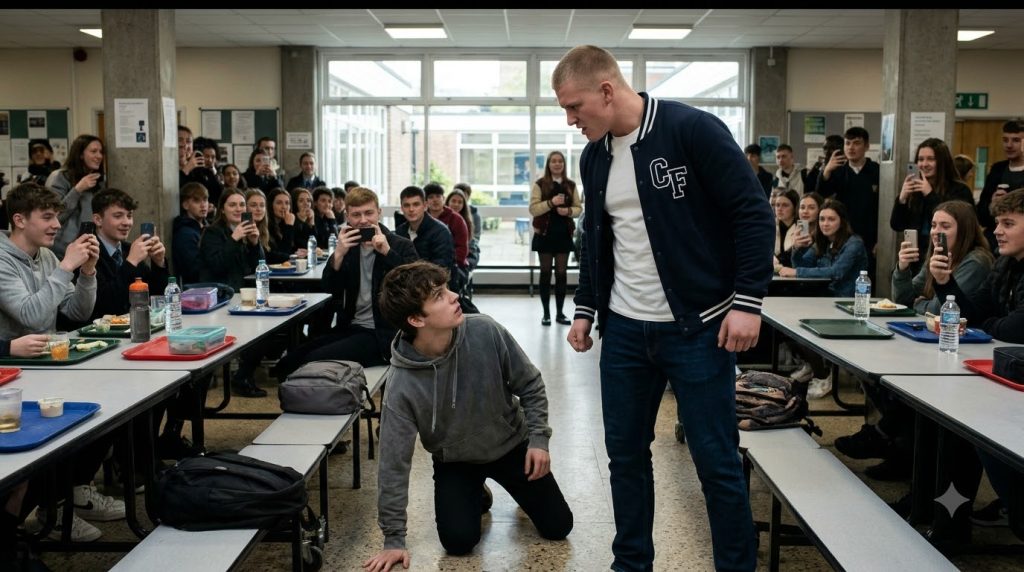
I hadn’t touched him.
I hadn’t done anything except move.
But the sound of his shoe striking the chair seemed to reach every student watching us.
A few people gasped.
Someone gave a startled laugh, then stopped.
One of Travis’s teammates took a quick step forward as though he expected the captain to fall.
Travis caught himself.
His hand reached toward the nearest table, and he straightened.
Advertisement
Hotel advertisement 8
For a moment, he stared at the chair.
Then he looked at me.
The expression on his face was no longer mocking.
It was furious.
I could see what he believed had happened.
He had tried to frighten me, and the result had made him look foolish.
Worse, it had happened in front of an audience.
The same audience he had gathered to laugh at me.
I wanted to tell him that I hadn’t planned anything.
That I hadn’t put the chair there.
That I had only moved because I didn’t want to be hurt.
But I couldn’t imagine him listening.
His cheeks flushed.
His hands curled into fists.
Then his voice exploded across the cafeteria.
“YOU THINK THAT’S FUNNY?”
A few students flinched.
I did too.
The shout was so loud that people farther away turned toward us.
One of the nearby students stopped halfway through lifting a drink.
The boy with the phone adjusted his position again, holding the screen higher.
And Travis took a step toward me.
I stepped back.
Not quickly enough to look like I was running.
Not slowly enough to let him get close.
I kept my eyes on him, trying to decide where he intended to move.
It struck me that I had never seen him like this before.
He had always been surrounded by laughter, always able to recover from a failed joke by making another one.
Now there was no easy joke available.
Everyone had seen his foot hit the chair.
Everyone knew I hadn’t touched him.
And the silence spreading around us seemed to make him angrier.
I could feel the space changing.
What had begun as another humiliating lunchroom prank was becoming something I couldn’t escape simply by walking away.
For eight months, I had imagined what it would feel like if Travis finally left me alone.
Usually, I pictured an ordinary day.
I would walk into the cafeteria, find an empty seat, eat lunch, and leave without thinking about him.
Nothing dramatic would happen.
No one would apologize.
No one would announce that things were different.
I would simply stop being the person he chose to bother.
That had always seemed like enough.
But now, watching him step closer with his face twisted in anger, I understood how little control I had over whether that day ever arrived.
I could choose not to provoke him.
I could choose not to answer his insults.
I could choose to move when he approached.
I couldn’t choose whether he decided to follow.
I couldn’t choose whether his friends laughed.
And I couldn’t choose what he might do when he realized that I wasn’t going to perform the reaction he wanted.
That helplessness had been building for months.
Not all at once.
A little each day.
It was there whenever I changed my route through a hallway.
Whenever I paused outside the cafeteria doors to see whether he was sitting inside.
Whenever I heard laughter behind me and instinctively wondered whether it was about me.
I hated that those habits had become automatic.
I hated even more that I sometimes felt foolish for being bothered by them.
After all, no single insult had seemed unbearable.
No single joke had lasted very long.
There were still classes where Travis wasn’t present, parts of the school day when I could almost forget about him.
But relief shouldn’t have depended on somebody else’s absence.
I hadn’t fully understood that until the moment I stood facing him with my lunch bag across the floor.
I had spent months treating the right to be left alone as something I needed to earn.
As though being quiet enough, agreeable enough, or invisible enough would eventually convince him to grant it.
Now it was painfully obvious that the problem had never been my behavior.
Travis was angry because I had said no.
Nothing more.
I wasn’t trying to embarrass him.
I wasn’t trying to take his place in front of his friends.
I wasn’t even refusing to pick up my lunch.
I was refusing to pretend that the humiliation was acceptable.
And he didn’t know what to do with that.
I finally raised both hands slightly, keeping my palms open.
The movement was deliberate.
There was nothing threatening about it.
I wanted him to see that I wasn’t preparing to hit him.
I wanted the students around us to see it too.



