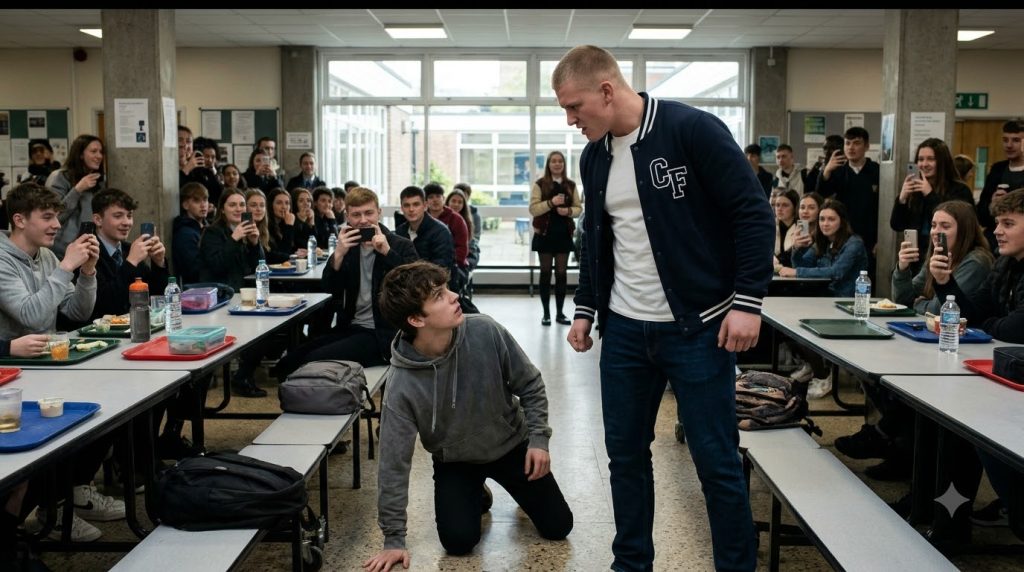
I met his eyes again.
“I said, leave me alone.”
The second time, my voice was steadier.
Not because I had suddenly become fearless.
My heart was beating hard enough that I could feel it in my throat.
I was frightened of what he might do.
But I was more frightened of spending the rest of high school believing I didn’t have the right to say those four words.
Travis’s grin disappeared.
Completely.
I had seen Travis irritated before.
Usually, it happened when somebody failed to laugh at the right moment or didn’t move quickly enough to suit him.
He would tighten his mouth, lower his voice, and lean forward.
Most people reacted by giving him whatever he wanted.
That was probably why he had so little patience for disagreement.
He wasn’t accustomed to anyone insisting on a boundary.
Especially not me.
His jaw moved as though he were chewing on an answer he didn’t want to say aloud.
He glanced toward his teammates.
The tallest of them was still smiling, but he had stopped laughing.
The student with the phone kept recording.
Travis turned back to me.
I wanted to tell him that I wasn’t challenging him.
I wanted to explain that I didn’t care where he sat, who his friends were, or what the football team had accomplished.
I wasn’t interested in taking anything away from him.
I only wanted my lunch.
But I knew that trying to explain myself might give him another opportunity to twist my words.
I had learned that the hard way.
During those eight months, I had repeatedly tried to make my responses harmless.
When he mocked me for being quiet, I sometimes smiled faintly so he wouldn’t accuse me of being offended.
When he blocked a path, I waited without complaining.
When he made a joke at my expense, I let it pass rather than risk making the moment bigger.
None of those choices had changed his behavior.
They had only made me easier to approach the next time.
Now, as I stood near the overturned chair, I wondered whether he had begun to believe that my silence meant I didn’t feel anything.
Advertisement
Hotel advertisement 7
Maybe he thought embarrassment didn’t bother me because I rarely complained.
Maybe he imagined that being quiet meant I didn’t have a temper.
The truth was more complicated.
I had a temper.
I knew what anger felt like.
I knew the sharp urge to say something cruel in return, or to shove someone away when they stepped too close.
But I also knew that acting on those feelings would not necessarily make anything better.
Travis had a whole group of friends ready to support his version of an argument.
I didn’t.
And in a school where his name carried so much weight, I had always assumed that if a confrontation became physical, people would be more interested in whether I had fought back than in how it started.
That was one reason I had spent so much time avoiding him.
I didn’t want the argument.
I didn’t want the attention.
I didn’t want to become part of another story that people would discuss without asking what actually happened.
Yet standing still was no longer keeping me out of trouble.
It was happening anyway.
Travis moved his shoulders forward.
My attention sharpened.
The laughter around us had faded enough that I could hear the rustling of his varsity jacket.
His eyes dropped toward the floor.
I followed his gaze.
My backpack was near the overturned chair.
For a moment, I thought he intended to move it.
Then he lifted his foot.
There are moments when your body reacts before your thoughts finish forming.
I don’t mean that I possessed some remarkable ability to predict what other people were going to do.
I didn’t.
I had never been the strongest student in any room, and I certainly wasn’t eager to test myself against a football player.
But I had been watching Travis closely.
His expression had changed.
His weight had shifted.
And when he lifted his foot toward my backpack, something about the movement made me uneasy.
I stepped slightly to one side.
Travis’s leg swung past the bag.
The movement was directed toward my side.
Had I stayed in exactly the same place, his sneaker would have struck me.
Instead, his foot connected with the metal leg of the overturned chair.
A sharp clang rang across the floor.
The chair shifted.
Travis’s expression changed instantly.
His face tightened in surprise, and his upper body pitched forward as he struggled to recover his balance.
He made a short, angry sound.
For the first time since he had approached my table, his movement looked uncontrolled.
I took another step away.
My hands were still at my sides.



