Blair Whitmore wanted to see Nolan in person. Her office sat on the top floor, all glass and leather and quiet money, a world away from the noise of the docks. Blair was 42 with a sharp dark bob and a cream blazer that probably cost more than Nolan’s rent. A portrait of her grandfather, the founder, hung behind her desk, and the family name was etched in steel above the front entrance downstairs. She did not look at the handover plan. Instead, she asked why Nolan believed his family deserved priority over the company in its most important season. Nolan answered evenly that he had worked many holidays before, and this time he only wanted to keep a promise to his daughter. Blair studied his faded uniform from collar to boots.
“This company pays you to work,” she said, not to arrange family dinners.
Nolan did not raise his voice. He told her he was not asking for a favor, only for the company to honor a day off it had already approved. Nobody in that building spoke to Blair that way, and she felt the irritation climb in her chest. Nolan noticed the soft carpet under his boots, the polished table, and the view of the lights across the river. He thought about how different this room was from the kitchen where two plates waited, and how little the people up here seemed to know about the floor that paid for it all. He had no anger in him yet, only a tired clarity. He had asked for something small, and he was being treated as if it were something enormous.
Trying to be useful, Nolan mentioned that the doc software had failed again tonight, and that the problem deserved a serious technical review. A thick folder lay open on her desk, labeled with an automation expansion and workforce streamlining plan. Blair closed it before he could read a single line. Her expression barely changed, but her palm stayed flat on the cover as if she were holding it shut. That will be all, she said. Then she lifted the phone and told her assistant to bring every night shift employee to the dispatch floor. She wanted all of them standing there because she had decided that Nolan Avery was going to be a lesson.
Out in the hallway, Meredith touched his sleeve and whispered that this was not about the schedule anymore. Nolan nodded and walked down the stairs toward the floor, still believing a calm man could not be broken by a loud one.
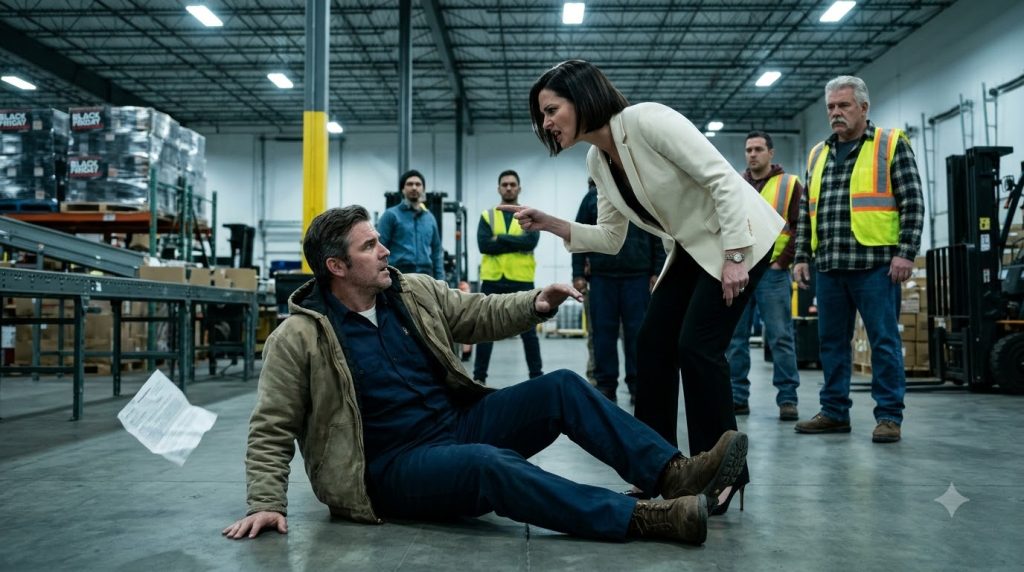
At 10 minutes past 10, the dispatch floor was bright and cold, and 20 night shift employees stood in a loose half circle with their hands in their pockets. Earl Bennett, 58, the gay-haired mustached foreman of the loading crew, stood near the front in his flannel shirt and reflective vest. Miles Carter, the 36-year-old dispatcher, stood by the console with his arms folded. Nolan waited off to one side his folder under his arm.
Then the stairwell door swung open and Blair Whitmore walked in, her heels clicking against the concrete like a clock. She announced that one of their supervisors was putting his personal interests ahead of the business at the busiest time of the year. Nolan stepped forward and said calmly that he had finished his work, written his hand over, and arranged his replacement. Blair turned to face the crowd and asked loudly enough to carry to the back wall. Is one dinner with his daughter worth more than the job that has fed his family for 11 years? Nobody answered. Somewhere in the distance, a forklift idled. Nolan looked straight at her and said, “I only wanted to keep a promise.”
“Then keep it somewhere else,” Blair said. “You’re fired. Put your badge on that table and leave.”
For a moment, no one moved. Nolan unclipped the badge from his jacket, set it on the metal table, and laid his approved leave form beside it, smoothing the corner with his thumb. Then he went to his locker, and began collecting his things one at a time, without hurry. Blair was not finished. You think this place can’t run without you? She said, “I can find 10 people tomorrow to do your job.” The words hung in the cold air like breath. Nolan set his hand over binder on the table, squared its edges, and answered in the same steady voice. I never thought I was more important than anyone here. I just thought we deserved some respect.



