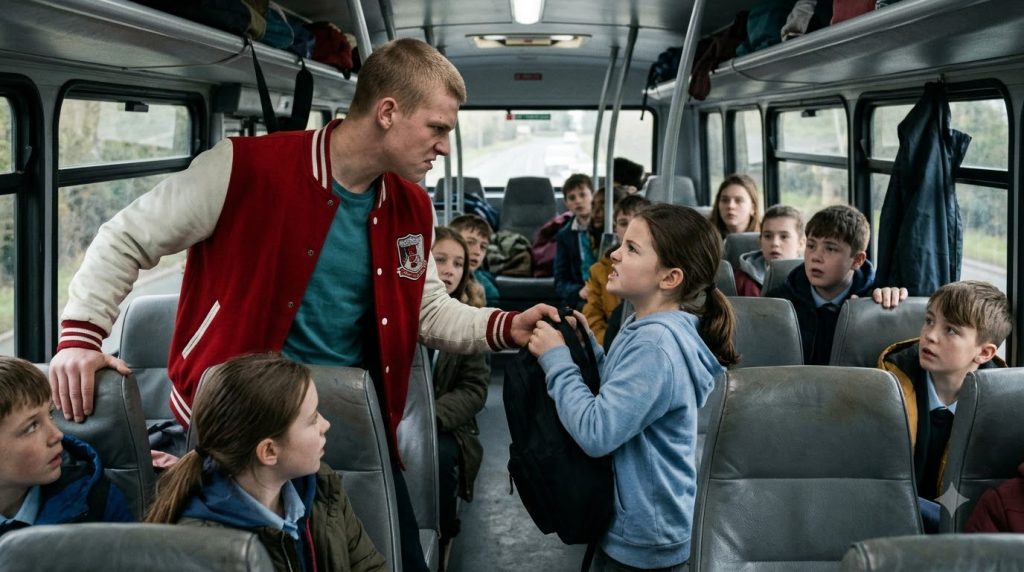
CHAPTER 1: THE SEAT I REFUSED TO GIVE UP
The biggest bully in our school grabbed my backpack and yanked so hard that I fell out of my seat. My knees struck the rubber floor of the school bus, and laughter exploded behind me before I could even catch my breath. “Didn’t I already tell you my friends sit here?” I looked up at Mason, the seventeen-year-old football star who had spent an entire semester making me wish I could disappear. There were empty seats directly behind him. He knew that. So did everyone watching. But Mason wasn’t interested in sitting down. He wanted to watch me crawl away. I was fourteen, small enough that most of the older students hardly noticed me until someone gave them a reason. Mason had decided months earlier that I was a reason. Now, with nearly every seat on the bus occupied and several students already reaching for their phones, he was determined to make sure everyone understood who controlled the aisle. The worst part wasn’t the pain in my knees. It was knowing exactly what would happen if I stood up. For most of the semester, I had learned that arguing with Mason only made him louder. Asking him to stop gave his friends something new to laugh about. Trying to explain what happened afterward never seemed to matter as much as the number of people who claimed they hadn’t noticed anything. But that afternoon, something inside me was tired of making myself smaller.
I placed one hand against the floor, tightened my grip on my backpack, and began to stand. Mason’s smile widened. He thought I was about to run. He had no idea that I was trying to decide whether walking away one more time would change anything at all. The first time Mason made me move on the bus, I had hardly understood that he was speaking to me. It was early in the semester, when the school year still felt new and the bus seats smelled faintly of cleaning solution instead of damp jackets and forgotten snacks. Students were settling into routines, discovering who sat with whom, and deciding which parts of the bus belonged to which groups. I liked sitting near the middle. Not because the seat was special,
but because it gave me room to look out the window without being right beside the driver or surrounded by the loudest students in the back. I could put my backpack on my lap, rest my hands on it, and spend the ride thinking about something other than school. One afternoon, Mason stopped beside my seat. “Move.” I looked up, uncertain whether I had heard him correctly. “Sorry?” He tilted his head toward the back. “You’re in our row.” I glanced at the empty space beside me, then at the rows behind him. There were seats everywhere. For a moment, I considered pointing that out. But his expression made the words feel foolish before I said them. Mason was tall, broad-shouldered, and built like someone who had spent years running into people on purpose.
He had short brown hair that always looked carefully trimmed and a strong square face that changed completely depending on whether he was smiling at a coach or looking at someone he disliked. At school, people knew him as the star linebacker. Teachers called him talented. Other students called him popular. His teammates treated him like someone whose jokes deserved laughter whether they were funny or not. I knew almost nothing about him then. I only knew that he was blocking my way. “Okay,” I said. I stood, pulled my backpack close, and moved two rows back. He slid into the seat I had just left. One of his friends laughed. “That was easy.” I heard the words, but I pretended not to. There was no reason to turn one unpleasant moment into an argument.
At least, that was what I told myself. The next day, Mason made me move again. And the day after that. Sometimes he was already sitting where I wanted to sit. Sometimes he waited until I had settled before approaching. Occasionally, he said nothing at all. He simply stopped beside me and stared until I gathered my things. At first, I believed he would grow bored. There were so many other things happening at school. Classes, football games, assignments, lunchroom conversations, and the ordinary excitement of students who had never been told they were too young to understand how much a small humiliation could hurt. Surely, I thought, someone like Mason would eventually find something better to do. But he seemed to enjoy the fact that I never challenged him. The less I said, the more certain he became that I wouldn’t. I began noticing his footsteps before I noticed his face. I learned the sound of his friends laughing together, and I could recognize his voice even through the noise of a crowded hallway. When I saw his red varsity jacket near the bus, my stomach tightened automatically. It was strange how quickly a person could turn something ordinary into something frightening. A school bus was supposed to be a way to get home. A seat was supposed to be a place to sit. A backpack was supposed to carry books. Yet by the middle of the semester, all three had become things I worried about long before the final bell rang. I started choosing seats based on how easily I could leave them. I kept the straps of my backpack wrapped around my hands so nobody could snatch it away without warning. I waited until other students had boarded before deciding where to sit, hoping Mason would already have claimed whatever space he wanted. Sometimes this worked. Sometimes it didn’t. And every time it didn’t, I told myself that tomorrow would be different. There were other reasons I hated making a scene. I wasn’t particularly loud, and I had never been good at answering an insult quickly. When someone surprised me, my mind seemed to empty at exactly the wrong moment. Hours later, I could think of a dozen things I should have said. During the moment itself, all I wanted was to get through it without crying. Mason appeared to understand that. He didn’t always need to touch



