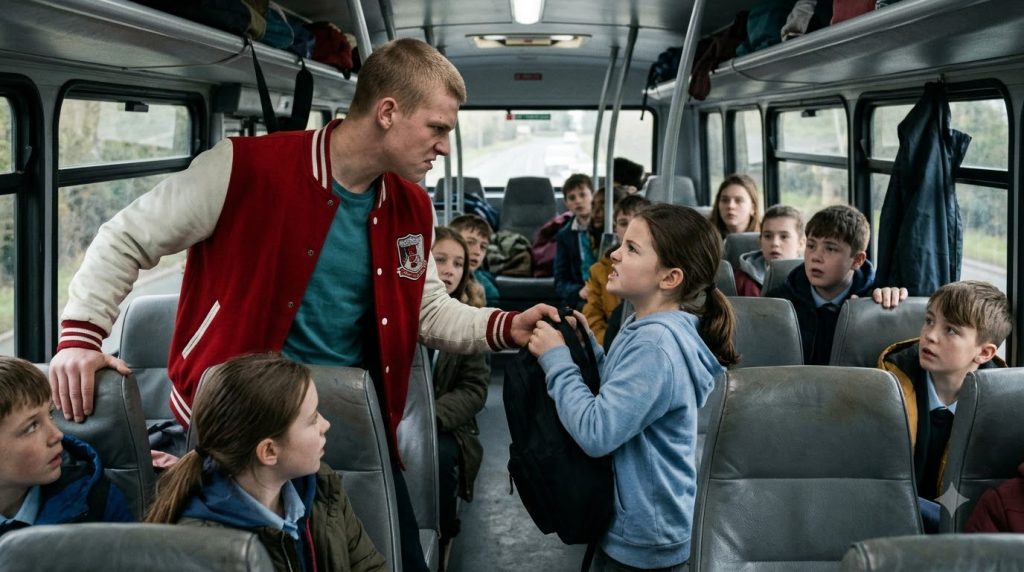
me to make me uncomfortable. A look could be enough. So could a word spoken loudly enough for his teammates to hear. “Wrong seat.” “Move along.” “You’re blocking everybody.” The words were ordinary by themselves. It was the way he delivered them that made them hurt. He spoke as though I were deliberately causing trouble by occupying a little space that anyone else could use. His friends usually laughed before I responded. Their laughter made it clear that whatever I did next would become part of the joke. If I stood up, I was obedient. If I hesitated, I was stupid. If I tried to explain myself, I was annoying. There was no answer that made the situation better. One afternoon, I finally asked him why he kept choosing me.
He had been standing beside a seat I had occupied for less than a minute. “Why do you care where I sit?” I asked. Mason looked toward his friends. Then he looked back at me with an expression of exaggerated confusion. “Why do you care so much about a seat?” I didn’t know how to answer. He smiled. “Then move.” I moved. For the rest of that ride, I stared at the back of the seat in front of me and tried to understand why that brief conversation bothered me so much. I had asked a reasonable question. He had turned it into proof that I was the problem. By the time I got home, I was angry at him and embarrassed with myself. The next morning, I promised I wouldn’t give him the satisfaction of seeing me upset.
That became my rule. Don’t cry. Don’t shout. Don’t give him another reason. For weeks, I followed it carefully. I learned to keep my face still when he made a remark. I learned to walk past his teammates without looking toward their laughter. I learned to hold my books firmly whenever someone crowded too close in the hallway. I became very good at pretending things didn’t matter. But pretending wasn’t the same as being unaffected. There were afternoons when I got home exhausted without understanding why. I would finish my assignments, put my school things away, and replay a conversation that had lasted less than thirty seconds. Sometimes I wondered whether I had misunderstood everything. Maybe Mason really did want a particular seat. Maybe his friends laughed at everyone. Maybe I was making too much of ordinary teenage behavior.
Then I remembered the way he watched my face after every insult. He always waited to see whether I would react. That was when I understood that the seat itself had never been the point. He wasn’t trying to get somewhere. He was trying to make sure I knew I could be moved. Once I understood that, the bus felt smaller. Mason’s teammates were part of the reason he could keep doing it. They were older boys who moved through the school with the confidence of students who had never needed to ask whether they were welcome somewhere. Most of them were physically bigger than I was. They wore athletic jackets, carried sports bags, and talked loudly enough that people turned to look when they entered a room. I didn’t know all their names.
I knew their faces, though. One had closely cut hair and a habit of folding his arms whenever Mason confronted somebody. Another kept his phone close to his chest, ready to lift it whenever the situation became entertaining. Neither boy was as loud as Mason. That didn’t make their presence harmless. They stood nearby when he told me to move. They grinned when he made comments about me. If I tried to step around them, they sometimes shifted just enough to make me hesitate. They almost never needed to say anything. Standing with him was enough. It took me a long time to notice that their laughter wasn’t always spontaneous. Sometimes one of them looked at Mason first, as if checking whether laughing was expected. Sometimes a smile disappeared the instant Mason turned away. Once, when Mason was occupied with another conversation, I saw one teammate glance at me with an expression that looked almost uncomfortable. I wondered whether he wanted to apologize. He didn’t. The moment Mason looked back, the boy laughed again. I thought about that expression for days. It would have been easier to believe every person standing beside Mason was as cruel as he was. Then the situation would have been simple. There would have been one group of bad people and everyone else. But I was beginning to understand that people could recognize something was wrong and still help it happen. Sometimes they did it by laughing. Sometimes they did it by looking away. Sometimes they did it because the person giving the



