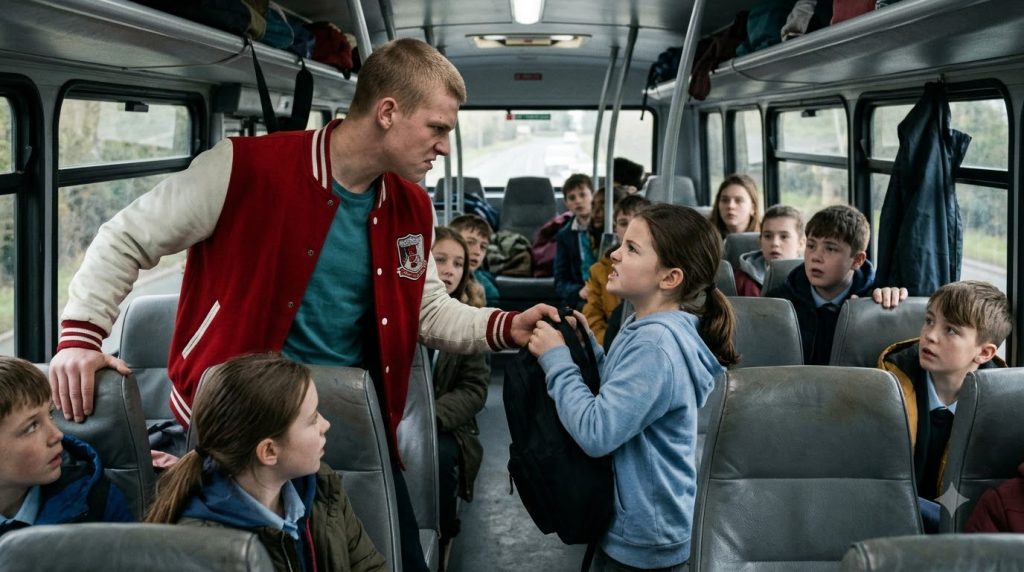
There had been an afternoon the previous school year when a group of younger students crowded around my seat. I remembered it because I had been confused rather than frightened at first. They were laughing too loudly. One boy had caught the strap of my backpack as I tried to move past him. Another had told me to find somewhere else to sit. I had thought they were being foolish. They were younger than the football players who dominated the back rows, and none of them seemed particularly confident. One boy had actually looked uncomfortable. I remembered that now. He had kept glancing toward the back of the bus. At the time, I thought he was checking whether someone was watching. I hadn’t known why. I had moved away and tried to forget the incident.
Later, when those same boys were quiet around me, I had assumed the behavior had been a one-time joke. I had never connected it to Mason. Why would I? He was older. He didn’t sit with those students. He wasn’t standing beside them when they bothered me. I had no reason to think he had anything to do with it. But the younger boy’s words made those memories look different. I could almost see the anxious glances again. The forced laughter. The way one student had seemed reluctant to touch my backpack. The way they had stopped when I moved away, as though they had completed something expected of them. I had spent so much time wondering what I had done to make Mason dislike me. Now I was learning that some of the people who had treated me badly might not even have decided to do it themselves.
Someone else had encouraged them. Someone else had made it seem necessary. And that person had been Mason. The realization was painful. It meant the problem had started earlier than I knew. It meant that some of the humiliations I had remembered as isolated incidents belonged to a larger pattern. It meant that the boy I had spent the entire semester trying to avoid had already been affecting my life before I understood who he was. But mixed with that pain was something unexpected. Relief. Not because the truth was pleasant. It wasn’t. The thought of being targeted for so long made me feel sick. But for months, I had wondered whether there was something about me that caused these things to happen. Something I said. Something I wore. Something about the way I walked or looked at people.
I had imagined that if I changed enough, people like Mason might stop noticing me. The younger boy’s confession made those explanations impossible to believe. Mason hadn’t treated me badly because of some mistake I had made. He had been teaching other people to treat me badly, too. And at last, someone was willing to admit it. The driver looked at the younger boy. “What do you mean, last year?” His voice was calm, but the question seemed to change the air inside the bus. Until that moment, the driver had been trying to understand an argument that had happened while he was outside. One student claimed another had attacked him. The other denied it. There were witnesses, a phone, and two teenagers standing on opposite sides of an accusation.
Now the situation was different. The younger boy had introduced something Mason clearly hadn’t expected. This wasn’t only about the afternoon’s confrontation. It wasn’t even only about the seat. It was about a pattern that had been happening while adults and students went about their ordinary days, rarely stopping long enough to ask why the same girl kept being forced to move. The driver looked toward Mason. Mason didn’t answer. He was sitting upright now, both feet planted on the floor. His hands rested stiffly on his knees. For the first time since I had known him, he seemed uncertain about what to say. The younger boy looked as though he wanted to disappear. I understood that feeling. He had just admitted something embarrassing in front of students who might repeat his words tomorrow. He had also challenged the oldest and most intimidating boy on the bus. I could see the effort it was taking him to remain standing. His fingers were still curled inside his sleeves. His shoulders were tight. But he hadn’t taken back what he said. That mattered. For months, I had believed courage would feel like confidence. I had imagined that brave people spoke without trembling and stood without fear. But looking at that boy, I began to understand something different. He was afraid. Anyone could see it. Yet he had decided that the truth mattered more than the comfort of remaining silent. I looked at him and wanted to thank him. The



