orders was bigger, louder, or more popular than they were. Whatever the reason, the result felt the same to the person standing alone. I tried not to think about how many people had witnessed Mason’s behavior. I knew the number would be higher than I wanted to admit. The bus carried students from different grades. Some had ridden with Mason for years. Others were younger and seemed to treat the older athletes with the kind of cautious admiration I had once felt myself. People came and went through the aisle, shared seats, traded snacks, and talked over one another. And through all that ordinary noise, Mason repeatedly made me move. Nobody ever seemed surprised. That was what frightened me most. Not the first time it happened. Not even the tenth.
It was the way the behavior became familiar. A student could glance up, see Mason standing over me, and return to a conversation without wondering why. Someone might laugh briefly and then forget about it before reaching home. For me, the moment lasted much longer. I carried it into the next morning. And then the next. By the afternoon everything changed, I had stopped expecting anyone to intervene. The final bell had rung, and the usual stream of students had poured out of the building toward the waiting buses. I remember the ordinary details because nothing about the day had warned me that it would become different from all the others. My backpack felt heavy against one shoulder. A loose strand of hair kept slipping across my face. Students were discussing homework,
weekend plans, and the football team as they walked toward the buses. A boy ahead of me nearly dropped a stack of papers, and another student caught them before they scattered. Someone laughed at a joke I couldn’t hear. Everything looked normal. I found myself wishing I could feel normal, too. Near the bus doors, I saw Mason talking to two teammates. He was wearing the same red varsity jacket he often wore after school. One hand rested on his sports bag, and his expression was relaxed. He looked like any other teenager enjoying the end of a school day. That was another thing I had come to dislike. How easily he could change. With his friends, he was funny and confident. When an adult passed by, he could become respectful in an instant.
He knew when to lower his voice, when to smile, and when to make a comment sound like an innocent joke. But when he looked at me, the smile changed. It became something deliberate. He saw me approaching the bus. For half a second, our eyes met. Then he turned back to his teammates. I kept walking. I could have waited for them to board first. I could have chosen another seat near the front. I could have spent another afternoon trying to calculate which row would attract the least attention. But I was tired. Not just physically tired. I was tired of thinking about him. Tired of checking where he stood. Tired of making decisions based on whether a seventeen-year-old boy might decide to laugh at me. So I boarded the bus and chose an empty seat near the middle.
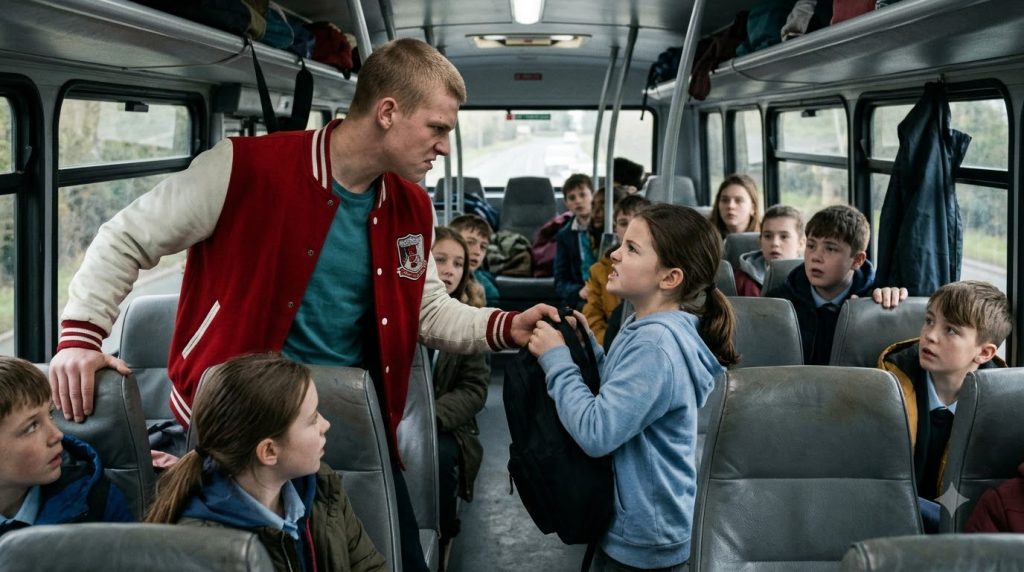
I put my backpack on my lap. The window beside me was cool to the touch, and the black rubber edging around it had begun peeling near one corner. Outside, students were still walking across the pavement. For a few moments, I let myself relax. There were two empty seats directly behind the row Mason usually preferred. I noticed them and felt a small sense of relief. If he wanted to sit with his friends, he could. There was enough room. Nobody needed to move. I looked down at the loose strap on my backpack and adjusted it so it wouldn’t hang into the aisle. Then I heard Mason board. His voice carried from the front. “Come on. Move back.” The footsteps behind him were familiar. So was the laughter. I kept my eyes on the window. Perhaps he would walk past me. Perhaps the empty seats would be enough. Perhaps, for one afternoon, I could simply go home. The bus filled around me. Students squeezed past knees and backpacks, calling to their friends and lifting bags onto their laps. A younger girl near the front asked somebody to make room. Two boys argued over whose turn it was to sit beside the window. The driver was outside, speaking with another staff member while checking paperwork. I could see them through the open doors when people moved out of the way. The bus was parked. Its engine was quiet. There was no reason for anybody to hurry. Mason stopped beside my seat. I didn’t look up immediately. A part of me still hoped