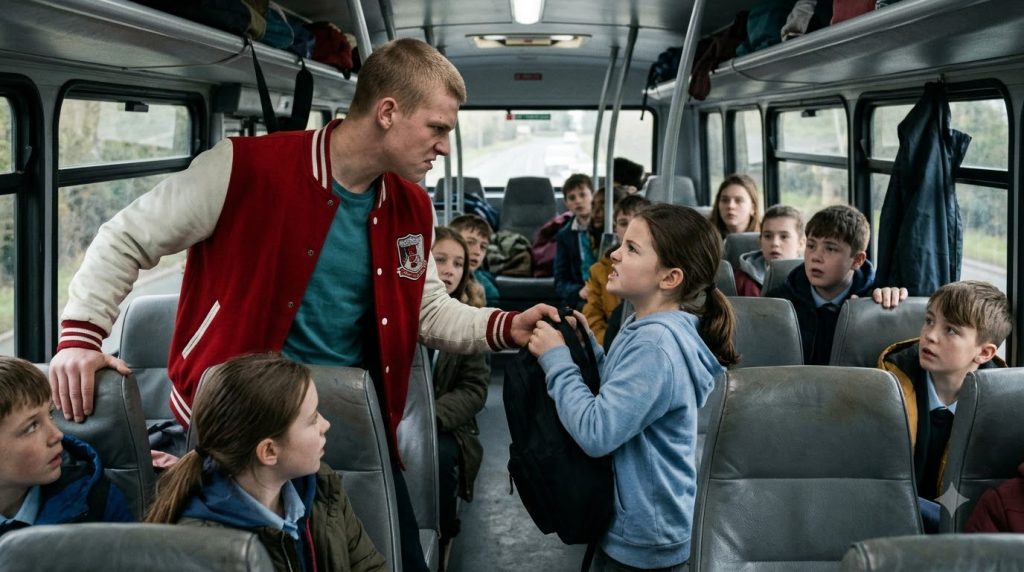
words wouldn’t come. My throat was too tight. Instead, I gave him a small nod. He noticed. His expression changed. Only slightly. His eyes softened, and for a second, he looked less alone. Then he turned back toward the driver. Around us, the students were watching with a kind of attention I had never seen before. Nobody was smiling now. The phone was still lowered. Mason’s teammates seemed unable to decide where to look. The boy who had stood beside him throughout the confrontation was staring at his hands. I wondered what he was thinking. Perhaps he was remembering other afternoons. Perhaps he was realizing how many times he had laughed without stopping to consider what that laughter meant. Perhaps he was afraid of what Mason would say later. I couldn’t know.
But I could see that the old certainty was gone. Mason had expected everyone to support him simply because he spoke first and spoke loudly. Now a younger student had contradicted him. And everyone had heard. I looked at the empty seat behind Mason. It was still there. The seat he had claimed he needed for his friends. The seat he could have taken without touching me. The seat that had been available from the very beginning. I found myself staring at it because the whole afternoon seemed almost unbelievable. If Mason had simply sat down, none of this would have happened. Nobody would have fallen into the aisle. Nobody would have raised a phone. The driver would have returned, started the bus, and taken everyone home. I would have spent another afternoon pretending that being ordered around didn’t bother me.
The younger boy would probably have remained silent. And the truth about last year might have stayed hidden. I realized how close we had come to repeating the same pattern forever. Mason would make a demand. I would obey. Other students would laugh. Someone might feel uncomfortable, but nobody would say anything. Then the next day would arrive, and the whole thing would happen again. It had become so familiar that I had almost stopped believing another outcome was possible. I thought about the moment my knees hit the floor. The shame. The laughter. The desperate wish to stand up without anyone noticing how badly I was shaking. I remembered how small I had felt beneath Mason’s shadow. I had believed the hardest part would be standing up to him.
Now I understood that there was another kind of difficulty. The difficulty of telling the truth when the person being accused had spent years convincing everyone that challenging him came with consequences. The younger boy was facing that difficulty right now. I wanted to help him. I didn’t want his courage to become another reason for someone to hurt him. So I moved a little closer to the front of the bus, remaining far enough from Mason that nobody could mistake my intention. The driver glanced toward me. I looked at the younger boy. Then I looked back at the driver. “He pulled me out of my seat,” I said again. This time, my voice was clearer. “I only tried to keep him from grabbing me.” I didn’t add anything.
I didn’t insult Mason. I didn’t ask the driver to punish him. The truth was enough. The younger boy looked toward me. I could see that my words had helped him steady himself. He was still frightened. But he was no longer the only person speaking. For a moment, we stood at opposite ends of the aisle, two students who had spent too much time trying to avoid the attention of one older boy. We had never really known each other. Yet we understood something important about the other. We knew what it felt like to be afraid of Mason. And now, for the first time, we knew what it felt like not to let that fear decide every word we said. The driver remained near the front, listening. His expression had become serious. I didn’t know what would happen after that afternoon. I didn’t know whether Mason would admit what he had done. I didn’t know what the driver would tell the school or whether the students who had watched the confrontation would be willing to explain it again. There were still difficult questions ahead. The younger boy had only begun to reveal what happened last year. The recording might show what had happened that day, but it couldn’t contain every afternoon that came before it. And I knew that Mason’s influence wouldn’t disappear simply because one student had contradicted him. Tomorrow, we would still attend the same school. We would still walk through the same hallways. The bus would still have the same narrow aisle and rows of ordinary seats. I would still be smaller



