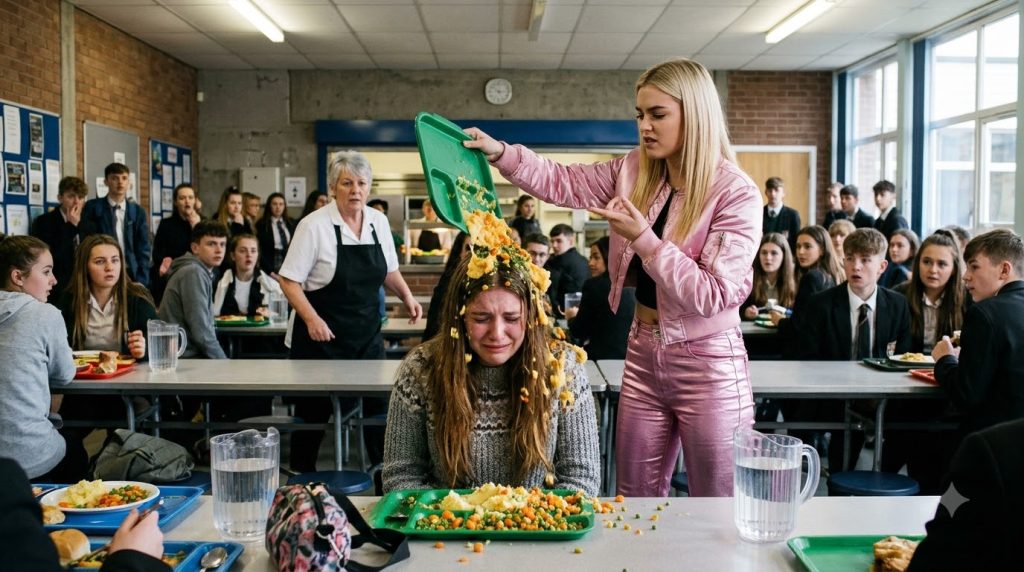
CHAPTER 1: THE WOMAN WHO REFUSED TO LOOK AWAY
The first thing Emma noticed was that Vanessa was smiling before she poured the food.
It was a small, pleased smile, the kind someone might wear after winning an argument or hearing a joke.
Except Vanessa Sterling was standing over Emma in the middle of the school cafeteria, holding a lunch tray above her head while dozens of students watched.
Then Vanessa turned the tray upside down.
Cold mashed potatoes struck Emma’s hair.
Gravy slid across her forehead and down the front of her faded gray sweater.
A spoon bounced off her shoulder and hit the floor with a sharp metallic sound.
For one terrible second, nobody moved.
Then the laughter began.
“That’s what happens when poor students forget their place,” Vanessa announced.
Emma stood frozen, her fingers curled around the edge of the cafeteria table.
She could feel gravy soaking into the collar of her sweater.
A piece of bread slipped from her shoulder and landed near her shoe.
Someone behind Vanessa whistled.
Another student shouted something Emma couldn’t understand because the laughter had become too loud.
Several phones were already pointed at her.
Emma wanted to disappear.
She had spent three years learning how to survive the halls of Westbrook High School without attracting attention.
She wore secondhand clothes, accepted the free lunches provided through the school meal program, and never complained when students whispered about the worn soles of her sneakers.
She had learned which stairwell remained empty between classes, which tables were safest at lunch, and which girls would laugh if she accidentally looked in their direction.
She had never learned what to do when someone decided to turn her humiliation into entertainment.
Across the cafeteria, an older woman stopped wiping a counter.
Her name was Margaret Hale, and she had worked in school cafeterias for most of her adult life.
At sixty-two, her back sometimes ached after a long shift, and the silver hair she pinned carefully beneath her work cap had become almost completely white.
She had seen children fight over seats, cry over grades, and occasionally say cruel things they later regretted.
But this was different.
She watched Emma stand in the middle of the room, her face burning with shame while food dripped from her hair.
She watched Vanessa laugh.
And she watched the other students do nothing.
Margaret slowly placed her cleaning cloth on the counter.
Then she untied her apron.
Her coworker glanced over.
“Margaret?”
Margaret didn’t answer.
She folded the apron once, placed it beside the cloth, and walked toward the crowded tables.
Her black work shoes made soft sounds against the cafeteria floor.
Students began moving aside as they noticed her approaching.
Vanessa turned, still smiling.
“What?”
Margaret stopped directly in front of her.
For a moment, she looked past Vanessa at Emma.
The girl was trying desperately to wipe her face with a napkin that had already become soaked.
Margaret’s expression changed.
She turned back to Vanessa.
“Do you think that was funny?”
Vanessa rolled her eyes.
“It’s a joke. She’s fine.”
“Look at her.”
“I said she’s fine.”
Margaret didn’t raise her voice.
“Look at what you’ve done.”
Vanessa glanced toward Emma, then shrugged.
“It’s just food.”
Margaret studied the expensive pink jacket, the perfectly arranged blonde hair, and the confident face of a girl who had never imagined anyone in this room might challenge her.
She recognized something familiar in Vanessa’s expression.
It was not the face.
It was the assumption that money made certain things unimportant.
Vanessa folded her arms.
“Are you going to report me?”
Margaret took one small step closer.
“Your father knows who I am.”
The change was immediate.
Vanessa’s smile disappeared.
Her eyes narrowed, then widened slightly.
“What did you say?”
Margaret held her gaze.
“You heard me.”
For the first time that afternoon, Vanessa looked uncertain.
The students surrounding them fell quiet.
And Emma, still trembling beside the table, raised her eyes toward the woman who had finally stepped forward.
She had no idea what those six words meant.
But she would remember them for the rest of her life.
Emma had known Margaret Hale since her first day at Westbrook High.
Not personally, at least not in the way students usually knew their teachers or friends.
Margaret was the woman who stood behind the serving counter, asked whether students wanted fruit, and quietly reminded them to take milk if they had forgotten.
Most students barely noticed her.
Emma did.
On her second day of freshman year, she had arrived at the register with her lunch tray and discovered that her meal account had not yet been updated.
The cashier looked apologetic.
“You’ll need to speak with the office.”
Emma’s face had grown hot.



