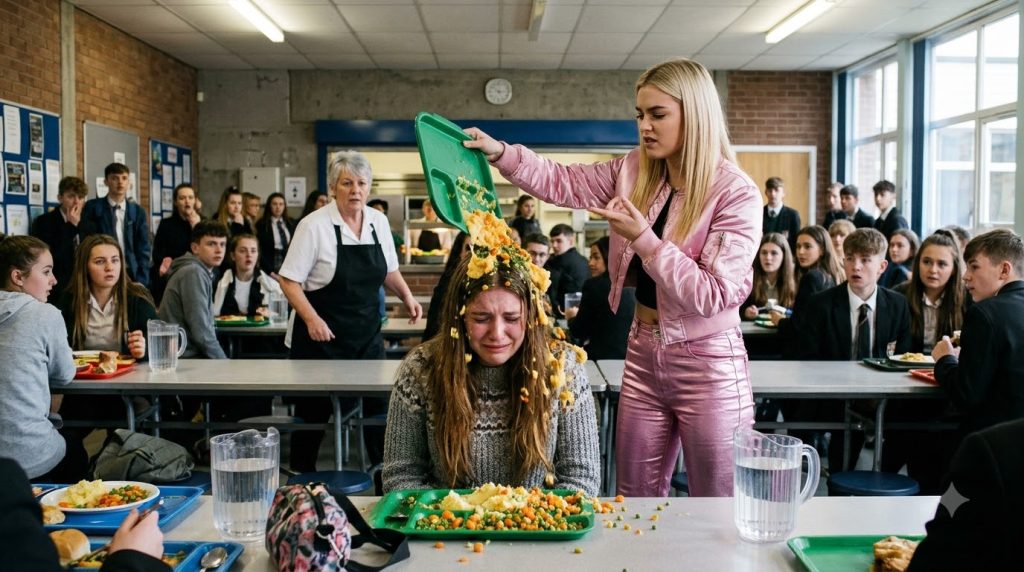
He had never spoken about any of this.
She knew her grandmother had worked hard, but she remembered her only as a quiet older woman who visited on holidays and brought homemade cookies.
Richard rarely discussed the years before he finished college.
Whenever Vanessa asked, he usually smiled and said he had grown up in an ordinary family.
Now she wondered what ordinary had meant to him.
Richard looked at Emma.
“I know what it’s like to arrive at school hungry.”
Emma lifted her eyes.
He continued.
“I know what it’s like to wear the same clothes until other children start noticing.”
Renee sat very still.
Margaret lowered her gaze.
Richard swallowed.
“And I know what it’s like to stand in a cafeteria line, hoping nobody realizes you don’t have enough money to pay.”
Vanessa shook her head.
“That doesn’t make sense.”
Richard looked at her.
“Why not?”
“Because you’re—”
She stopped.
He waited.
“Because I’m what?”
Vanessa stared at her bracelet.
“Because you’re successful.”
Richard nodded slowly.
“Yes. I am now.”
The words settled heavily across the table.
Richard turned toward Margaret.
“Mrs. Hale worked at my elementary school. She knew my mother was struggling.”
Margaret said nothing.
He continued.
“I was too proud to admit when I couldn’t afford lunch. I’d tell people I wasn’t hungry. Sometimes I’d leave the line before reaching the register.”
Vanessa looked toward the older woman.
Margaret’s face was calm, but her eyes had become wet.
Richard gave a sad smile.
“One day, she noticed.”
He paused.
“She didn’t embarrass me. She didn’t announce anything. She simply asked me to help carry a box of supplies to the kitchen.”
Margaret remembered that afternoon.
A small boy in an oversized jacket.
His hands tucked inside sleeves that were too long.
His stomach making a sound he tried desperately to hide.
She had offered him a sandwich while he stood beside the kitchen counter.
He had refused at first.
Not because he wasn’t hungry.
Because he was embarrassed.
Richard looked down.
“She helped my mother get the meal assistance paperwork completed. Until everything was sorted out, she made sure I had something to eat.”
Vanessa stared at him.
“You got free lunches?”
Richard met her eyes.
“Yes.”
“But—”
“Just like Emma.”
Vanessa’s face changed.
Richard’s voice grew quieter.
“And when I was older, I still needed help sometimes. Mrs. Hale encouraged me to apply for scholarships. She told me I had a future even when I couldn’t imagine one.”
Margaret wiped one eye.
“You were a hardworking boy.”
Richard shook his head.
“I was a hungry boy who needed someone to believe in him.”
He looked toward his daughter.
“The woman you dismissed on Friday helped me when I had almost nothing. And the girl you humiliated was living through something I understand better than you ever knew.”
Vanessa covered her mouth.
For several seconds, nobody spoke.
Then Caroline reached for Richard’s hand.
“Why didn’t you ever tell us?”
Richard looked at his wife.
He knew she was asking a question he had avoided for years.
His success had become a polished story.
People admired the expensive house, the company, the charitable donations, and the comfortable life he had created.
When his business began attracting attention, interviewers often asked about his beginnings.
Richard usually answered with stories about ambition.
He mentioned long hours and difficult decisions.
He spoke about determination.
He rarely mentioned hunger.
And he never described the shame of accepting a meal from someone who had very little herself.
“It was easier not to talk about it,” he admitted.
Caroline looked hurt.
“You could have told me.”
“I know.”
“I wouldn’t have thought less of you.”
Richard’s expression softened.
“I know that now.”
He looked toward Vanessa.
“But somewhere along the way, I started believing that if I told people how hard things had been, they might stop seeing me as successful.”
Margaret spoke gently.
“Richard, needing help didn’t make you unsuccessful.”
He looked at her.
“I understand that.”
She held his gaze.
“Do you?”
The question wasn’t cruel.
It was the same kind of question she used to ask him when he was a child and tried to hide his feelings behind pride.
Richard lowered his head.
After a moment, he answered.
“I’m learning.”
Vanessa looked at Emma.
For three years, she had thought of the girl as someone completely different from her.
Emma wore old clothes.
She ate free school lunches.
She rarely attended parties.
She didn’t have the expensive things Vanessa and her friends considered normal.
Vanessa had used those differences to make herself feel important.
Now she was looking at her father and realizing something uncomfortable.
The same things she had mocked in Emma had once been part of his life.
“Why didn’t Grandma ever tell me?” she whispered.



