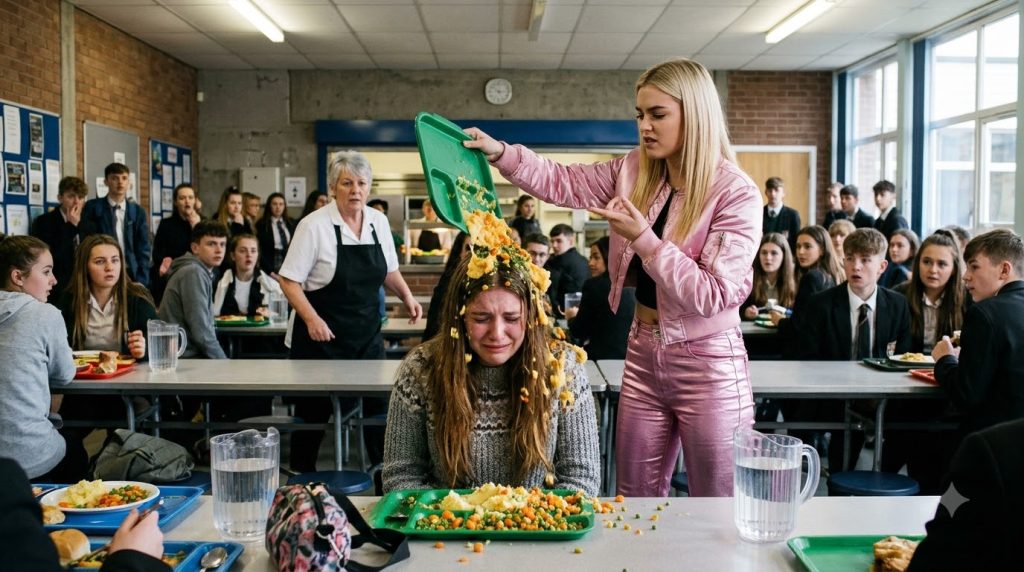
A few who had once laughed at Emma now behaved as though Vanessa alone had been responsible for everything.
She found that unfair.
Then she remembered how often Emma had been treated unfairly, and the thought made her uncomfortable.
At lunch, Vanessa’s usual group sat near the windows.
One of the girls leaned toward her.
“Everybody’s being so dramatic about that video.”
Vanessa looked at her.
“What?”
“It was messed up, sure, but people are acting like you committed some horrible crime.”
Vanessa stared at her tray.
The girl continued.
“Honestly, Emma is probably loving all the attention.”
Vanessa’s stomach tightened.
She heard her own voice from Friday.
Poor students forget their place.
The words had sounded powerful when everyone was laughing.
Now they sounded ugly.
“Don’t say that,” Vanessa said.
Her friend looked surprised.
“What?”
“Don’t talk about her like that.”
The girl rolled her eyes.
“Since when do you care?”
Vanessa hesitated.
She could have offered a simple explanation.
Her father was angry.
The school had punished her.
The video had made her look bad.
All those things were true.
But none of them were the reason she wanted the conversation to stop.
“Because it’s wrong,” she answered.
Her friend laughed.
“Wow. Okay.”
Vanessa looked across the cafeteria.
Emma was sitting with Chloe.
They were discussing something in a notebook.
Emma smiled at a comment Chloe made.
Vanessa felt a strange ache.
She had spent years making Emma the center of cruel jokes without knowing anything meaningful about her.
She didn’t know what books Emma liked.
She didn’t know what she wanted to do after graduation.
She didn’t even know whether Emma enjoyed pasta.
Yet she had felt entitled to judge her entire life.
Vanessa pushed her chair back.
“Where are you going?” her friend asked.
“Somewhere else.”
She carried her tray to another table.
She sat alone.
It was uncomfortable.
She could feel people looking at her.
But for the first time, she didn’t try to win their approval by saying something cruel.
She simply ate her lunch.
And thought about how much easier it had always been for her to walk away from an uncomfortable table than it had been for Emma.
Several weeks later, Richard Sterling returned to the cafeteria after the lunch rush.
Margaret was cleaning the serving counter when he entered.
She looked up and smiled faintly.
“Richard.”
“Mrs. Hale.”
He stood awkwardly near the entrance.
Margaret set down her cloth.
“Are you looking for someone?”
“Actually, yes.”
“Who?”
He gave a small smile.
“You.”
Margaret studied him.
Then she pulled out a chair.
“Well, sit down.”
Richard laughed quietly.
It was such a familiar instruction that for a moment he felt like a schoolboy again.
He sat.
Margaret took the chair opposite him.
For a while, they talked about ordinary things.
Her children.
His business.
How much the school had changed.
The old elementary building where they’d first met had been renovated years earlier, but Margaret still remembered the layout of the kitchen and the little tables near the windows.
Richard remembered them too.
Eventually, his expression grew serious.
“I’ve been thinking about what you said.”
Margaret waited.
“About teaching Vanessa respect.”
She nodded.
“How is she?”
“Struggling.”
“That’s understandable.”
Richard looked toward the empty tables.
“She doesn’t like being treated differently.”
Margaret raised an eyebrow.
He gave a rueful smile.
“I know.”
They sat quietly.
Then Richard continued.
“I used to tell myself that everything I accomplished came from hard work.”
“Hard work mattered.”
“Yes. But it wasn’t everything.”
Margaret folded her hands.
“No one gets through life entirely alone.”
Richard looked at her.
“I understand that better now.”
He hesitated.
“I’ve been reviewing the foundation’s school programs. We fund technology, scholarships, and building improvements. Those are good things.”
Margaret nodded.
“But I realized we never asked whether students felt comfortable asking for basic help.”
Margaret listened carefully.
Richard continued.
“I spoke with the district about making meal assistance easier to access and less embarrassing for families. They already have programs, but there are ways to improve the process.”
He paused.
“And I told the foundation board that we need to listen to the people who work with the students every day.”
Margaret smiled.
“That sounds sensible.”
Richard looked at her.
“I was hoping you’d help us understand what we’re missing.”
Margaret tilted her head.
“I’d be glad to share what I’ve learned.”
He smiled.
Then he reached into his jacket and removed a small envelope.
Margaret’s expression changed.
“Richard.”
“It’s not what you think.”
She gave him a skeptical look.
He laughed.
“It’s a letter.”
Margaret accepted the envelope.
Inside was a handwritten note.
Richard watched her read it.



