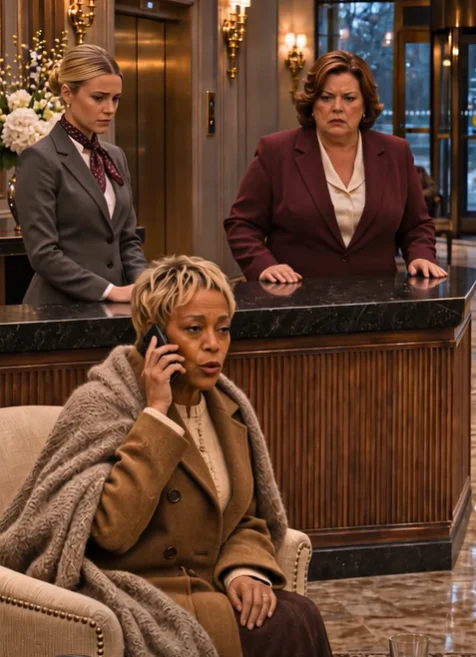
Clara thought of her mother saying almost the same thing downstairs. She wondered how many women had learned that lesson by paying for it.
Her phone buzzed. A message from Anna asked whether Clara would be willing to provide an account of the lobby incident before the end of her shift. She could have a colleague present. She could also choose tomorrow.
Clara showed Evelyn.
“That sounds fair,” the older woman said.
“I don’t know what to say.”
“The things that happened. Start there.”
Downstairs, the reception had begun without its promised announcement. Through the lounge doors Clara could hear conversation, glassware, the smooth confidence of people who assumed a delay meant nothing worse than an overrun meeting.
Samir waited near the service lift.
“How is she?”
“Warm. Angry.”
“Better than cold and polite.”
He handed Clara a mug of tea and led her into the staff dining room. Peter was there, along with Joseph and a housekeeper named Leena. They fell quiet when she entered.
Clara stopped.
“Please don’t.”
Samir frowned. “Don’t what?”
“Look as though I’ve done something heroic. I nearly threw up in the lift.”
Leena pushed out a chair.
“Heroes can sit down, too.”
The small joke loosened the room. Clara sat. Peter turned his report over so she would not feel obliged to read it.
“I wrote that I should have questioned the instruction sooner,” he said.
“You did question it.”
“After she’d already been frightened.”
Samir leaned against the counter.
“There are things I should have questioned months ago.”
No one asked him to explain. That was how Clara knew they already understood.
Leena opened her locker and took out a folded sheet of paper.
“My overtime,” she said. “Three weeks. Margaret said the clock system had made an error.”
Joseph rubbed his forehead.
“Mine, too.”
“It might be an error,” Clara said.
“It might.” Leena put the paper on the table. “But I asked twice. Then my next rota had fewer shifts.”
Samir looked at the corridor door.
“Not everything needs to go into one conversation tonight.”
“No,” Clara agreed. “But perhaps it needs somewhere to go.”
She asked Anna, when she arrived, whether staff could submit concerns without passing through Margaret. Anna did not promise instant answers. She wrote down the question, said she would contact the people team that evening, and asked permission to take copies of the overtime records.
That careful lack of drama made Clara trust her more.
The statement took forty minutes. Clara described Evelyn’s arrival, the chair, the water, the blanket, the security request, and the access card. Anna asked her to distinguish exact words from impressions. Sometimes Clara could. Sometimes she could not.
When she reached the moment Margaret asked for her card, her voice shook again.
“You can stop,” Anna said.
“I want to finish.”
Samir sat beside her, hands folded, saying nothing. She was grateful for that, too.
At the end, Anna read the account back. Clara corrected a time and one sentence. She signed it, feeling exhausted by the strange labor of putting an obvious event into words no one could later rearrange.
“Will Margaret see it?” she asked.
“She’ll have an opportunity to respond to the allegations. We won’t promise secrecy we can’t maintain. But we can make clear that retaliation won’t be accepted, and we can change reporting arrangements while the review takes place.”
Clara nodded. It was more complicated than being rescued. It was also more useful.
Upstairs, Margaret stood outside the sitting room holding a glass of water she had not drunk.
She had spent fifteen minutes preparing an explanation, then ten minutes discarding it. Security procedure sounded weak now. Miscommunication sounded worse. She had heard Evelyn call the owner sweetheart, and she had seen Daniel cross the lobby like a boy being summoned home.
What she could not stop remembering was the suitcase.
Not because it had been expensive in disguise. It had not. It was cheap and worn and exactly what it appeared to be. She had judged correctly that the woman had little money. She had simply believed that answered a question it did not answer.
When Anna opened the door, Margaret set the untouched glass on a side table.
Martin was no longer in the room. Daniel sat with the folder open before him.
“Please sit,” he said.
She did.
He asked her to explain the evening from Evelyn’s arrival. At first she used the language she knew: visitor management, operational judgment, staff discipline. Each time, Daniel asked for the action beneath the phrase.
“What did you ask her to do?”
“Leave the seating area.”
“Why?”
“It was reserved for guests.”
“Where is that rule written?”
“It is customary.”
“Did you apply it to the gentleman waiting for his car?”
“He was a guest.”



