Clara watched Evelyn at the center of it, not performing gratitude, simply eating with people who knew how she took her tea.
Daniel tapped his glass once.
Evelyn looked up sharply.
“You said no speeches.”
“I said a short one.”
“You negotiated badly.”
The room laughed. He waited for it to settle.
“I wanted to thank you for coming,” he said. “And to acknowledge that several of you came here for answers long before we made a place for you at a table.”
His gaze moved over the faces, stopping briefly on Clara.
“I used to think a hotel’s reputation depended on what guests saw. I was taught to keep difficulty out of sight. Some of you know what that cost better than I do.”
He took a breath.
“The work isn’t finished. There are agreements still being reviewed, repairs still to complete, and questions we should have answered years ago. Tonight doesn’t settle those things.”
Evelyn’s expression softened.
“But I’m glad you’re here,” he continued. “And I’m grateful to the people who kept insisting on being heard.”
He sat.
For a moment the room was quiet. Then Mr. Patel raised his glass.
“To the boiler,” he said.
Everyone laughed again, and the toast passed around the table with considerably more enthusiasm than Daniel’s speech might have earned.
After dessert, Evelyn asked Daniel to walk with her into the lobby.
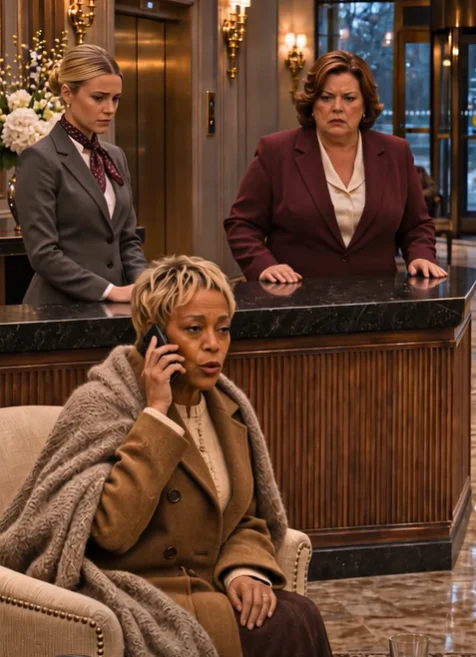
The rain had returned. Beyond the revolving doors, blue reflections moved across the wet pavement. The brass lamps shone on the marble, and a vase of white flowers stood where Clara had first gone to fetch water.
Evelyn stopped beside the cream armchair.
“Still here,” she said.
“We considered replacing it.”
“Why?”
“The upholstery.”
She ran a hand along the arm.
“It has a few years left.”
Daniel stood beside her, hands in his pockets. He had learned not to answer every silence with an offer.
“May I ask you something?” he said eventually.
“You usually do.”
“Do you want to keep living at St. Agnes Lane?”
She looked toward the windows.
“For now.”
“I meant permanently.”
“So did I.”
He smiled.
“I have rooms here. You know that.”
“Yes.”
“And the house by the river. There’s a room downstairs. You could make it yours.”
“Daniel.”
“I’m not trying to move you where I can keep an eye on you.”
She raised an eyebrow.
“All right,” he admitted. “Not entirely.”
She sat in the chair. He took the one opposite.
“I like my kitchen,” she said. “I like knowing which floorboard complains. I like Mrs. Patel calling through the wall when she thinks I’ve gone out without my keys. I don’t want to become a guest in the last part of my own life.”
He nodded slowly.
“I understand.”
“You can still invite me.”
“Every Sunday?”
“Don’t become greedy.”
“Two Sundays a month?”
“One. And you can come to me.”
He looked down, smiling now in a way that made him resemble the boy in the red sweater.
“I’d like that.”
“Bring oranges.”
“I can do that.”
“Pay for them yourself.”
He laughed, and she did, too.
Then the laughter faded. Evelyn watched him carefully.
“There’s something else.”
He waited.
“You asked me last week whether I thought of you as my son.”
The lobby seemed to recede around him.
“I shouldn’t have put you on the spot.”
“You did. You always asked difficult questions when I was holding a hot pan.”
“I thought the timing might help.”
“It did not.”
She took his hand.
“I didn’t answer because I was angry that you thought you needed to earn a word I’d been using in my own head for thirty years.”
Daniel stared at her.
Evelyn’s eyes filled, though her voice remained steady.
“I’m still angry with you sometimes. I expect to be angry again. You’ll be late. You’ll forget something. You may try to fix a feeling with a committee.”
A laugh broke in his throat.
“But yes,” she said. “You are my son.”
He bowed his head over her hand.
She gave him a moment. Then another.
When he looked up, he seemed almost ashamed of the tears.
“Don’t,” she said softly. “You’re old enough to stop apologizing for having a heart.”
Across the lobby, Clara stood just inside the dining room doorway. She had come to find her mother’s coat and saw them by the chair. This time she did not cover her mouth in surprise. She turned quietly away and gave them the privacy the first evening had not allowed.
At the cloakroom, Ruth was arguing with her scarf.
“Your father used to do this knot,” she said, holding it out.
Clara loosened it.
“You tied it yourself tonight.”
“Well, then I’ve inherited his worst habit.”



