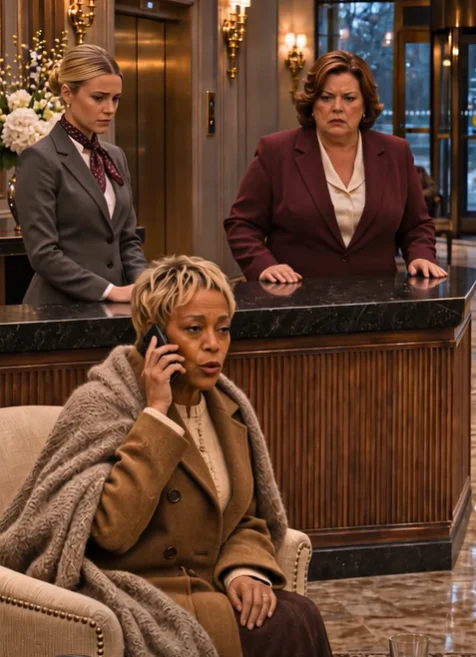
“She already told me my shoes were impractical.”
“She likes you.”
Downstairs, Clara began her next shift under Joseph’s supervision. The desk looked the same. That unsettled her. The flowers had been changed, the marble polished, the brochures aligned. Her access card worked. A man complained that his luggage had taken twelve minutes to arrive, and she apologized because twelve minutes could genuinely be inconvenient.
The world had not rearranged itself around her difficult evening.
At four, a guest asked why security had been escorting an old woman out the night before. Clara said there had been an issue that management was addressing. The guest leaned closer.
“I heard she was the owner’s mother.”
Clara hesitated.
“That’s her private business.”
“Well, they should have recognized her.”
Clara looked at him.
“They should have helped her.”
He blinked, then took his room key.
Afterward she went into the staff corridor and shook for a minute. Small corrections were no easier simply because one large correction had gone well.
Samir found her there.
“You all right?”
“I think I’m becoming difficult.”
“You’ve always been difficult. You used to do it more quietly.”
He offered her half a biscuit.
The internal investigation took three weeks.
That was slower than anyone wanted and faster than Margaret feared. Employees gave statements. Rotas were compared with time records. The community correspondence was traced through emails and meeting notes. Some allegations could not be substantiated. Some had explanations less sinister than they first appeared. Two payroll discrepancies were genuine errors, corrected with back pay; other records showed adjustments that should never have been made without employees’ knowledge.
Clara learned to tolerate uncertainty without surrendering what she knew.
She also learned that people who had remained silent could feel angry with someone who had spoken. One colleague told her she had made everyone nervous. Another said she was lucky the old woman knew the owner. Clara agreed with the second statement because it was true.
Luck had protected her. That was part of what needed changing.
Margaret asked to meet Evelyn in the second week.
Evelyn considered the request for a day, then agreed to twenty minutes in the lounge. She asked Clara to be nearby but not at the table. Daniel offered to attend. Evelyn declined.
“I can listen without a guard,” she said.
Margaret arrived in an ordinary coat. Without her uniform, she seemed less formidable and more exposed. She waited to be invited to sit.
Evelyn pointed at the chair.
“You don’t need to ask me.”
Margaret sat, swallowing.
“I’m sorry,” she began. “For the way I treated you. And for what I did to Clara.”
Evelyn kept her hands around her cup.
“Why did you do it?”
Margaret looked toward the rain-darkened windows.
“I thought I knew what sort of situation it was.”
“What sort?”
“Someone trying to obtain something they weren’t entitled to.”
“Warmth?”
The word landed between them.
Margaret bowed her head.
“Yes. I see how that sounds.”
“How did it sound to you that evening?”
“Like keeping control.”
Evelyn waited.
“I was good at keeping control,” Margaret said. “I thought being indispensable meant nothing could happen without my permission. Eventually even kindness began to feel like someone questioning me.”
“That sounds lonely.”
“It was.”
“It was also cruel.”
“Yes.”
Margaret took a tissue from her pocket but did not use it.
“My mother cleaned offices. When I was a child, I hated the way people looked through her. I promised myself no one would look at me like that.”
Evelyn’s expression softened with recognition, then grew firm again.
“And you practiced on someone else.”
Margaret flinched.
“Yes.”
They sat quietly while a waiter brought fresh water. Evelyn thanked him by name. Margaret noticed that, and wished noticing it now could change the years in which she had not.
“I’m not asking you to speak for me,” Margaret said. “To Daniel, I mean. Whatever happens with my job, I wanted you to hear the apology.”
“Then I’ve heard it.”
“Can you forgive me?”
Evelyn looked at her for a long time.
“I can decide not to carry you around in my anger. Forgiveness may come later. You don’t get to set the date.”
Margaret nodded. It hurt, but it was honest, and she had begun to understand how little honest discomfort she had allowed herself.
When she stood to leave, Evelyn asked one final question.
“Will you apologize to the people you don’t expect to meet again?”
Margaret gripped her bag.
“I’m trying to make a list.”
“Start before the list is finished.”
On the day before the review concluded, Clara met Margaret by chance at the tram stop.



