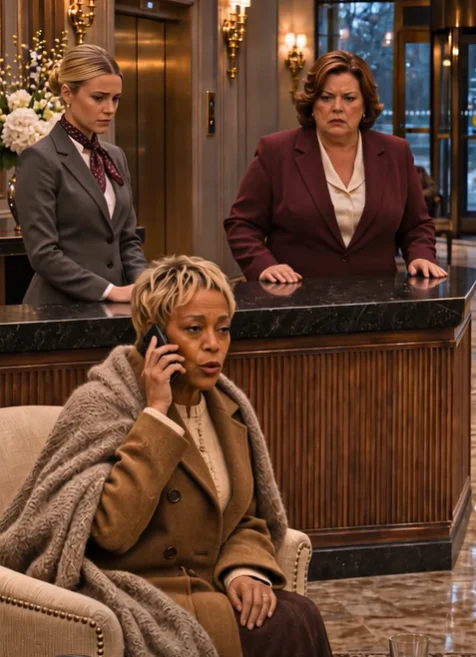
“You can. Whatever comes next will still be there in ten minutes.”
They ate. Daniel remained by the window until Evelyn pointed at the empty chair and told him she had not raised him to let guests eat alone.
He sat.
For a little while, the room held only the sounds of spoons, rain, and Anna typing quietly beside the fireplace. Clara discovered how hungry she was. Evelyn buttered half a piece of bread and placed it on Daniel’s plate without comment.
Clara’s phone lit up beside her plate. Her mother had sent another message, this time only four words: Are you safe there?
She stared at it long enough for Evelyn to notice.
“Tell her yes, if you are,” the older woman said. “And tell her when you’ll call. Waiting makes mothers inventive.”
Clara typed a reply. Daniel stood and moved a few steps away, giving her space without leaving the room.
“My mother never liked this hotel,” Clara said when she put the phone down.
Evelyn raised an eyebrow.
“Even before?”
“She thought I’d forget how to talk to people who couldn’t afford to stay here.”
“And have you?”
“I don’t think so.”
“Neither do I.”
Clara looked toward Daniel. He was reading something Anna had sent, his shoulders rigid.
“I thought he would be different,” she admitted quietly. “When he came downstairs. For a minute I thought everything would be easy because he could just tell people what to do.”
“He can tell a great many people what to do.”
“But that doesn’t mean he’ll know what to tell them.”
Evelyn smiled, a tired, approving smile.
“You’re catching on.”
Daniel turned back. He had heard enough to know they were discussing him, and enough to know he deserved it.
“I don’t mind you saying that to me,” he said.
Clara felt her cheeks warm.
“I wasn’t trying to—”
“I know. And I don’t want you to feel obliged to reassure me.”
He sat again, keeping his hands away from the documents for a moment.
“Last night, before this reception, I read a list of our community initiatives. Scholarships, apprenticeships, donations. I knew the figures. I could have recited them.”
“I don’t know the number on Ruth’s letter,” he continued. “I don’t know who answers it. Until tonight, I didn’t know I needed to ask.”
“You needed to ask before tonight,” Evelyn said.
“Yes.”
Clara pulled her sleeve down over the place where her watch had left a red mark.
“I work here and live there,” she said. “I didn’t know how to connect the two. At home I’m someone worried about a letter. Here I’m someone supposed to know where the answers are.”
Daniel looked at her.
“That must have been exhausting.”
She almost said it was fine. The phrase rose automatically, as polished as the desk downstairs.
Instead she said, “It has been.”
For a moment no one answered. The silence felt different from the silences Margaret created. There was no penalty waiting inside it.
Evelyn broke a piece of bread and dipped it in her soup.
“When I was working in the laundry,” she said, “we used to know whether a guest had slept badly by the sheets. Some were barely disturbed. Some looked as though a storm had gone through them. We’d send the clean ones upstairs and never know whether anyone had asked what was wrong.”
She looked at Daniel.
“That’s what I mean when I ask what happens while you’re upstairs.”
He nodded, slowly.
Clara picked up her spoon again. Outside, the rain had softened, but she could still hear water ticking against the window frame. She thought of her mother beside the kitchen telephone, waiting for an answer that someone, somewhere, kept assuming another person had given.
When the knock came, no one looked surprised.
Martin Vale entered in a navy suit with a silver pin at the lapel. Clara had seen him before, walking through the lobby with Margaret at his side. He carried a thin folder and an expression calibrated for a minor administrative inconvenience.
“Daniel. I’m sorry this has reached you in such a confusing form.”
His eyes moved to Evelyn, then Clara. Recognition sharpened them for an instant.
Daniel noticed.
“You know Miss Reed?”
“We’ve corresponded through the management team.”
“You sent a letter describing her tenancy as an irregular occupancy.”
“A legacy classification.”
“Is it irregular?”
Martin opened his folder.
“There are several historical agreements with unclear documentation. We’ve been attempting to regularize the position.”
Evelyn wiped her fingers on a napkin.
“By telling us our homes were unsafe until we agreed to leave?”
“Safety concerns are separate from the development.”
“Then why did the repair notice include the surrender form?”
Martin paused. He had expected emotion, Clara realized. He had not expected someone who kept envelopes.
Daniel held out his hand.
“The complete file.”
Martin did not give it to him immediately.
“There are commercially sensitive details.”
“These are their homes.”
“And we have obligations to the company.”
Daniel looked at Evelyn’s worn suitcase beside the chair.
“Yes,” he said. “We do.”
He took the folder.
On its first page, beneath the heading Community Transition, a sentence had been highlighted in yellow.
Key remaining occupiers should be resolved before public announcement.
Evelyn leaned forward to read it.
“Resolved,” she repeated.
Martin’s smile had disappeared.
Daniel turned the page. Clara saw a familiar signature at the bottom of an internal note, beneath a recommendation about restricting informal access to hotel facilities during the transition period.
Margaret Voss.
For the first time that evening, the manager’s cruelty seemed less like a bad decision and more like a door someone had deliberately closed.
Chapter 3- What the File Left Out 8999
Martin remained standing while Daniel read.
It was a practiced choice. Standing made him look busy, temporarily interrupted, a man with a room full of investors to return to. Sitting would have acknowledged that something might be wrong.
Clara recognized the maneuver because she had watched hotel guests use it at reception when arguing over a charge. People behaved differently when they believed they could end a conversation simply by moving away.
Daniel closed the folder.
“Sit down.”
Martin glanced at the clock.
“They’re expecting us.”
“Then Anna will explain there’s a delay.”
“I’d advise against creating uncertainty.”
“There already is uncertainty. You’ve given it a different name.”
Martin sat.
Evelyn took her glasses from her coat pocket. Clara offered to fetch the case from the suitcase, but the older woman shook her head.
“Let him finish. I’ve carried that envelope for three days. I can wait another minute.”
Daniel laid Margaret’s note on the table.
“Why is a hotel manager advising a property acquisition team about residents?”
“The hotel provides occasional facilities to the community. Complimentary tea mornings, access to the lounge, meeting space. Informal arrangements.”
“Arrangements made by whom?”
“Your father, in some cases.”
Evelyn looked up sharply.
Martin noticed and corrected himself.



