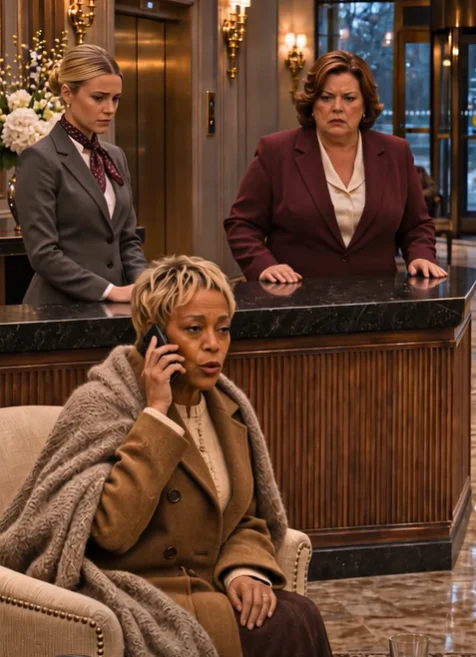
Margaret’s expression softened into something worse than disbelief.
“Mr. Whitmore is attending a private meeting.”
“I know. He told me he would be finished at seven.”
“It is six twenty.”
“Yes.” The woman adjusted her grip on the suitcase. “The earlier coach was the only one still running.”
Clara looked toward the windows. Rain traveled down the glass in crooked lines. The weather had emptied the pavements, and the brass lamps cast long reflections across the lobby floor.
“May I take your name?” she asked.
The woman turned toward her. “Evelyn Reed.”
Clara typed it into the arrivals list. No result. She tried the messages log, then the internal directory. Before she could open the visitor register, Margaret placed two fingers on the counter beside her keyboard.
“Thank you, Clara. I can manage this.”
Evelyn watched the hand, then the younger woman’s face.
“I have his number,” she said. “I’ll call him.”
“That would be best.”
She moved toward a cream armchair near the reception desk. Margaret stepped around the end of the counter.
“That seating area is reserved for registered guests.”
Evelyn stopped. The suitcase leaned against her calf.
For one strange second, the lobby seemed to hold its breath. A businessman waiting for a car looked down at his phone. The pianist in the lounge continued playing, but Clara could no longer distinguish the tune.
“The chair?” Evelyn asked.
“We’re hosting an important reception tonight. We need to keep the public areas clear.”
The chair sat empty. So did the three beside it.
Clara came out from behind the desk before she had decided what to say.
“I can bring you some water.”
Margaret turned. “Clara.”
“She’s wet and she’s been traveling.”
“I can see that.”
Evelyn tightened her mouth, not in anger. Clara thought she was trying to make herself smaller, and the thought made something inside her ache.
“I’m all right, sweetheart,” the older woman said. “I don’t want trouble.”
The endearment nearly undid her. Clara was twenty-seven, behind on two bills, and six weeks away from qualifying for the permanent contract she needed to help her mother move into an accessible apartment. Trouble had a measurable cost. Margaret knew it, too.
“There’s no trouble,” Clara said. She pulled the chair back a fraction. “Please sit.”
Evelyn hesitated, then lowered herself slowly. Only once she was seated did Clara see the effort she had spent standing straight. Her knees trembled. A soaked cuff clung to her wrist.
Clara fetched water from the service station. On the way, she took a clean gray shawl from the cabinet where the hotel kept blankets for terrace guests. Margaret followed her with her eyes.
When Clara returned, Evelyn had opened an old phone case. A photograph was tucked into the transparent pocket, its corner bent and whitened. A boy in a red sweater stood beside a woman outside a brick building. Clara saw it only briefly before Evelyn closed the flap.
“The water’s room temperature,” Clara said. “I thought that might be better.”
“You thought right.”
She laid the shawl over Evelyn’s shoulders. It smelled faintly of lavender detergent. The old woman pinched a fold between her fingers and nodded, as if acknowledging an arrangement neither of them needed to discuss.
“Thank you.”
Behind them, Margaret said, “My office. Now.”
Clara followed her around the counter but stopped short of the office door.
“I need to cover reception.”
“You need to follow instructions.”
“I gave someone a chair.”
“You contradicted me in front of a visitor.”
“A visitor who asked to see the owner.”
“People ask to see the owner every week. People ask for charitable donations, employment, complimentary rooms, access to private events. We have a process.”
Clara glanced at the visitor register lying closed beside the telephone.
“Then we should use it.”
Margaret’s face changed. She was a broad, carefully dressed woman with copper-brown hair arranged in soft waves. Her lipstick never smudged. She could remember a wine preference from a guest’s stay three years earlier, and she could reduce a junior employee to silence without raising her voice.
“Are you suggesting I don’t know my job?”
Clara could have retreated. She knew the correct expression: a slight lowering of the chin, an apology that admitted nothing specific. She had used it often enough.
Instead she said, “I’m suggesting we call upstairs.”
“He has instructed us not to interrupt the meeting.”
“His assistant, then.”
“Return to your station.”
The conversation ended with the soft click of Margaret’s office door.
Clara stood for a moment beside the counter. Her pulse made the scarf at her throat feel too tight. She had been at the Halcyon for nine months. She knew how to arrange flowers so their reflection looked right in the marble. She knew which guests wanted conversation and which wanted invisibility. She knew that the staff entrance flooded whenever the rain came from the west, and that the man who repaired it never received the urgent work order until a guest complained about a smell.



