Chapter 1: The Card on the Counter
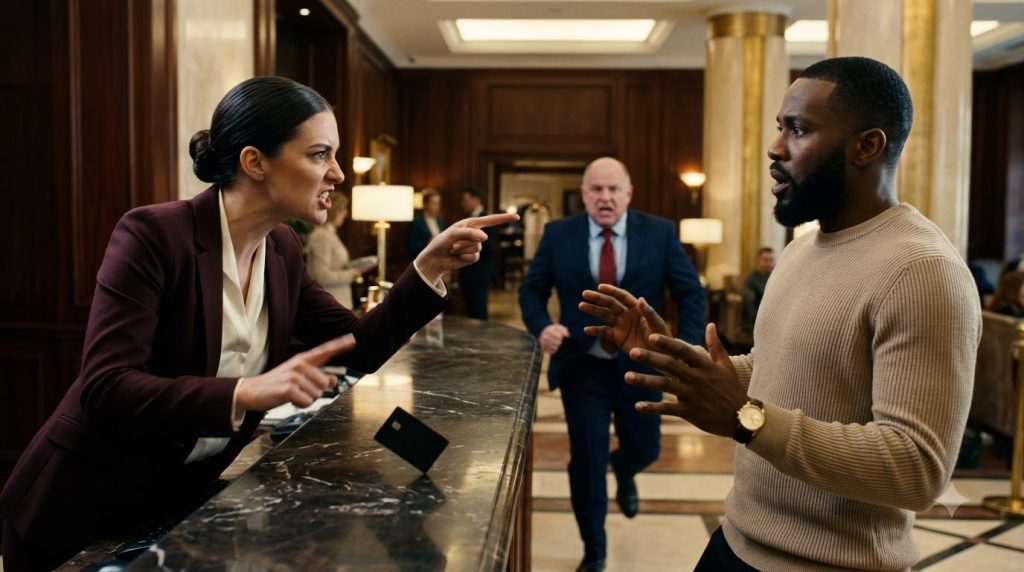
The receptionist smiled at my card before she looked at my face. Not the smile people gave when they recognized something valuable. The other kind. Small and private, as if she had caught a child wearing his father’s watch. She lifted the black card between two fingers.
“Nice card. Did it come with the costume?”
Behind her, the brass clock ticked above a wall of dark walnut. Somewhere beyond the lobby, a pianist worked his way through a song my mother used to hum while she washed dishes. The room smelled of polished wood, expensive flowers, and the kind of money that never needed to explain itself.
I had been inside the Bellweather Hotel for less than four minutes. Already, someone had decided I did not belong. I looked at the card beneath her fingers, then at the small silver nameplate pinned to her teal jacket. The name was partly hidden by her lapel.
“Your name?”
Her expression sharpened. “Vanessa. Now leave before I call security.”
She said it quickly, with a hard little emphasis on leave, her right hand changing from a flat palm beside my card to a finger aimed at the marble. For a moment, I watched that finger. It was extraordinary how much confidence a person could borrow from a counter.
Then I heard footsteps. Fast ones. Hard heels striking polished stone, approaching from the far end of the lobby. A man in a charcoal suit came around a column so quickly that a porter stepped backward to avoid him. He was bald, red-faced, and breathing through his mouth. I recognized him from the documents. Richard Cole. General manager.
He reached the reception desk, planted one hand on the marble, and looked at Vanessa with an expression she clearly had never seen directed at her before. “Vanessa, what did you say to him?”
Her finger disappeared. “Mr. Cole, I was just—”
My phone was already in my hand. I opened the message from our transaction counsel: We are assembled. Awaiting your authorization to release signatures. I pressed the call button. When Evelyn answered, I looked down at the black card on the counter. “Tell the board the deal is off.”
Richard made a sound like someone had tightened a belt around his chest. “Mr. Mercer.”
Vanessa looked at him. Then at me. Then back at him. And for the first time since I had walked through the hotel doors, she seemed unsure what she was seeing.
Thirty-six hours earlier, my mother had asked me not to buy the hotel. She had done it while peeling an apple over the kitchen sink. No dramatic speech. No trembling voice. Just a long ribbon of red skin curling over her thumb while rain tapped against the window.
“You don’t have to go back there for me, Adrian.”
I sat at the same small table where I had done homework as a boy. The refrigerator still hummed too loudly. A blue ceramic bowl still occupied the center of the table, full of keys that no longer opened anything. “I’m not buying it for you.”
She gave me a look. My mother had spent thirty years listening to rich people lie politely. She could recognize an incomplete truth before the speaker finished taking a breath. “I’m buying the operating company,” I said. “The property happens to be part of it.”
“The property happens to have a name.” “Yes.” “And a lobby.” “Yes.” “And memories you still carry like stones in your pockets.”
I watched her turn the apple. The scar at the base of her right thumb had faded almost to silver. I remembered when it had been red. “Mom.”
“Don’t ‘Mom’ me in that voice. You use that voice when you’re preparing to explain something expensive.”
I laughed despite myself. She put the peeled apple on a plate and brought it to the table. At sixty-eight, Ruth Mercer still moved as if she were trying not to inconvenience the room. She closed drawers softly. She folded grocery bags. She said excuse me when she reached across an empty counter. For most of my childhood, the Bellweather had paid her to make other people’s lives appear effortless. She had worked in laundry first, then housekeeping, then as a floor supervisor when her knees became too damaged for the carts. By the time she left, she could identify a room by the way its curtains dragged. She knew which guests stole bathrobes, which executives tipped only when someone was watching, and which members of management spoke about staff as if they were part of the plumbing.
She had never hated the hotel. That was the part I found hardest to understand. Even after everything, she spoke fondly of its winter flowers.



