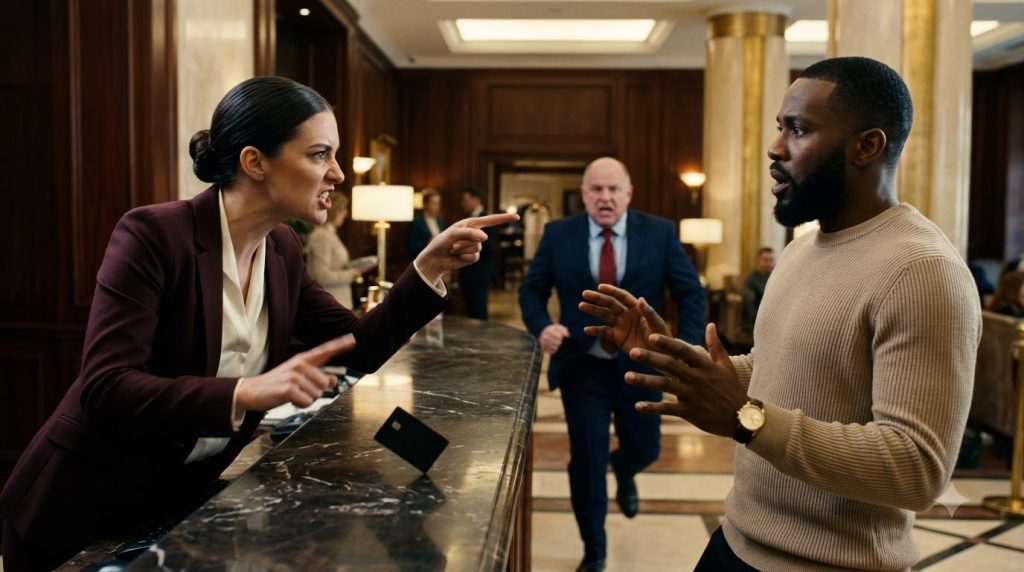
Conference Room Three overlooked an interior courtyard. Richard opened the door, switched on the lights, and began explaining before I had set down my bag. “We employ more than four hundred people at this property. There are occasions when an individual fails to meet our standards.” “How long has Vanessa worked here?” “Approximately two years.” “Any previous complaints?” “I’d need to check.” “You knew which desk to run to.” “I received a message that you had arrived.” “From whom?” He paused. “Guest services.” “Which employee?” “I would have to look.” “You can do that now.”
He reached for his phone. I watched him carefully. There are two kinds of delay in business. The kind caused by disorganization, and the kind caused by someone deciding which version of the truth will cost them least. Richard had the second kind. “Before we turn this into something larger,” he said, “I hope we can acknowledge that the transaction itself remains sound.” “Does it?” “The assets, the revenues, the properties—” “The employees?” “Of course.” “The culture?” “We have excellent guest satisfaction scores.” “I didn’t ask about scores.”
He took a breath. Behind the courtyard glass, rain began to fall. Small dark marks on pale stone. “Mr. Mercer, I have worked toward this closing for eleven months.” “I’ve worked toward it for fourteen.” “Then you understand what is at stake.” “Yes.” He looked relieved for half a second. Then I continued. “I’m trying to determine whether you do.”
Evelyn arrived nine minutes later with a legal pad and the expression she wore when someone had turned a manageable afternoon into evidence. Richard stood. “Ms. Shaw.” “Richard.” She placed her bag on the table. “Please have your counsel join us remotely. We’ll need preservation confirmed in writing.” He looked at me. I said nothing. “Certainly.” When he stepped into the corridor, Evelyn closed the door. “Tell me the exact sequence.”
I did. She wrote without interrupting. When I finished, she tapped her pen once. “You can suspend. Termination will depend on what we find and the agreement’s provisions.” “I know.” “The sentence you gave me on the phone was broader.” “I know.” She studied me. “This is about more than the receptionist.”
I reached into my bag and took out the printed settlement register. My mother’s name was highlighted. Evelyn read the entry. Then looked back at me. “You didn’t send this to the diligence team.” “No.” “Why?” “Because I wanted to ask her first.” “Did you?” “Yes.” “And?” “She told me not to buy the hotel.”
Evelyn sat down. That was when I understood she was taking the page seriously. Not as a son’s old grievance. As something that might matter. “Do you believe the settlement was improper?” “I don’t know what it was.”
“Then we start there.” A knock sounded at the door. Richard entered carrying a thin folder. Too thin. “I have Vanessa’s employment summary.” Evelyn held out her hand. He placed it on the table. Three pages. Hire date. Training certifications. Performance rating. Nothing else. Evelyn turned the pages once. “Complaint history?” “She has no active disciplinary findings.” “That wasn’t the request.” “I’m obtaining the remaining records.”
I pointed to the highlighted name on the register. “While you’re obtaining things, find this.” Richard looked down. His face changed. Not dramatically. No dropped folder. No staggering backward. Just a fraction of a second in which his mouth forgot how to arrange itself. Then he said, “That predates my current role.” “But not your employment.” He looked at me. I had read his résumé. He knew it. “I was an assistant operations manager then.” “Did you know Ruth Mercer?” “The name is familiar.” “She worked here for thirty years.” “Yes.” “She was my mother.”
The rain grew heavier against the courtyard glass. Richard did not look at the page again. “That would explain your interest.” “No,” I said. “What happened to her would explain my interest.” He left to retrieve the file. This time, Evelyn watched him go.
When the door closed, she said, “He knew the name.” “Yes.” “He recognized it before you explained the relationship.” “Yes.” She wrote something on her pad.
I went to the window. Across the courtyard, a maintenance worker climbed a ladder beneath an awning. Water ran down the outside of his sleeve. He shifted carefully, trying to keep the tool in his hand dry. My mother had worked while sick because she could not afford the absence. She had sewn the lining of her uniform because the replacement charge came out of wages. Once, when I was eleven, she brought home a slice of wedding cake wrapped in a paper napkin. She had carried it upright on two buses. I remembered thinking the Bellweather must be a wonderful place if it could produce something that beautiful.



