“What do you remember about the Bellweather?” she asked. “The service entrance.” Her eyes rested on me. “Anything else?” “The Christmas tree.” “That was a good tree.” “The night you came home without your coat.”
Her fingers went still on the edge of the plate. Outside, a car passed through standing water. “Adrian.” “I remember that too.” “I know.” “And I remember being told you’d resigned.”
She sat across from me. For a few seconds, neither of us spoke. The official version had always been simple. My mother had resigned after a disagreement about scheduling. There had been paperwork. A small final payment. A sentence about moving on. I had been sixteen. Old enough to understand what losing a job meant. Young enough to believe an adult when she said everything would be fine.
Later, I learned that fine sometimes meant the electricity bill went unpaid until the second notice. It meant rice cooked three different ways. It meant my mother giving me the larger piece of chicken and pretending she had eaten earlier. I had spent years imagining the moment I would become wealthy enough to walk through the Bellweather’s front doors without anyone asking why.
Then I became wealthy. The imagined moment lost its importance. There were businesses to build, employees depending on payroll, contracts that mattered more than an old humiliation. I learned that revenge consumed attention at a terrible rate and produced almost nothing useful. For a long time, I thought I had outgrown the hotel.
Then the Bellweather came up for sale. Not the building alone. The management business, the brand, the regional portfolio, the service contracts, the whole beautiful machine. And buried in a due-diligence folder, among pension liabilities and maintenance schedules, I found my mother’s name. Not in a staff anniversary photograph. Not in a list of former employees. In a legal settlement register.
I had read the entry six times: Mercer, Ruth. Personnel matter. Resolved. Confidential. The date was three days after the night she came home without her coat.
Now, across the kitchen table, she watched me thinking about it. “Whatever you believe you’re going to find,” she said, “make sure you’re prepared to hear the whole thing.” “What does that mean?” “It means a person can tell the truth and still hurt someone.” “Who are you protecting?” Her answer came too quickly. “No one.”
There it was. The first complete lie she had told me in years.
Chapter 2: The Night She Left
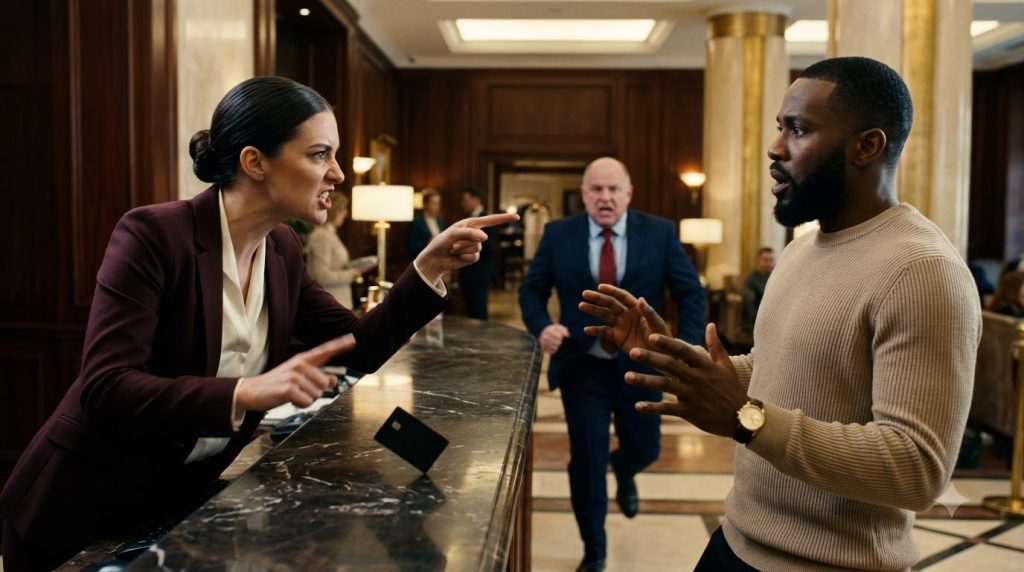
I arrived at the Bellweather the following afternoon wearing a burgundy sweater, dark trousers, and the watch my first business partner had given me when we sold our company. No entourage. No security team. No car waiting directly outside the entrance with a driver standing beside an open door. My assistant thought this was unnecessary. Evelyn thought it was legally inconvenient. My mother thought it was a mistake. I thought an acquisition worth hundreds of millions of dollars should survive one unscheduled visit.
Our team had spent months examining numbers. Occupancy, revenue per available room, banquet margins, deferred maintenance. Consultants had interviewed managers in prepared conference rooms beneath prepared lighting and returned with reassuring conclusions. But a hotel was not a spreadsheet. It was what happened when someone approached a desk without the right clothes. It was whether a housekeeper could report a broken lock without being punished for slowing down. It was what happened when management did not know the person watching could change their lives.
I had asked Richard Cole for a master access credential earlier that week for a private inspection. He had arranged for one to be delivered to our office. The card was plain black, with a narrow silver stripe and a small embossed crest. No diamond. No account balance. Just access. I carried it because I intended to inspect the east wing before the closing meeting. I had not intended to use it as a test. Vanessa made that decision for me.
Before the card, there had been the bag. A young porter reached for it as I entered. “Checking in, sir?” “Meeting.” “Of course. Reception will help you.” He was perhaps twenty, with a carefully pressed uniform and a left shoe that had been repaired along the seam. His smile was easy and genuine. “What’s your name?” I asked. “Luis.” “Thank you, Luis. I’ll keep the bag.”
At reception, Vanessa did not look up immediately. She finished typing, adjusted something on her screen, then glanced at my sweater. “Deliveries are around the back.” “I’m not making a delivery.” She looked at the canvas bag in my hand. It held a notebook, a charger, and a folder. Apparently, it also held an entire biography. “Then how can I help you?” “I’m here for a meeting with Richard Cole.” “Mr. Cole is occupied.” “I know. I’m early.” “Your company?” “Mercer.”



