“Why give it to you?” “She said she might have to sign something.” My stomach tightened. “What?” “She wouldn’t tell me.” “And my father?” “He left first.” “Alone?” Helen hesitated. “Not through the staff entrance.” I turned back. “Which entrance?” “The loading bay.” “Why?” “I don’t know.” “With whom?” Her eyes filled. “I saw Richard walk toward the bay after him.” Evelyn put down her pen. No sudden movement. No dramatic reaction. Just a deliberate pause. “Helen, did you see them leave the property together?” “No.” “Did you see Richard enter a car?” “No.” “Did you hear what they said?” “No.” “Then what you know is that Adrian’s father walked toward the loading bay and Richard followed in the same direction.” “Yes.” I was grateful for her precision. I hated it at the same time. Memory had already begun arranging those movements into a conclusion, and Evelyn would not let it. My father had died on the east bypass. A wet road. A failed turn. The car struck a concrete barrier below an overpass. That was what the police had told us. There had been no passenger.
No other vehicle identified. No crime announced. For years, I had wondered whether he had been tired. Whether he had looked at his phone. Whether some tiny, stupid distraction had taken the rest of his life. Now I was wondering whether he had been driving toward something. Or away from it. “Did my mother know you saw Richard follow him?” I asked. “Yes.” “What did she say?” Helen looked down at her clasped hands. “She asked me not to mention it.” “Why?” “She said seeing a man walk down a corridor wasn’t proof of anything.” My mother’s voice seemed to enter the room. Measured. Practical. Refusing the comfort of an easy accusation. “And then?” “Someone came to collect her.” “Who?” “Security.” “What did they do?” “They took her back to the office.” “Did she return?” “Not to the linen room.” Helen’s voice grew smaller. “I saw her outside later. Near the bus stop.” “Without her coat.” Her eyes lifted. “Yes.” I called my mother. She answered on the third ring. “Have you eaten?” For a second, I could not speak. It was such an ordinary question. Such a cruelly ordinary question. “Adrian?”
Chapter 10: The Arrival
Richard returned with hotel counsel eleven minutes later. Counsel was a woman named Judith Lane, whose glasses hung from a thin gold chain. She introduced herself, placed a business card on the table, and looked at Helen without seeming to. Evelyn stood. “We need a preservation notice circulated immediately.” “It has been,” Judith said. “To whom?” “Relevant management.” “Include security, information technology, human resources, finance, and the board office. Please preserve historical material as well as current records.”
Judith’s eyes moved to the old note. “How historical?” “Twenty years.” Richard shifted. Judith did not. “Much of that material may no longer exist.” “Then we’ll document the retention schedule and any destruction dates.” “Certainly.”
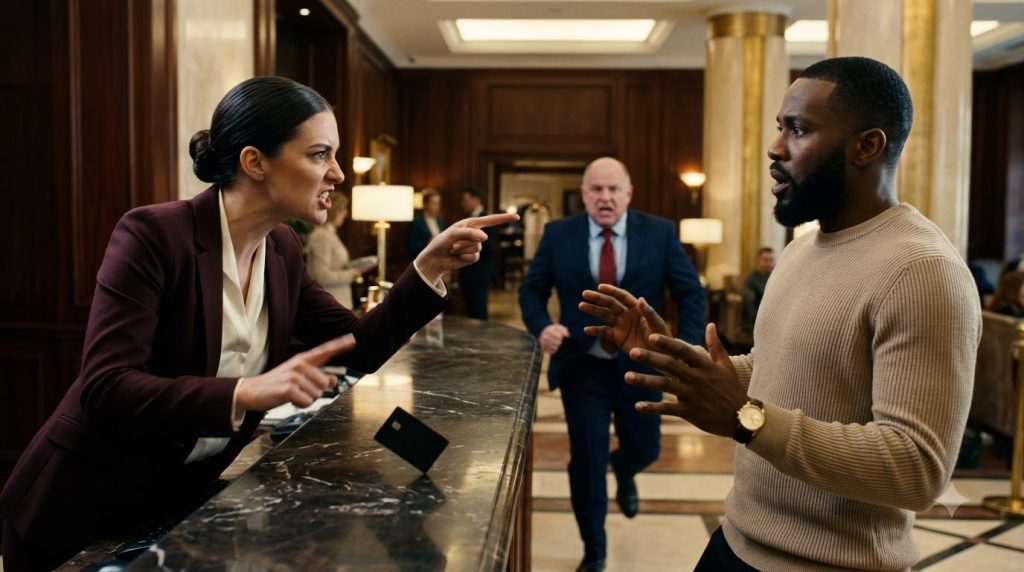
There was a difference between Judith and Richard. She did not waste energy pretending the request was unreasonable. Instead, she began calculating exactly what answering it would reveal. “Mr. Mercer,” she said, “I understand there was an unfortunate interaction at reception.” “There was.” “We will investigate it.” “You’re investigating more than that.” “So I gather.”
Richard placed a folder in front of me. “This is everything currently available on Ruth Mercer’s departure.” I opened it. A resignation letter. A payroll summary. A receipt for a severance payment. Three pages. Again. My mother’s signature appeared at the bottom of the first. I knew the signature. I did not know the woman described above it. According to the letter, Ruth Mercer had voluntarily chosen to pursue other opportunities after many rewarding years. She had thanked management for its support. She had acknowledged that no dispute remained. The paper looked clean. That made it worse.
“How much was she paid?” I asked. Richard pointed to the third page. I read the amount: three thousand dollars. Thirty years reduced to a number smaller than one night in the presidential suite. “What did she release?” Judith answered, “We would need the underlying agreement.” “Where is it?” “It wasn’t in this personnel file.” “But it appears in the settlement register.” “We’re checking.”
Evelyn reached for the resignation letter. “May I?” I gave it to her. She read it, then read it again. “Who drafted this?” Richard said, “Human resources, presumably.” “Who witnessed the signature?” “It should be listed.” “It isn’t.” She placed the page beside my mother’s note. “Why does the letter say she resigned on Thursday?” Richard looked down. “That was her final employment date.” Helen spoke: “It happened on Wednesday.”



